
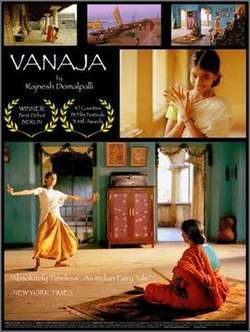
Movie Info
ℹ️ More Movie InfoTrailer
Storyline
Vanaja is the 15-year-old daughter of Somayya, a poor, low caste fisherman from rural . Somayya struggles to support his family due to dwindling catches at sea and mounting debts. One day, Vanaja and her teenage friend Lacchi watch a theatrical performance by a former (a native form) great, Rama Devi. The sequence of events lead to a predicting to Vanaja that she will be a great dancer. With permission from her father, she goes to work in the house of the local landlady Rama Devi with the hope of learning . While she is employed as a farmhand, she is entrusted with tending the chickens. When she gets caught playfully chasing them, she lies to conceal her pranks. Her vivaciousness and spunk soon catch the landlady’s eye. To keep her out of trouble, Rama Devi soon promotes her to a kitchen underhand where she meets Rama Devi’s cook, the old, crusty, and extremely loyal Radhamma. After settling down at the landlady’s house, Vanaja gets invited to play a game of (a leisurely game in rural towns of Andhra Pradesh) against the landlady. Knowing that losing isn’t the mistress’s forte, she deliberately gives up her game. This gesture, in turn, eventually secures her the landlady’s mentorship, first in music and then in dance. Vanaja excels at these art forms and seems to be on a steadily ascending path until the arrival of Shekhar, the landlady’s 23-year-old son, from the United States. Shekhar is a handsome, muscular young man who is running for an office in the local government. Sexual chemistry is ignited between Shekhar and Vanaja (still a minor at 15) when flirtation and sexual innuendo bloom. In the meanwhile, her father’s fishing boat is taken away by creditors. He sinks into a state of sadness and begins to drink away their savings. On one occasion, Vanaja’s superior intellect pits her against Shekhar in a public incident which ultimately humiliates him in front of his mother. Matters escalate, and one day Vanaja is raped by Shekhar. She eventually loses her job when she becomes pregnant. She gives birth to a boy, much against Rama Devi’s wishes who would have liked her to abort the foetus. Vanaja hopes that the physical evidence of the child will be proof of the rape and that somehow Shekhar will be brought to justice. However, Shekhar has no desire to marry Vanaja because she is from a . In the end, Rama Devi and Shekhar gain possession of the child, who will grow up to be an upper caste boy. Director Rajnesh Domalpalli graduated with bachelor’s and master’s degrees in in 1984 and 1986. While working on his bachelor’s degree at the , he wrote short stories. One of his stories, , was twice selected for broadcast by while he was in . During schooling, he was introduced to south , especially on the , and followed this up with years of training on the vocals. While he was working as a in , , he pursued filmmaking and graduated with a degree from . A short synopsis, including a character and a conflict study of , was Domalpalli’s project submission in his first semester at the in fall of 2001. The story was inspired by a child’s scream upon being separated from her mother in . Over the next three semesters, however, the story veered from its original focus of mother-child separation to what Domalpalli later described as a study of “elements of and conflict that continue to infuse our society and culture even today.” Referring to its emphasis, he said the film was also about “fading institutions of folk art, old buildings that are collapsing, things which we should be protecting — which are a part of our heritage.” Speaking of the need for preservation of Indian culture and heritage, he said that making the film was an opportunity to emphasise the Indian , too. With the early version of the script being ready at the end of his fourth semester, Domalpalli’s initial intent was to find financing for in India and then in the United States. However, he could not find financing. Domalpalli decided to select non-professionals and train them in a year. In the United States, producers voiced similar concerns over the marketability of the film and what they referred to as “its lack of cohesion.” Beside this, Domalpalli’s inexperience in filmmaking added to their concerns. Recalling initial hurdles, Domalpalli later said, “it was only when I showed my professors a rough cut of the film, and they approved, that purse strings finally came loose.” It eventually constituted the thesis for his master’s degree. He imbibed socio-cultural from his upbringing in several rural areas of , and this prompted him to make the movie in the . In 2004, he began filming with a meagre sum of 20000 provided by his mother Latha Domalpalli, the eventual film producer. Referring to filming the (a story-telling technique used in ) scene at the beginning of the film, Domalpalli said: If you talk to people who perform a Burrakatha, you will see a huge difference in the way the older generation performs the art vis-à -vis the way the younger generation performs it… This has happened because of the advent of television. Burrakatha is a long-format art form. The point we are making is that if we don’t protect these folk arts, they will be on their way out. The producers faced a stiff challenge in securing a rural bungalow to serve as the landlady’s mansion. Even after obtaining a building as the best possible fit in the coastal town of , infestation of snakes and bats posed a problem for the crew. In addition, the building was not strong enough to support the filming equipment. Under these circumstances, the makeshift refurbished the building with space for chicken coops and goat pens as required by the script. To make the space look inhabited, local help was sought for trampling the ground with their livestock. The local people wanted to act as extras in exchange for providing farming tools, and other material. As a result, the crew had to ensure that these extras didn’t look into the camera during filming. “Given the rural nature of the story, and the tendency of most local acting to lean towards the theatrical, it was clear that non-actors drawn from hutments, labor camps and the vast Indian middle class were the right choice,” said Domalpalli, referring to his choice of casting. In addition, the inclusion of Radhamma’s character was to bring a natural feel for the film. Her behavior such as the way she “sits, stands, moves, grunts and groans — that is the way people from a village talk and behave… You would immediately recognize a person who served you breakfast… That makes a point.” Referring to the challenges faced in casting, he said that while they were canvassing local people for auditions, they were warding off rumours that they were after the people’s kidneys. When placing a newspaper advertisement for the landlady’s character did not seem viable, they advertised for household help instead. Upon seeing this, Urmila Dammannagari turned up for the interview with Domalpalli. Inadvertently, their conversation veered toward the film and the real motive behind the advertisement became evident. Though initially shocked and despite the fact that she had to commute 25 kilometres (16 mi) from her house to the location, she took up the role. Professionally Krishnamma Gundimalla, who played the role of Radhamma, carried bricks on her head as a construction worker. On the other hand, Ramachandriah Marikanti, who plays Vanaja’s fisherman father, was a sweeper and worked as a security guard. For casting Vanaja and Lacchi, he said that they met approximately 2500 children, interviewed about 260, and finally selected two from a shortlist of five to play the roles of Vanaja and Lacchi. Parents of these children were distrustful of them because their wards would have to frequently commute to Domalpalli’s house for acting lessons for at least a year. Domalpalli felt that “to convince people to devote so much of their children’s time and energy was hard enough, but to find the right combination of intelligence, commitment and talent as well was probably the steepest cliff they had to climb.” While visiting schools for identifying the child cast, Mamatha Bhukya at first was not selected because her hair was short. But after she sang a song on , she was selected for the role. Srinivas Devarakonda, a disciple of well-known Kuchipudi Vempati Chinna Satyam, taught Mamatha the classical dance form for a year in the basement of Domalpalli’s house. Due to this sustained effort, she altered her ambitions from becoming a doctor to an actress and a dancer. Bhavani Renukunta was chosen for Lacchi’s role after an interview at the Hyderabad office of Varija Films, the company that handled the publicity. -born Milton Kam, who had shot 10 feature films and more than 50 short films, was chosen as the . Since Domalpalli’s experience was limited to short video films with a different , he was shocked to look through the lens the day they commenced the shoot. However, Kam helped him to stay composed during the production. Domalpalli used for the background score. This featured the violin-playing of B. S. Narayanan. a student of renowned Carnatic violinist . Narayanan played the popular Jayadeva “Sa virahe”, having retuned it in the or known as “Behag”. Domalpalli used “janapada geetalu” in the film: folk songs that are rarely heard. To record these songs for the film, Domalpalli and his crew travelled to towns and villages in rural Andhra. The film was released in the United States on 31 August 2007. After being screened at over 100 film festivals in 49 countries, has won 24 international awards and 2 nominations. The (MPAA), invited the screenplay to be placed in the permanent archives of the Margaret Herrick Library. The DVD, which released on 8 March 2008, has subtitle options in English. Besides interviews with Domalpalli and Bhukya, unedited dance sequences and several short films of Domalpalli, the DVD is available in , , and format. While reviewing it, Jeffrey Kauffman from DVD Talk observed that though most of the film was made using natural lighting situations, the colour and saturation quality was excellent. Further, the reviewer was quite favourable about the use of exotic sounds right from birds to the instruments. On 11 September 2006, first premiered at the . The same year, it won an Honorable Mention for the Golden Starfish Award at the . It won the Best Narrative Film award at the Film Festival. Following that, it was showcased at the and the by the end of 2006. At the film’s screening at the 2007 , it won a standing ovation from the audience, bringing Mamatha Bhukya to tears and emotionally affecting . The film won the Best First Feature award at this festival. The same year, received a special international jury prize at the , Best Feature at the Memphis International Film Festival, Best International Film at the Sacramento International Film Festival, and a Platinum award at the WorldFest-Houston International Film Festival. It received a special mention for the grand jury prize at the , the MiloÅ¡ Macourek Award in special recognition for a feature film for youth at the ZlÃn International Film Festival, an Achievement Award at the , and a special jury prize for Best Production Design at the . It won the prize for Best Cinematography at the , the first prize in the live-action feature film category at the , and the Camério Meilleur Long Métrage/Starlink Aviation award at the . In addition, the film won also won an award for the best live-action film at the International Young Audience Film Festival. Bhukya won the best actress award at the . It was chosen as one of 13 “key films” when the focused on India in 2011. The film received an overall positive response from critics and was particularly noted for the theme and for Mamatha Bhukya’s performance. The review aggregator gives the film a score of 85% based on 26 critic reviews with an average rating of 7/10. described Bhukya as “a natural star, her eyes and smile illuminating a face of freshness and delight.” Writing about , he added that “there are the glorious colors of saris and room decorations, the dazzle of dance costumes and the dusty landscape that somehow becomes a watercolor by , with its hills and vistas, its oxen and elephants, its houses that seem part of the land. In this setting, Domalpalli tells his story with tender precision, and never an awkward moment.” Ebert listed it among the top five foreign films of 2007. According to Laura Kern from , the film “is a coming-of-age tale that is engrossing, if slightly overlong, and absolutely timeless, unfolding against an antiquated class system that sadly stands firm in rural areas of India to this day.” A review in called it “a film that touches the heartstrings as it brings home the cruel class distinctions that poison Indian society,” and said it “is more than a children’s film, despite revolving around a central character of 14. Its social message, linked to the story of a poor farm girl who aspires to be a dancer, never feels forced, and the moral issues it depicts are realistically complex.” Commenting on its commercial feasibility, the review concluded that “while that might not translate into obvious box office potential, art house appeal is there for distributors willing to seek out a market.” The wrote: It’s a touching, believable, often funny but ultimately sad tale of how one class can take advantage of another, even in the guise of patronizing benevolence. Though sometimes shifting abruptly in time, is an arresting story of modern-day hardship and class exploitation, recalling Charles Dickens as well as Western fairy-tale lore. Domalpalli’s settings are ultra-real in detail and color, from the crude, almost feudal deprivations of Vanaja’s dirt-floor background to the stately rituals and autocratic entitlement of the well-to-do. Speaking of Bhukya’s performance, the writes, “Bhukya delivers an entrancing and natural performance, deftly balancing both the wide-eyed childishness of a young girl with the dawning awareness of life’s darker possibilities. She’s also an accomplished dancer, which she proves at several points in the film.” It adds, “can this wonder-filled film truly be not only Domalpalli’s first feature, but originally part of a thesis submission at Columbia University? Both in the film’s writing and direction, Domalpalli displays maturity, wisdom and a loving sense of visual and character detail.” Marc Savlov of proclaimed, “director Domalpalli, who, with his debut feature, turned in what may well be the best Columbia University master’s thesis ever.” also claimed like the that the film would remind the Western audience of , and further stated that it “… gives a detailed sense of place and shows a mastery of story telling. The themes of fate and class resonate and the work of the amateur players is remarkably moving.” Despite the generally positive reception, some critics differed in their opinion of the content and depiction. The criticised the film saying that “there’s enough mush in the Indian melodrama to fill an entire season of a TV soap opera,” adding that toward its ending, the “viewers will be bored stiff by (the) long, tedious film”. Though the “narrative meanders … [it] evokes village life with stark authenticity,” said a review by .
Details
Reviews
There are no reviews yet. Be the first one to write one.