
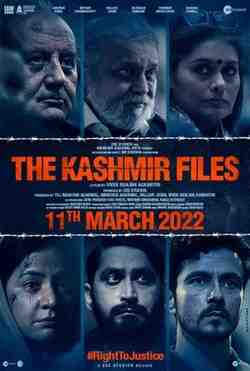
Directed by Zee StudiosAbhishek Agarwal ArtsI Am Buddha
• Music: Rohit Sharma
0.0
0.0 out of 5 stars (based on 0 reviews)
Excellent0%
Very good0%
Average0%
Poor0%
Terrible0%
Your Rating for
The Kashmir Files

Trailer
https://www.youtube.com/watch?v=A179apttY58
Soundtrack
Storyline
<p>The plot frequently switches between the contemporary period set in the year 2020 and flashbacks to 1989–1990 throughout the film. In 1989–90 , Islamic militants storm and from the using the slogans (“convert (to Islam), leave or die”) and (“with god’s grace whole Kashmiri Pandit community will leave valley”). Pushkar Nath Pandit, a teacher, fears for the safety of his son Karan, who has been accused by the militants of being an Indian spy. Pushkar requests his friend Brahma Dutt, a civil servant, for Karan’s protection. Brahma travels with Pushkar to Kashmir and witnesses the violence against Kashmiri Pandits. He takes up the issue with the of (J&K), who suspends Brahma. Militant commander Farooq Malik Bitta, also a former student of Pushkar, breaches Pushkar Nath’s house. Karan hides in a rice container but is found and shot by Bitta. Pushkar and his daughter-in-law Sharda plead for their lives. Bitta compels Sharda to eat rice soaked in Karan’s blood in exchange for their lives. After Bitta and his gang leave the house, Pushkar begs his doctor friend Mahesh Kumar to bring an ambulance and save Karan’s life. However, the hospital gets taken over by militants, who forbid the hospital staff from treating non-Muslims. Subsequently, Karan succumbs to injuries from the gunshots. To ensure their safety, Pushkar and his family are taken by their journalist friend Vishnu Ram to Kaul, a Hindu poet who maintains a cordial relationship with Muslims. Kaul takes in many Pandits into his home but a group of militants arrives to pick Kaul and his son up under the guise of offering protection. The rest of the Pandits leave the place but are later shocked to find corpses of Kaul and his son hanging from trees. The refugee Pandits from the Kashmir valley settle in and live on meagre ration and in poor conditions. Brahma is appointed as an advisor to the new Governor of J&K. At his request, the visits the Jammu camps where Pushkar demands the removal of and the resettlement of Kashmiri Pandits. Brahma manages to get Sharda a government job in Nadimarg in Kashmir, and the family moves there. One day, a group of militants headed by Bitta dress up as members of the and arrive at Nadimarg. They start rounding up the Pandits living there. Sharda resists when the militants get hold of her elder son Shiva. Angry Farooq strips her and saws her body in half. He lines up Shiva and the remaining Pandits and shoots them into a mass grave. Pushkar is spared to spread the word about what happened. In the present day, Sharda’s younger son Krishna is brought up by Pushkar. He believes that his parents had died in an accident. A student of , Krishna is under the influence of professor Radhika Menon who is a supporter of . Pushkar’s friends Brahma, Vishnu, Mahesh, and police officer Hari Narain, who had served in Kashmir when Karan was killed, recall the events of Kashmir from their memory that Brahma calls a ” “. Krishna contests the ANU’s student election. Following the advice of professor Radhika Menon, he holds the responsible for the issue of Kashmir, much to the anger of Pushkar. Later, when Pushkar dies, Krishna travels to his ancestral home in Kashmir to scatter the ashes per Pushkar’s last wish. Menon asks Krishna to record some footage in Kashmir to expose the government’s supposed atrocities. With the help of one of Menon’s contacts, Krishna meets Bitta and accuses him of being responsible for the situation of the Pandits. But Bitta declares himself to be a new-age who is leading a non-violent democratic movement. Bitta claims that it was the , who killed Krishna’s mother and brother. When Krishna questions Brahma about this claim, Brahma hands him files of newspaper cuttings (collected by Pushkar), reporting that militants, disguised as Indian Army soldiers, had killed them. Krishna returns to and gives his scheduled speech for the university presidential elections to a roaring crowd at the ANU campus. He elaborates on the history of Kashmir and the plight of his family and other Kashmiri Hindu victims that he had discovered from his visit. This shocks his mentor professor Menon and her other students, and Krishna is initially met with resistance and ridicule at the meeting. Some students eventually welcome and applaud Krishna’s speech. On 14 August 2019, Agnihotri announced the film with its first look poster with an intent to release it on 15 August 2020, coinciding with . The subject of the film was the exodus of that took place between the late 80s and early 90s. Agnihotri touted the film to be the second instalment of his trilogy of “untold stories of independent India”, which includes the films (2019) and an upcoming . As a part of the production, Agnihotri claimed to have interviewed more than 700 emigrants from the exodus and recorded their stories over a period of two years. Actor Anupam Kher joined the cast as the lead actor of the film in December 2019. The first schedule of the film, supposed to take place in March 2020, was called off due the , and was started later the same year in December in . The entire film was shot in 30 days, largely in Mussoorie and , along with a week-long shooting schedule in Kashmir, including at . was removed before the production started in December 2020 for his speeches at the , and was brought in as the replacement. A , Sarahna died during the production by suicide. The production was wrapped up by 16 January 2021. Produced by Tej Narayan Agarwal, Abhishek Agarwal, Pallavi Joshi and Vivek Agnihotri under the banners of Zee Studios, IAmBuddha and Abhishek Agarwal Arts, the film was made on a budget of approximately (US$1.8 million) to (US$3.0 million). The (CBFC) gave , which is restricted to . According to CBFC, it is a feature film in the genre ‘ ‘ and there is no mention of the film being commercial/documentary in the CBFC records. In the United Kingdom, the (BBFC) passed the film uncut with a 15 classification on March 9th 2022 for ‘strong bloody violence, threat, brief scene of sexual humiliation’. Australian censors gave the film an plus rating. In New Zealand, the censorship clearance was mired in controversy. The film had originally received an classification from the New Zealand . However, with the raising concerns about potential incitement of , the rating was raised to ; , the , highlighted “the nature and intensity of the violence and cruelty depicted” and defended the new age restriction to be in consistence with Australia and India. Leader of the party accused the Classification Office of censoring the film based on its political content, and was supported by other politicians. In Singapore, the film was banned by the after a consultation with the and the ; the film’s “provocative and one-sided portrayal of Muslims” was held to have the potential of disrupting “social cohesion and religious harmony”. The ban has been argued as a strong-handed way of protecting the country’s , an approach of pre-emptive actions that the , the governing party of Singapore, has long been undertaking to maintain racial and societal harmony. A (PIL) was filed by an Uttar Pradesh resident which sought a stay on the film’s release on grounds that the film may portray the Muslims as killers of the Kashmiri Pandits, presenting what it described as a one-sided view that would hurt the sentiments of Muslims and could trigger . The PIL was dismissed by the on grounds that the filer should have challenged the certificate issued to the film by the . Another lawsuit was filed by the widow of an Indian Armed Forces squadron leader who died during the Kashmir Insurgency. The widow’s lawsuit said that the film portrayed a false depiction of events related to her husband and sought a stay on its release. Accordingly, the court restrained the makers from showing the relevant scenes. In addition, miscellaneous petitions were filed in various courts to stop the screening on the potential of promoting communal enmity. was set to release theatrically worldwide on 26 January 2022, coinciding with , but was postponed due to the spread of the of . It was initially released in over 630 screens in India on 11 March 2022 and was later increased to 4,000 screens. The film was re-released on 19 January 2023. The film was premiered for worldwide streaming on from 13 May 2022, in Hindi, Tamil, Telugu, Kannada and . With this film, ZEE5 became the first to release a commercial with an interpretation in the Indian Sign Language. The film also recorded the highest number of views for ZEE5 during its opening weekend and the first week at more than 6 million and 9 million views respectively. The ruling (BJP) has endorsed and promoted the film in explicit terms, which has led to significant audience at theatres making it a runaway commercial success. Union Minister was one of the most vocal in promoting it. Prime Minister Narendra Modi has attacked critics in response to negative reviews, claiming that there is a conspiracy to discredit the film, which according to him “reveals the truth”; he met with Agnihotri to congratulate him, as did Home Minister . The BJP Information and Technology Cell, known for being the party’s propaganda unit promoted the film with its head raising calls for people to watch it. Pro-government media were also involved in its promotion; — a pro- news portal — published several articles raining praises on the film and questioning the motives of critics as well as opposition parties while television channels hosted multiple shows and debates to the same ends. Following the release of the film, Agnihotri was provided with a from the by the , based on what an official described as inputs of perceived threat to the director’s safety. The film was declared tax-free in multiple BJP governed states— , , , , , , , , and —with calls by several chief ministers and for “everyone to watch the film”. and Madhya Pradesh granted vacations to government employees and police personnel respectively, if they planned to watch the film; Assam, Karnataka and Tripura governments held special screenings of the film. In addition, in the states of , and , which have opposition parties in power, BJP legislators have called for their respective state governments to make the film tax-free. Across the country, BJP legislators have bought out screens for audiences to watch the film for free. On the website , 40% of 5 critics’ reviews are positive. reviewing for rated the film 1.5 out of 5 stars, criticising the film for being uninterested in nuance and describing the film as propaganda aligned with the ruling party, that aimed to stoke the “deep-seated anger” of Pandits. However, she also stated that the film did tap “into the grief of the displaced Pandits,” and commended Kher’s performance. Rahul Desai reviewing for , found the work to be a “fantasy-revisionist” rant lacking in clarity, craft, and sense where every Muslim was a Nazi and every Hindu, a Jew; with an unconvincing screenplay and weak characters, it was propaganda that strove only to tune in with the mood of the nation rather than offer any genuine empathy to the displaced victims. Tanul Thakur, reviewing for , was scathing: the film—”monotonous”, “inert”, and featuring an “objectively poor screenplay”—was set up in an alternate reality and felt like iterations of collected screeds in service of a Hindu majoritarian state and especially ; Agnihotri lured the audience with facts only to distort and them, and target those who are critical of the incumbent political government in India. Asim Ali, reviewing for , was also critical of the film, finding it to have exploited the sufferings of Kashmiri Pandits in peddling a Hindu Nationalist worldview where no Muslim in Kashmir had any aspiration except persecuting Hindus. Shilajit Mitra of panned the film with a rating of 1 out of 5 stars and castigated Agnihotri for exploiting the suffering of Kashmiri Pandits by doing away with all nuance in service of a “communal agenda”. Debasish Roy Chowdhury, co-author of , found the film to be a prominent marker of India’s “descent into darkness”; rather than offering genuine closure for the Pandits, Agnihotri inflamed hatred against Muslims, secular parties, and liberal media in pursuance of a Hindu Supremacist cause. , a Kashmiri Pandit academic, reviewing for , held the work to be a communal and propaganda that collapsed the complex politics of Kashmir into a one-sided moral tale palatable to the current Hindutva dispensation in India; Agnihotri appropriated Pandit sufferings to portray all Kashmiri Muslims as barbarian invaders, undeserving of any solidarity. Alpana Kishore, one of the few journalists who had covered Kashmir in the 1990s (as part of ), found the film to be a set of factual episodes but strung together in a contextless fashion; Agnihotri did not bother to even portray the other side of the divide, and was brazen in pushing a pro-right agenda. Suparna Sharma, reviewing for , panned the film with a rating of 1 out of 5 stars: “neither cinematic nor historical”, Agnihotri simply attempted to weaponize the tragedy of Kashmiri Pandits in pandering to the current sociopolitical climate. Uninterested in nuance and context, dripping with gore, and pushing an overt pro-right agenda, it was not even well made propaganda. Writing for , Ashutosh Bharadwaj noted the film to be deeply insensitive to Muslim claims and memories concerning the exodus; it bore evidence of India’s refashioning into a Hindu majoritarian state. Anuj Kumar reviewing for described the film as being composed of “some facts, some half-truths, and plenty of distortions” with brutally intense visualisations and compelling performances, aimed at inciting hatred against Muslims. In contrast, , reviewing for , rated the film 3.5 out of 5 and found the film to have made a compelling case for Kashmiri pandits and their “hitherto unaddressed wounds” but wished for more nuance; the cinematography (especially the colour palette), Anupam Kher’s acting, and realist depictions were praised in particular. Likewise, Jagadish Angadi of was effusive in his praise — Agnihotri’s use of non-linear narratives and strong dialogues, enviable background research, and strong individual performances produced an “intense watch”. Avinash Lohana of rated the film 3 out of 5 stars, praising the cast performances—particularly that of Kher—and the behind-the-scenes research, but criticised the lack of balance. Rohit Bhatnagar of found the screenplay and the individual performances to be sloppy, thus failing to make any mark; however, he admired the effort that went behind the film and rated it 2.5 out of 5 stars. The film was an entry at the , held in Goa in November 2022. Chosen for screening at the section, it failed to win any award and sparked adverse reaction from the jury. , the chief juror, assessing the submissions in a closing speech, singled out the film for pointed criticism: it was “vulgar propaganda”, he said, and an “inappropriate [submission]”, which had shocked his fellow jury members. In subsequent interviews, Lapid doubled down, highlighting how every single minute of the film could be used as case-exhibits for cinematic propaganda in film studies. Faced with opposition from the Hindu Right, who accused Lapid of denying the , he emphasized that the film was not equivalent to the tragedy. Days later, Lapid’s fellow jurors — Pascal Chavance, Jinko Gotoh, Sudipto Sen, and Javier Angulo Barturen — came out in support of Lapid’s observations; Chavance, in particular, noted how the monolithic caricaturish portrayal of Muslims gave away the film’s intentions. Reception among Pandits has been mixed with some regarding the film to be a cathartic experience while others have been critical. Journalist , who fled from during the exodus, said that the experience for Pandits watching the film was like “an emotional catharsis.” A Kashmiri Hindu immigrant to told that was a good representation of the exodus, requesting that Muslims watch it to understand the other side of the conflict. President of the Kashmiri Pandit Sangharsh Samiti (KPSS) Sanjay Tickoo criticized the film for its misrepresentations and added that this film is making Kashmir Pandits feel unsafe in the . The film’s director Vivek Agnihotri claims the film to be a depiction of the “truth of Kashmir”, when “terrorism seep[ed] in and humanity [was] absent”. Its key message — in line with Hindu Right views on the issue — is that what is known as the was actually a “genocide” which was kept out of history textbooks and mainstream discourse deliberately. This was achieved by selecting several horrific events known to have occurred over a period of a decade and half, and then depicting them as happening in the course of about a year to one single fictitious family – a “fictional take on real events”, as one reviewer labelled it. The film’s exclusive focus on violence of Muslims on Hindus—with limited attention given to the overall —and especially, the painting of all Muslims as active or passive participants in the exodus has been seen as promoting and aiding a cause. The film has also faced charges of and unnuanced storytelling. Several critics have compared Agnihotri with , a . Isaac Chotiner, interviewing Agnihotri for , summed up the work as an ahistorical exercise in “stigmatization and fearmongering”. In response to accusations of propaganda, Agnihotri said: “How can a film on terrorism be propaganda?”, adding that “The film is only against terrorism. I have not criticized Muslims.” He also denied allegations that the film could create a divide between Hindus and Muslims, calling the allegations “agenda-driven”. Krishna’s father is killed in the film while hiding in a container of rice, an event fashioned after the killing of telecommunications engineer B. K. Ganjoo in 1990. But the additional portrayal of militants forcing his wife to eat the blood-soaked rice was rejected by Ganjoo’s brother as ‘fiction’; he emphasized that the family was never consulted while making the film. Krishna’s mother is raped and killed by cutting her with a mechanical saw, an event fashioned after the killing of unrelated Girija Tikoo, also in 1990. This event juxtaposed in the film with a massacre fashioned after the in an entirely different time frame under the watch of a government. The massacre is depicted in the film as occurring in broad daylight in front of Kashmiri Muslim neighbours as passive participants, in contrast to the real event which happened in the dead of night with silenced guns and no witnesses. Sanjay Tikoo, the head of the Kashmiri Pandit Sangharsh Samiti, says, “that was not like that; … no massacre of Kashmiri Pandits took place before [the eyes] of Kashmiri Muslims”. The film depicts the as an unpatriotic institution sympathetic to terrorism. of the Constitution, that granted nominally autonomous status to Jammu and Kashmir and was in effect during the time frame of the film, is named as one of the factors behind the displacement of Kashmiri Pandits. Blame is also attached to , the chief minister of Jammu and Kashmir prior to the 1990 exodus; the former Indian prime minister ; and Indian home minister , a person of Kashmiri heritage. The serving prime minister (in 1990), and the that supported his government, appear to be absolved of responsibility by the film. The central character Krishna Pandit is shown as being provoked by terrorists to turn against the present-day prime minister . The former prime minister is also subtly derided for attempting to win the hearts of Kashmiris. A militant named Farooq Malik Bitta is depicted in the film, fashioned after (“Bitta Karate”) and rolled into one. But he is also shown as being involved in the , which was of neither’s doing. The facts of Bitta Karate’s long years of incarceration despite a lack of conviction or Malik’s eventual conversion to non-violent means of struggle are not mentioned. The film’s central characters repeatedly blame an -led government in Delhi for the Kashmir exodus while in reality the actual exodus took place during a coalition government supported by the BJP. At the theatres, Hindutva activists raised slogans advocating for fatal violence against as well as in general. In one instance, calls were made to “[s]hoot the traitors to the nation” by members of the , a member of the . Agnihotri has defended such cases, citing . In Jammu, a Kashmiri Pandit activist and his family were heckled by a mob of activists allegedly belonging to the BJP, for he had labelled the film exploitative of the Pandit community. Several videos that went viral on social media showed audience members calling for boycotts of Muslim-owned businesses. Indian Muslim journalist , felt humiliated and physically unsafe during a screening, and was yelled at by a man to go to Pakistan. During the 2022 , is seen to have played a role in inspiring . In in Madhya Pradesh, the scene of a woman being cut up by a mechanical saw was recreated with makeshift devices and emblazoned with the slogan, “Wake up Hindus, lest other states in India become Kashmir.” A leader declared that, if Hindus did not draw the lesson from , eventually similar films would need to be made about Delhi, Bengal, Kerala and Khargone. The film’s version of truth that Muslims formed a blood-thirsty community whole-heartedly supporting militants’ assaults was believed liable to be replicated in other parts of India. In the Uttarakhand’s region, people said that the film enthused them to fight for their “rights”. They regarded the local Muslims as jihadis, who were conspiring against the Hindus and tearing the nation apart. opened to box office with a slow start and competed with -starrer , which was released on the same day, but has quickly gained higher share of collections within days. The film recorded an earnings of (US$420,000), (US$1.0 million) and (US$1.8 million) in India respectively on its first three days, taking its opening weekend collection to (US$3.2 million) and an estimated (US$590,000) in India and overseas, respectively. After the response from the first two days, the screens were increased to 2,000 on 13 March 2022. With a collections growth of 323% on its first Monday compared to the release day, the film broke the record for the highest increase in collections for an Indian film on its first Monday. At the end of the first week, the film earned (US$12 million) at the Indian box office. After the response from the first week, the screens were increased to 4,000 by 18 March. In an interview with in June 2022, Agnihotri stated that ZEE Studios did not have faith in the film and thus the production studio had only released the film in 400 screens; and that the increase in the shows was in response to the audience demand. However, ZEE Studios clarified that the gradual increase in the number of screens was a “pre-decided business strategy” which was also agreed upon by the director. The film emerged as a major box-office success within its first two days of release. It received massive push in the form of government support, national news coverage, social media forwards and and rode on them following its opening weekend. By the end of April, according to estimates, the film grossed (US$35 million) in India and (US$5.1 million) overseas, for a worldwide gross collection of (US$40 million), making it the . It was the first film to cross the figure of (US$30 million) in the aftermath of . The film became a major competitor for the -starrer , which was released one week after , and eroded its box office collections. The music of the film is composed by and .</p>
Details
🎬
Genres:
Thriller
✍️
Writer:
Vivek Agnihotri, Saurabh M. Pandey
👤
Producer:
Tej Narayan Agarwal, Abhishek Agarwal, Pallavi Joshi, Vivek Agnihotri, [, 1, ], 24 August 2023
🎵
Music:
Rohit Sharma
🎬
📸
Cinematography:
Udaysingh Mohite
👥
📅
Release Date:
11-Mar-22
✂️
Edited By:
Shankh Rajadhyaksha
💸
Budget:
20
🏭
Production Company:
📺
OTT Platform:
Zee5
⏱️
Runtime:
2h 50m
🗣️
Language:
Hindi
💵
Box Office:
Mystery
🌐
Other Languages:
📄
Screenplay:
🔒
Censorship:
Reviews
There are no reviews yet. Be the first one to write one.