
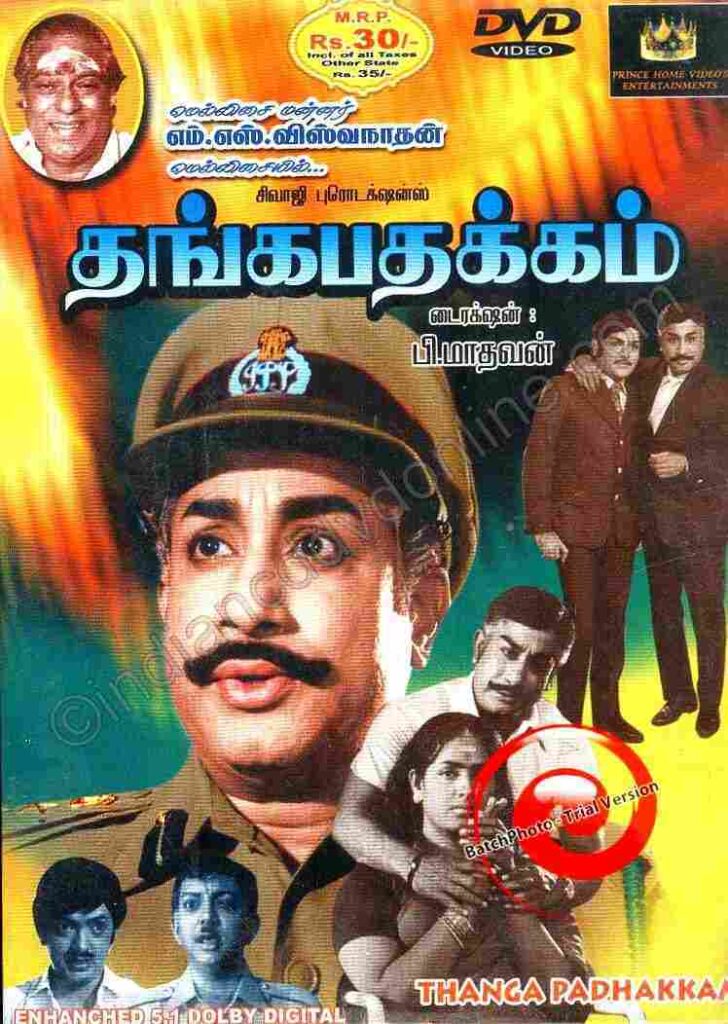
Directed by P. Madhavan
• Music: M. S. Viswanathan
0
0 out of 5 stars (based on 0 reviews)
Excellent
Very good
Average
Poor
Terrible
Your Rating for
Thangappathakkam
Streaming On
Trailer
Soundtrack
Storyline
<p>Choudhry is a strict and committed police officer. Though a loving husband and father, his top priority is his duty. While he upholds the principles of justice and honesty, his son Jagan proves contrary to this even at a young age. After his father berates him for skipping school and indulging in , Jagan runs away from home. He lands in , where he is caught by the police for a petty theft and sent to . Though Choudhry’s wife Lakshmi longs to meet their son, Choudhry prevents her as he feels it would hamper Jagan’s reformation process. Years later, Choudhry is promoted to . Jagan, after his release, returns home. While affectionate towards his mother, he still dislikes his father. This hatred has been ingrained over the years since his father had ignored him for the sake of duty. Jagan falls in love with a woman named Vimala, marries and brings her home. Choudhry and Lakshmi accept her, hoping that all differences have been sorted out and they would now be able to enjoy domestic happiness. However, father and son are still at loggerheads. Jagan, who befriended other criminals in prison, indulges in several illegal activities like theft, kidnapping and smuggling, and is wanted by the police. Choudhry tries his best to reform Jagan, but fails. His repeated attempts to reform him are misunderstood by Jagan, who decides to take revenge on his father for blocking his path to easy riches. In their fight, the family splits, and a depressed Lakshmi dies. Jagan does not come even for her cremation. Jagan decides to sell sensitive military documents to a foreign country for a large sum. Choudhry learns of this, confronts him and persuades him to stop, but Jagan refuses and shoots Choudhry, who is forced to shoot back. Jagan dies in the arms of Choudhry, who survives, and is later rewarded with a for his valour. ( ) was a play written by for actor . While naming the male lead character, a , Mahendran could not find any convincing name in Tamil; he found the Bengali name ” ” convincing, and finalised that name. After seeing the play, bought the rights and staged the play again with some changes under the title , starring as Choudhry. This play, which was inaugurated in 1972, was directed by S. A. Kannan. It became a huge success, being staged more than 100 times. Ganesan’s company decided to adapt it into a film with the same title, with directing. Ganesan’s daughter Shanthi Narayanaswamy produced the film along with T. Manohar. Mahendran wrote the film’s dialogues and was also credited for the original story. Ganesan reprised his role from the play as Choudhry, was cast as his wife Lakshmi, reprising the role originally played by Sivakami while was cast as Choudhry’s son Jagan, reprising the role originally played by Rajapandian. was cast in two roles: a politician named Vaiyapuri and his older brother Sundaram, a constable. The politician character was not present in the play. Mahendran did not write any dialogue for the scene where Lakshmi dies, instead he “visually depict[ed] the sorrow of a widower, which was very challenging”, although Ganesan managed it successfully in a single take. Cinematography was handled by , and editing by R. Devarajan. According to Ganesan, is not about a man killing his son to receive a , but a police officer’s commitment to his post. In his view, the story elucidates the code of conduct for police officers and how they should perform their duties; the character upholds justice, so the title “Thangappathakkam” (meaning gold medal) actually personifies this dutiful police officer. Within the film, Vaiyapuri calls the policy Annaism (introduced in 1973 by politician , described by him as “a blend of the fine aspects of , communism and capitalism”) as “Appaism” (Anna meaning elder brother and Appa meaning father), as a means of ridiculing the policy which was known for being very radical. The music was composed by , with lyrics by . The song “Thatti Sellum” is set in the known as , and “Sumaithangi Saaithal” is set in . was released on 1 June 1974. F. C. Arul, the then of Tamil Nadu, made all possible arrangements to exhibit the film in 16Â mm in all police stations throughout Tamil Nadu. On 30 June 1974, the Tamil magazine appreciated the film and mentioned that Ganesan showed how a police officer should behave and live through his fantastic acting, and added that the film was a gold medal for Ganesan. Kanthan of lauded the performances of the lead cast, particularly Srikanth for portraying a new kind of villain not usually seen in Tamil films, in addition to Madhavan’s direction and Mahendran’s writing. was a commercial success, running for over 175 days in theatres, thereby becoming a . It won the Chennai Film Fans’ Association Awards for Best Film, Best Actor (Ganesan), Best Story (Mahendran) and Best Actress (Vijaya). was dubbed in as in 1976. It served as an inspiration for the Telugu film (1981), the film (2004), and the film (1982). According to ‘s N. Sathiya Moorthy, Ganesan’s characterisation of Choudhry “became a role model for aspiring young police officers”. The characterisation of the role became a benchmark in such a way that many later Tamil films would often refer to Choudhry when mentioning an “honest and upright officer”. According to film historian , the scene where Choudhry does not utter even a word after his wife’s demise “is the way [Mahendran] started his brand of cinema”.</p>
Details
🎬
Genres:
Drama
✍️
Writer:
Mahendran
👤
Producer:
Shanthi Narayanaswamy, T. Manohar
🎵
Music:
M. S. Viswanathan
🎬
Director:
P. Madhavan
📸
Cinematography:
P. N. Sundaram
👥
Starring:
Sivaji Ganesan, K. R. Vijaya, Srikanth, Prameela
📅
Release Date:
01-Jun-74
✂️
Edited By:
R. Devarajan
💸
Budget:
🏭
Production Company:
📺
OTT Platform:
⏱️
Runtime:
2h 44m
🗣️
Language:
Tamil
💵
Box Office:
🌐
Other Languages:
📄
Screenplay:
🔒
Censorship:
Reviews
There are no reviews yet. Be the first one to write one.