
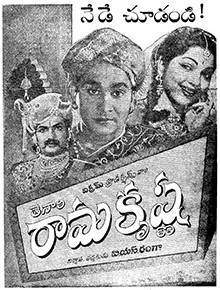
Directed by B. S. Ranga
• Music: Viswanathan–Ramamoorthy
0
0 out of 5 stars (based on 0 reviews)
Excellent
Very good
Average
Poor
Terrible
Your Rating for
Tenali Raman
Streaming On
Trailer
https://www.youtube.com/watch?v=ngGSjd9ctgY
Soundtrack
| Song Name | Singer(s) | Lyricist | Video |
|---|---|---|---|
| Vinnulagalil Minni | This song was sung by P. Bhanumathi and the music was composed by Vishwanathan Ramamoorthy. Lyrics works are penned by Kannadasan. | Kannadasan | |
| Ulakellam Unathu | This song was sung by P. Leela and the music was composed by Vishwanathan Ramamoorthy. Lyrics works are penned by M. K. Aathmanathan. | M. K. Aathmanathan | |
| Thennavan Thaai Naattu | This song was sung by P. Susheela and the music was composed by Vishwanathan Ramamoorthy. Lyrics works are penned by Kannadasan. | Kannadasan | |
| Ullasam Thedum | This song was sung by Ghandasala and the music was composed by Vishwanathan Ramamoorthy. Lyrics works are penned by Tamil Mannan. | Tamil Mannan | |
| Thangam Pongum Meni | This song was sung by R. Balasaraswathy and the music was composed by Vishwanathan Ramamoorthy. Lyrics works are penned by Kannadasan. | Kannadasan | |
| Ulakellaam Un Arulaal Malarum | This song was sung by P. Leela and the music was composed by Vishwanathan Ramamoorthy. Lyrics works are penned by M. K. Aathmanathan. | M. K. Aathmanathan | |
| Putrile Paambirukkum | This song was sung by T. M. Soundarajan and the music was composed by Vishwanathan Ramamoorthy. Lyrics works are penned by Kannadasan. | Kannadasan | |
| Naattu Jananga | This song was sung by S. C. Krishnan and the music was composed by Vishwanathan Ramamoorthy. Lyrics works are penned by Kannadasan. | Kannadasan | |
| Haririha Mukthi | This song was sung by P. Susheela and the music was composed by Vishwanathan Ramamoorthy. Lyrics works are penned by Geetha Govindam. | Geetha Govindam | |
| Pirantha Naal | This song was sung by P. Bhanumathi and the music was composed by Vishwanathan Ramamoorthy. Lyrics works are penned by Kannadasan. | Kannadasan | |
| Adari Padarndha | This song was sung by V. N. Sundharam and the music was composed by Vishwanathan Ramamoorthy. Lyrics works are penned by Kannadasan. | Kannadasan | |
| Chittu Pola | This song was sung by A. P. Komala and the music was composed by Vishwanathan Ramamoorthy. Lyrics works are penned by Kannadasan. | Kannadasan | |
| Kangalil Aadidum | This song was sung by P. Bhanumathi and the music was composed by Vishwanathan Ramamoorthy. Lyrics works are penned by Kannadasan. | Kannadasan | |
| Aadum Kalai | This song was sung by P. Leela and the music was composed by Vishwanathan Ramamoorthy. Lyrics works are penned by Kannadasan. | Kannadasan |
Storyline
<p>During the reign of the , Raman is a poet and scholar whose talent is not recognised in his hometown . To earn a livelihood, he migrates to along with his wife Kamala and son Madhava. On his way to Hampi, he halts at a temple where he is initially terrified looking at the goddess’ idol and the animal sacrifices made to please her. That night, Kali appears before him and grants a boon: he would have to choose either wisdom or materialistic wealth. Raman opts for both, which angers Kali who warns that he might end up as a clownish poet whose wisdom is solely useful for entertaining others. Raman accepts it as a blessing and requests Kali to save him from further dangers, to which the goddess agrees and disappears. Raman reaches Hampi and approaches Rajaguru, the royal priest of the Vijayanagara empire to find employment in the court of king Krishnadevaraya. Neither Rajaguru nor his assistants help him and he returns dejected. However, he finds an opportunity when Krishnadevaraya is unable to distribute 17 disputed elephants among three brothers as per their deceased father’s will. Raman solves the problem and Krishnadevaraya appoints him as a court member. With his wit and loyalty, Raman soon earns the respect of all the court members, except Rajaguru who sees him as a problem. The Deccan Sultans of , , , , and decide to wage a war on Vijayanagara empire with united military forces. They send Kanakaraju, a spy, to Hampi where he meets Raman, who happens to be his distant relative. Some days later, Kanakaraju tries to assassinate Krishnadevaraya and Rajaguru blames Raman for giving shelter to a spy. As Raman is about to be killed as per the king’s orders, he overhears a conversation between another spy and the court’s astrologer. The spy bribes the astrologer to influence Krishnadevaraya in postponing the war on Bijapur so that they can have time for proper preparations. Raman escapes and meets Appaji with whose help he reveals the astrologer’s intentions. The astrologer is killed and Rajaguru, who believed in him with good faith, is accused of trying to back stab the king. Raman intervenes and Rajaguru is saved, which improves their relation. The Bahmani Sultanate then send courtesan Krishna to Hampi. With her acclaimed dancing skills, she manages to elicit the notice of Krishnadevaraya, who finds himself besotted by her wits and sensuousness. He issues orders that anyone who enters his private chamber would be beheaded and continues to spend with time with Krishna for months. Appaji and Raman learn that the Sultans are planning to take advantage of the King’s inaccessibility and shall launch a combined attack on Hampi soon. Worried at the state of affairs, Raman braves the prohibitory order and enters Krishna’s abode dressed as a woman, but is ignored and expelled from the kingdom. Meanwhile, Krishnadevaraya’s wife falls seriously ill, and he finally realises his mistakes. Once the King is back at his palace, Raman manages to gain entry into Krishna’s chamber again, this time under the guise of a saint who assures her that he would bring the King back to her. He catches her red-handed with her gang of spies, and signals to the hidden soldiers to surround her. She kills herself preferring a dignifying death, and Raman wishes to leave for to convince emperor from sending his elephantry to support the Sultanate in the war. Raman reaches Delhi and meets Babur in the guise of an aged fakir and sings praises of him, until he empties all the gold coins he has. Babur then invites him to his palace to gift him properly. Raman goes to Babur’s palace, and introduces himself as one of those innocent citizens of the Vijayanagara empire who shall suffer if Babur extends his support to the unjust Sultanate. Babur is convinced and calls off his elephantry back. Dismayed at the sudden turn of events, the Sultanate call off the war. Krishnadevaraya learns about Raman’s efforts in stopping the war from Appaji. Remorseful, Krishnadevaraya invites Raman to rejoin the court, to which he agrees gladly. After the success of his first production venture (1954), wished to produce and direct a historical film based on the life of the 16th century Telugu poet and scholar , who was one of the (a collective title given to the eight Telugu poets in the court of , which literally translates to eight great elephants). He planned it as a to be filmed simultaneously in Telugu and Tamil languages with a slightly altered cast. Ranga collaborated with , and Murugadasa on the basic script for both the versions. They decided to adapt Ch. Venkataramaiah’s Kannada stage play into a film, instead of following the script of 1941 Telugu film of the same name. Ranga titled the film as in Tamil, while was chosen for the Telugu version. was the second Tamil film based on Tenali Rama, after a 1938 film. Venkataramaiah’s play was comical in nature, and focused plainly on the life and times of Rama. Fearing that it would fail to translate on-screen effectively, Samudrala and Kannadasan decided to incorporate political elements during the rule of Krishnadevaraya. While Samudrala focused on the administrative aspects of Krishnadevaraya, Kannadasan opted to “humanise” the king by writing scenes related to his personal life and preferences. was filmed in and around Revathy Studios at Madras, as the floors of Ranga’s production company Vikram Studios were still under construction excluding the recording and projection theatres. Ranga cast to play Raman in Tamil with replacing him in the Telugu version. and were signed to play Krishnadevaraya and his minister. played the role of the kingdom’s royal priest and was replaced by in the Telugu version. Ranga approached to play Krishna. Initially disinterested, Bhanumathi accepted the offer keeping in view Ranga’s association as a cinematographer for films produced by the former’s production company . Surabhi Balasaraswathi, and Master Venkateshwar were cast in key supporting roles. were signed to compose the soundtrack and background score for both the versions. In addition to directing, Ranga also worked as the director of photography. P. G. Mohan edited the film. Vali and Ganga were the art directors, while Chopra and Gopalakrishnan choreographed the dance sequences. The soundtrack was composed by . was released on 3 February 1956, nearly a month after the Telugu version. Kannadasan published a still from the film showing Raman buried neck deep, waiting to be trampled by an elephant, with a caption describing it as Ganesan’s future. wrote, “It is a film which deserves to be seen…. It is a narrative well told, in terms of resourceful acting, (from [Sivaji] Ganesan in the central role in particular, and from others) attractive high flown language, and impressive backgrounds built with an eye to period.” said, “…. is a very entertaining picture. Some of the songs in the classical style are pleasing. There are a few delightful dances which ought to enhance the entertainment value of the picture.” said, “With witty dialogues, and a number of pleasing dances and songs the film is entertaining.” said, “[Sivaji] Ganesan portrays the role of Tenali Raman extremely well. The film should appeal to all sections of picture-goers.”</p>
Details
🎬
Genres:
Drama
✍️
Writer:
👤
Producer:
B. S. Ranga
🎵
Music:
Viswanathan–Ramamoorthy
🎬
Director:
B. S. Ranga
📸
Cinematography:
B. S. Ranga
👥
Starring:
Sivaji Ganesan, N. T. Rama Rao, V. Nagayya, P. Bhanumathi, Jamuna
📅
Release Date:
03-Feb-56
✂️
Edited By:
P. G. Mohan
💸
Budget:
🏭
Production Company:
📺
OTT Platform:
⏱️
Runtime:
2h 49m
🗣️
Language:
Tamil
💵
Box Office:
🌐
Other Languages:
📄
Screenplay:
🔒
Censorship:
Reviews
There are no reviews yet. Be the first one to write one.