
Streaming On
Trailer
https://www.youtube.com/watch?v=JgOCgOnbey0
Soundtrack
Storyline
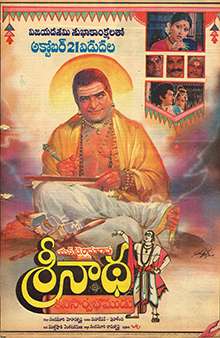
<p>The film begins at the court, where King is instructed by Emperor Prouda Devaraya of Vidyanagaram to challenge his royal scholar, Gowda Dindima Bhattu, who has defeated poets throughout the kingdom. Poets who lose must bow before Bhattu, while those who win have the right to break his golden drum, a symbol of his heritage. To defend his kingdom’s honour, Vema Reddi enlists the talented poet , who swears an oath before the Kondaveedu family deity’s sword, Nandikanta Potaraju Katari, and sets off on his mission. Srinatha, a hedonistic poet who enjoys an extravagant life with his devoted wife Sridevi, begins his journey with stops for pilgrimage and flirtatious poetry. Along the way, he meets his brother-in-law , a natural poet, and invites him to join his lavish lifestyle. Pothana, however, declines, content with his simple life as a farmer. During a stop in a village, a deceitful chieftain, Karanam Nagayya, attempts to embezzle funds allocated for Srinatha’s hospitality. When his scheme is exposed, Nagayya is punished, leading him to seek revenge. He incites Raja Vallabharaya, a subordinate of the emperor, against Srinatha. However, Vallabharaya, impressed by Srinatha’s intellect, becomes his admirer. Consequently, Srinatha mentions Vallabharaya in his works , , and . Srinatha eventually arrives at Vidyanagaram, where Dindima Bhattu and his disciples mock his literary skills. Seeking a fair challenge, Srinatha befriends royal ambassador Sarparaya Telunga, who arranges a competition at the emperor’s court. Srinatha defeats Dindima Bhattu, breaks the golden drum, and earns the title “Kavi Sarvabhouma” (Emperor of Poets). The scholarly committee acknowledges Srinatha’s unique contributions to literature, awarding him gold for his excellence. Meanwhile, Vema Reddi is betrayed by Singa Bhupaludu of , who seizes the imperial sword. Srinatha retrieves the sword through his literary talents but finds Kondaveedu in decline, with the prince, Chinna Vema Reddi, indulging in debauchery. Disillusioned, Srinatha abandons his wealth and status, choosing a humble life. Over time, Srinatha becomes a wanderer, seeking patronage from various kings but finding none. He arrives in and mocks its terrain, prompting Chennakesava to appear in the form of a child and inspire him to document their history in the . Eventually, Srinatha settles in a village, where Nagayya, still seeking vengeance, subjects him to humiliation and torture. When Nagayya is overthrown by a public uprising, Srinatha, now weary of life, decides to end his own. Sridevi dies in his lap, and Srinatha takes his own life by drowning. The film concludes with Srinatha’s spirit ascending to the heavens. Source: had a long-standing ambition to portray the celebrated Telugu poet on screen. The idea first emerged in 1966 when Bharat Films produced under the direction of G. Ramineedu. Rama Rao was initially approached to play Srinatha in the film. He expressed a strong commitment to the role, requesting six months to study Srinatha’s life and immerse himself in the poet’s customs and lifestyle. Rama Rao also proposed shaving his head for authenticity and completing the film within two months after preparation. However, the filmmakers hesitated and suggested using a instead, leading Rama Rao to decline the role. The idea of portraying Srinatha remained significant to Rama Rao throughout his career. In 1983, while serving as the of , he planned to produce and direct a film on Srinatha. was enlisted as the music director, and was assigned to write the lyrics. Some songs were recorded during the early stages of production. However, political pressures and the central government’s refusal to grant permission for him to act while holding office led to the project being postponed. In December 1984, Rama Rao revived the project. Unhappy with the earlier compositions, he replaced J. V. Raghavulu with as the music director and re-recorded the songs with singer . Rama Rao emphasized his personal connection to the role by taking on the responsibilities of directing and producing the film, which was titled . C. Narayana Reddy was tasked with writing the dialogues and lyrics. Despite his renewed commitment, the project faced further delays due to Rama Rao’s continued duties as chief minister, especially after his third term began in March 1985. After seven years of delay, the project moved forward under the direction of . Rama Rao collaborated with Bapu and writer for the film. They expressed concerns, noting that Srinatha’s life did not provide a large enough narrative to captivate audiences. They also highlighted the financial risks involved in producing a film about a historical figure who was relatively unknown to the masses. Despite these concerns, Rama Rao remained determined, emphasizing that the film should be made with sincerity. He believed that even if it did not achieve widespread commercial success, it would still resonate with a smaller, appreciative audience. Following Rama Rao’s insistence, the film was produced by his son, Nandamuri Rama Krishna, under the banner of Srimathi Movie Combines. Bapu directed the film, with Mullapudi Venkata Ramana providing the screenplay and dialogues. The story was based on the novels and by Nori Narasimha Sastry, which depict the life of Srinatha. took place in , , , and other locations along the . The cinematography was handled by , son of Rama Rao. The production was completed on a budget of ₹3 . While was the last film featuring N. T. Rama Rao to release, it was not his final performance. His last acting role was in (1993), which was filmed after but released earlier. and were credited as debutants, though they had appeared in minor roles in earlier films. The film’s music was composed by and , with lyrics penned by . The soundtrack was released under the Beats Audio label. The film was released on 21 October 1993 and was a commercial failure. Devaraju Ravi reviewed the film, calling it a masterpiece. He praised Bapu’s direction, N. T. Rama Rao’s performance, the dialogues, lyrics, and cinematography. He recommended that every Telugu person watch the film and urged the government to make it tax-free.</p>
Details
🎬
Genres:
Drama
✍️
Writer:
Mullapudi Venkata Ramana
👤
Producer:
Nandamuri Rama Krishna
🎵
Music:
🎬
Director:
Bapu
📸
Cinematography:
Nandamuri Mohana Krishna
👥
Starring:
N. T. Rama Rao, Jayasudha, Rajendra Prasad
📅
Release Date:
21-Oct-93
✂️
Edited By:
Dasineni Subhash
💸
Budget:
3.00 crore
🏭
Production Company:
📺
OTT Platform:
⏱️
Runtime:
🗣️
Language:
Telugu
💵
Box Office:
🌐
Other Languages:
📄
Screenplay:
🔒
Censorship:
Reviews
There are no reviews yet. Be the first one to write one.