
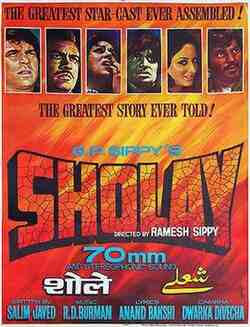
Sholay 3D
★
—/5
Directed by Ramesh Sippy
• Music: R. D. Burman
0
0 out of 5 stars (based on 0 reviews)
Excellent
Very good
Average
Poor
Terrible
Your Rating for
Sholay 3D
Streaming On
Trailer
https://www.youtube.com/watch?v=6uqcput3XEI
Soundtrack
Storyline
<p>Jai and Veeru are small-time crooks who are released from prison, where they are recruited by a former Baldev Singh to capture a notorious named Gabbar Singh wanted for , as the duo had saved Thakur from a train robbery which makes Thakur to recruit them for the mission with an additional reward. The duo leave for Thakur’s village in , where Gabbar is residing and terrorising the villagers. After reaching Ramgarh, Veeru falls for Basanti, a feisty talkative . Jai meets Thakur’s widowed daughter-in-law Radha and falls for her, who later reciprocates his feelings. The two thwart Gabbar’s dacoits, who came to extort money. During the festival of , Gabbar’s gang attacks the villagers where they corner Jai and Veeru, but the duo manage to attack and chase them away from the village. The duo are upset at Thakur’s inaction (when Jai and Veeru were cornered, Thakur had a gun within his reach, but did not help them) and consider calling off the mission. Thakur reveals that a few years ago, Gabbar had killed his family members (except Radha and Ramlal), and had both his arms cut off; he concealed the by always wearing a , which was the sole reason he could not use the gun. Seeing how much Thakur has suffered, Jai and Veeru took pity by taking an oath that they will capture Gabbar alive, free of charge. After learning the duo’s heroics, Gabbar kills the local Rahim Chacha’s son Ahmed, all to threaten the villagers to make Jai and Veeru surrender to him. The villagers refuse and instead get the duo to kill a few of Gabbar’s in revenge for the boy’s death. Gabbar angrily retaliates by having his men capture Veeru and Basanti. Jai arrives and attacks the hideout, where the trio are able to flee Gabbar’s hideout with dacoits in pursuit. Shooting from behind a rock, Jai and Veeru nearly run out of . Unaware that Jai was wounded in the , Veeru is forced to leave for more ammunition and also to drop Basanti at a safe place. Jai sacrifices himself by using his last bullet to ignite on a bridge from close range, killing Gabbar’s men. Veeru returns, and Jai dies, leaving Radha and Veeru devastated. Enraged, Veeru attacks Gabbar’s den and kills his remaining men where he catches Gabbar and nearly beats him to death. Thakur appears and reminds Veeru of the vow to hand over Gabbar alive. Thakur uses his -soled shoes to severely injure Gabbar and his hands. The police arrive and arrest Gabbar for his crimes. After Jai’s funeral, Veeru leaves Ramgarh and finds Basanti waiting for him on the train. The screenwriter pair , consisting of and , began narrating the idea for as a four-line snippet to filmmakers in 1973. The idea was rejected by two producer/director teams, including directors and . About six months after the release of (1973), Salim-Javed contacted and his son , and narrated the four-line snippet to them. Ramesh Sippy liked the concept of and hired them to develop it. The original idea of the film involved an army officer who decided to hire two ex-soldiers to avenge the murder of his family. The army officer was later changed to a policeman because Sippy felt that it would be difficult to get permission to shoot scenes depicting army activities. Salim-Javed completed the script in one month, incorporating names and personality traits of their friends and acquaintances. The film’s script and dialogues are in ; Salim-Javed wrote the dialogues in , which was then transcribed by an assistant into script so that Hindi readers could read the Urdu dialogues. The film’s plot was loosely styled after ‘s 1954 film, . is a defining example of the film, combining the conventions of Indian , especially ‘s (1957) and the and film (1961), with that of , especially ‘s such as (1968) as well as (1960). It also has some plot elements borrowed from the Indian films (1971) and (1973). A scene depicting an attempted train robbery was inspired by a similar scene in , and has also been compared to a similar scene in (1959). A scene showing the massacre of Thakur’s family has been compared with the massacre of the McBain family in . may have also been influenced by ‘s Westerns, such as (1969) and (1973), and ‘s (1969). The character was modelled on a real-life dacoit who had menaced the villages around in the 1950s. Any policeman captured by Gujjar had his ears and nose cut off, and was released as a warning to other policemen. The fictional Gabbar was also influenced by larger-than-life characters in Pakistani author ‘s , Dilip Kumar’s dacoit character Gunga from the film who speaks with a similar mixed and dialect, and villains from Sergio Leone’s films. Sippy wanted to do away with the clichéd idea of a man becoming a dacoit due to societal issues, as was the case in other films, and focused on Gabbar being an emblem of pure evil. To emphasise the point of Gabbar being a new type of villain, Sippy avoided the typical tropes of dacoits wearing and and sporting a and worshipping ” “; Gabbar would be wearing . The character of the jailer, played by was influenced by . Javed Akhtar brought a book on which had several pictures of Hitler posing to set the typical posture of the character in the film. Asrani spiced up his character with some ideas about Hitler’s speech delivery he had heard from a teacher in . The trademark ‘Ha Ha’ at the end of his monologues was inspired by a similar performance by in . Soorma Bhopali, a minor character, was based on an acquaintance of actor Jagdeep, a forest officer from named Soorma. The real-life Soorma eventually threatened to press charges when people who had viewed the film began referring to him as a woodcutter. The main characters’ names, Jai and Veeru, mean “victory” and “heroism” in Hindi. The producers considered for the role of Gabbar Singh, but he could not accept it as he was committed to act in ‘s (1975), under production at the same time. Amjad Khan, who was the second choice, prepared himself for the part by reading the book , which told of the exploits of dacoits. The book was written by Taroon Kumar Bhaduri, the father of fellow cast member Jaya Bhaduri. Sanjeev Kumar also wanted to play the role of Gabbar Singh, but Salim-Javed “felt he had the audience’s sympathy through roles he’d done before; Gabbar had to be completely hateful.” Sippy wanted to play the part of Jai, but there were already several big stars signed, and Amitabh Bachchan, who was not very popular yet, lobbied hard to get the part for himself. He was cast after Salim-Javed recommended him for in 1973; Bachchan’s performance in their first collaboration, , convinced Salim-Javed he was the right actor for the part. Salim-Javed were also impressed with Bachchan’s performance in (1972), and at Bachchan’s request, Dharmendra had personally put in a word for him. All these factors ensured that the role was Bachchan’s. As cast members had read the script ahead of time, many were interested in playing different parts. was considered for the role of Thakur Baldev Singh, but Sippy thought Sanjeev Kumar was a better choice. Initially, Salim-Javed approached to play Thakur’s role, but he turned down the offer; Dilip Kumar later said it was one of the few films he regretted turning down. Initially, Dharmendra was also interested to play the role of Thakur. He eventually gave up the role when Sippy informed him that Sanjeev Kumar would play Veeru if that happened, and would thus be paired with Hema Malini, who Dharmendra was trying to woo. Dharmendra knew that Kumar was also interested in Malini. Malini was reluctant to play the role of a , more so after Sippy told her that the film belongs to Sanjeev Kumar and Amjad Khan, but she trusted Sippy to give her a meaty role, given that he had played a huge role in essaying her stardom through their previous collaborations. During the film’s production, four of the leads became romantically involved. Bachchan married Bhaduri four months before filming started. This led to shooting delays when Bhaduri became pregnant with their daughter . By the time the film released, she was pregnant with their son . Dharmendra had begun courting Malini during their earlier film (1972), also directed by Sippy, and used the location shoot of to further pursue her. During their romantic scenes, Dharmendra would often pay the light boys to spoil the shot, thereby ensuring many retakes which would allow him to spend more time with her. The couple married five years after the film’s release. Much of was shot in the rocky terrain of , a town near , . The filmmakers had to build a road from the Bangalore highway to Ramanagara for convenient access to the sets. Art director Ram Yedekar had an entire township built on the site. A prison set was constructed near in , also outdoors, to match the natural lighting of the on-location sets. One part of Ramanagara was for a time called “Sippy Nagar” as a tribute to the director of the film. As of 2010 , a visit to the “Sholay rocks” (where much of the film was shot) was still being offered to tourists travelling through Ramanagara. Filming began on location on 3 October 1973, with a scene featuring Bachchan and Bhaduri. The film had a lavish production for its time (with frequent banquets and parties for the cast), took two and a half years to make, and went over budget. One reason for its high cost was that Sippy re-filmed scenes many times to get his desired effect. “Yeh Dosti”, a 5-minute song sequence, took 21 days to shoot, two short scenes in which Radha lights lamps took 20 days to film because of lighting problems, and the shooting of the scene in which Gabbar kills the imam’s son lasted 19 days. The train robbery sequence, shot on the route near , took more than 7 weeks to complete. was the first Indian film to have a soundtrack and to use the format. However, since actual 70 mm cameras were expensive at the time, the film was shot on traditional and the was subsequently converted to a 2.2:1 frame. Regarding the process, Sippy said, “A 70 mm format takes the awe of the big screen and magnifies it even more to make the picture even bigger, but since I also wanted a spread of sound we used six-track stereophonic sound and combined it with the big screen. It was definitely a differentiator.” The use of 70 mm was emphasised by film posters on which the name of the film was stylised to match the logo. Film posters also sought to differentiate the film from those which had come before; one of them added the : “The greatest star cast ever assembled – the greatest story ever told”. The of has a different ending in which Thakur kicks Gabbar onto a nail on one of the two poles that Gabbar had used to chain Thakur when he had cut off his arms, stabbing him in the back and killing him, along with some additional violent scenes. Thakur’s shoe soles getting armed with spikes, Gabbar’s death scene, and the scene in which the imam’s son is killed, were cut from the film by India’s , as was the scene in which Thakur’s family is massacred. The Censor Board was concerned about the violence, and that viewers may be influenced to violate the law by punishing people severely. Although Sippy fought to keep the scenes, eventually he had to re-shoot the ending of the film, and as directed by the Censor Board, have the police arrive just before Thakur can kill Gabbar. The censored theatrical version was the only one seen by audiences for fifteen years. The original, unedited cut of the film finally came out in a British release on in 1990. Since then, has released two versions on DVD. The director’s cut of the film preserves the original full frame and is 204 minutes in length; the censored widescreen version is 198 minutes long. Scholars have noted several themes in the film, such as , conformation to , debate between and mobilised usurpers, bonding, and the film’s role as a . Koushik Banerjea, a sociologist in the , notes that exhibits a “sympathetic construction of ‘rogue’ ” exemplified by the likeable Jai and Veeru. Banerjea argues during the film, the moral boundary between and gradually erodes. Film scholar Wimal Dissanayake agrees that the film brought “a new stage in the evolving dialectic between violence and social order” to Indian cinema. Film scholar M. Madhava Prasad states that Jai and Veeru represent a population that is introduced into conventional society. Prasad says that, through the elements of revenge included in the plot and the application of Jai and Veeru’s criminality for the greater good, the narrative reflects reactionary politics, and the audience is compelled to accept . Banerjea explains that though Jai and Veeru are , they are humanised by their emotional needs. Such dualism makes them vulnerable, in contrast to the pure evil of . Gabbar Singh, the film’s antagonist, was well received by the audience, despite his pervasive sadistic cruelty. Dissanayake explains that the audience was fascinated by the dialogues and mannerisms of the character, and this element of spectacle outweighed his actions, a first for Indian melodrama. He notes that the picturisation of violence in the film was glamourised and uninhibited. He further notes that, unlike earlier melodramas in which the as an object of male fetish, in , the male body becomes the centrepiece. It becomes the battleground where compete for supremacy. Dissanayake argues that can be viewed as a national allegory: it lacks a comforting logical narrative, it shows social stability being repeatedly challenged, and it shows the devaluation of human life resulting from a lack of emotions. Taken together, these elements comprise the allegorical representation of India. The narrative style of , with its violence, revenge, and action, is occasionally compared by scholars to the political unrest in India at the time of its release. This tension culminated in ( ) declared by prime minister in 1975. Dissanayeke and Sahai note that, although the film borrowed heavily from the , particularly in its visuals, it was successfully “Indianised”. As an example, William van der Heide has compared a massacre scene in with a similar scene in . Although both films were similar in technical style, emphasised Indian family values and melodramatic tradition, while the Western was more materialistic and restrained in its approach. , in , notes that infuses the style of the Western genre into a “feudalistic ethos”. Ted Shen of the notes s “hysterical visual style” and intermittent “populist message”. Cultural critic and Islamic scholar lampoons the film in his book , both for its caricature and stereotyping of Muslim and women characters, and for what he calls mockery of innocent villagers. Sardar notes that the two most prominent Muslim characters in the film are Soorma Bhopali (a buffoonish criminal), and an impotent victim of the bandits (the imam). Meanwhile, the sole function of one female character (Radha) is to suffer her fate in silence, while the other female lead (Basanti) is just a garrulous village belle. Some scholars have indicated that contains themes. Ted Shen describes the male bonding shown in the film as bordering on . Dina Holtzman, in her book , states that the death of Jai, and resultant break of bonding between the two male leads, is necessary for the sake of establishing a relationship (that of Veeru and Basanti). composed the film’s music, and the lyrics were written by . The songs used in the film, and released on the original soundtrack are listed below. Following that is a list of unused tracks and dialogues which were released later on an updated soundtrack. , and performed vocals for Dharmendra, Malini and Bachchan, respectively. The song “Mehbooba Mehbooba” was sung by its composer, R. D. Burman, who received his sole for his effort. The song, which is often featured on Bollywood hit song compilations, is based on “Say You Love Me” by Greek singer . “Mehbooba Mehbooba” has been extensively anthologised, remixed, and recreated. A version was created in 2005 by the for their -nominated album , featuring . It was also remixed and sung by , along with Bhosle, in his debut acting film (2007). “Yeh Dosti” has been called the ultimate friendship anthem. It was remixed and sung by and for the 2010 Malayalam film , and also in 2010 it was used to symbolise India’s friendship with the United States during a visit from President . Several songs from the soundtrack were included in the annual list of top songs. “Mehbooba Mehooba” was listed at No. 24 on the , and at No. 6 on the . “Koi Haseena” was listed at No. 30 in 1975, and No. 20 in 1976. “Yeh Dosti” was listed at No. 9 in 1976. Despite the soundtrack’s success, at the time, the songs from attracted less attention than the film’s dialogue—a rarity for Hindi language films. The producers were thus prompted to release records with only dialogue. Taken together, the album sales reached an unprecedented 500,000 units. By 1979, the soundtrack went (equivalent to 1 million sales at the time), becoming one of the top-selling of the 1970s. Music critic Oli Marlow reviewed the soundtrack in 2013, calling it a unique fusion of religious, folk, and classical music, with influences from around the world. He also commented on the sound design of the film, calling it psychedelic, and saying that there was “a lot of incredible incidental music” in the film that was not included in the soundtrack releases. In a 1999 paper submitted to London’s Symposium on Sound in Cinema, film critic Shoma A. Chatterji said, ” offers a model lesson on how sound can be used to signify the terror a character evokes. is also exemplary in its use of soundmatching to jump cut to a different scene and time, without breaking the continuity of the narrative, yet, intensifying the drama.” was released on 15 August 1975, , in Bombay. Due to lackluster reviews and a lack of effective visual marketing tools, it saw poor financial returns in its first two weeks. From the third week, however, viewership picked up owing to positive . During the initial slow period, the director and writer considered re-shooting some scenes so that Amitabh Bachchan’s character would not die. When business picked up, they abandoned this idea. After being helped additionally by a soundtrack release containing dialogue snippets, soon became an “overnight sensation”. The film was then released in other distribution zones such as , , , and on 11 October 1975. It became the highest-grossing of 1975, and film ranking website has given the film a verdict of . went on to earn a still-standing record of 60 golden jubilees across India, and was the first film in India to celebrate a silver jubilee at over 100 theatres. It was shown continuously at Bombay’s Minerva theatre for over five years. was the Indian film with the longest theatrical run until (1995) broke its record of 286 weeks in 2001. Exact figures are not available on the budget and box-office earnings of , but film trade sources provide estimates of its success. According to Box Office India, earned about in net income (valued at about US$16,778,000 in 1975) in India during its first run, which was many times its 30 million (valued at about US$3,355,000 in 1975) budget. Those earnings in India were a record that remained unbroken for nineteen years, which is also the longest amount of time that a film has held for being the highest grossing film in India. Its original gross was increased further with re-releases during the late 1970s, 1980s, 1990s, and early 2000s. The film’s total gross revenue in India amounted to ( ). Box Office India estimates the film’s total footfalls in India as over 100 million tickets sold. The film was also an in the , where it was released in 1979. The film sold 48.4 million tickets during its initial run at the , before eventually selling 60 million tickets including re-runs. The film was also released in China, as two parts in 1988. It was the ever up until (1982), and the up until (1994). In 1985, estimated that the film drew a total audience of 250 million over the years, which is comparable to the by some of the world’s adjusted for inflation. It is often cited that, after adjusting the figures for inflation, remains one of the in the history of Indian cinema, although such figures are not known with certainty. Box Office India estimated as s adjusted domestic net income in 2008, while estimated over as the adjusted domestic gross in 2009. estimated the film’s total adjusted gross as ( ) in 2014. Initial critical reviews of were negative. Among contemporary critics, K.L. Amladi of called the film a “dead ember” and “a gravely flawed attempt”. said that the film was an unsuccessful mincing of Western style with Indian , making it an “imitation western—neither here nor there.” Others labelled it as “sound and fury signifying nothing” and a “second-rate take-off” of the 1971 film . Trade journals and columnists initially called the film a flop. In a 1976 article in the journal , author Michael Gallagher praised the technical achievement of the film, but otherwise criticised it stating, “As a spectacle it breaks new ground, but on every other level it is intolerable: formless, incoherent, superficial in human image, and a somewhat nasty piece of violence”. Over time, the critical reception to greatly improved; it is now considered a classic, and among the greatest Hindi-language films. In a 2005 BBC review, the well-rounded characters and simple narrative of the film were commended, but the comical cameos of Asrani and Jagdeep were considered unnecessary. On the film’s 35th anniversary, the wrote that it was a “trailblazer in terms of camera work as well as music,” and that “practically every scene, dialogue or even a small character was a highlight.” In 2006, The described as “an extraordinary and utterly seamless blend of , , “, labelling it an “indisputable classic”. critic Ted Shen criticised the film in 2002 for its formulaic plot and “slapdash” cinematography, and noted that the film “alternates between and melodrama”. In their obituary of the producer G.P. Sippy, said that “revolutionized Hindi filmmaking and brought true professionalism to Indian script writing”. was nominated for nine , and the only winner was , who won the award for . The film also won three awards at the 1976 (Hindi section): “Best Actor in Supporting Role” for Amjad Khan, “Best Cinematographer (Colour)” for , and “Best Art Director” for Ram Yedekar. received a special award at the 50th Filmfare Awards in 2005: . has received many “Best Film” honours. It was declared the “Film of the Millennium” by in 1999. It topped the ‘s “Top 10 Indian Films” poll of 2002, and was voted the greatest Indian movie in a poll of one million British Indians in 2004. It was also included in the magazine s “Best of Bollywood” list in 2010, and in ‘s list of the “100 greatest Indian films of all time” in 2013. In 2023, ranked it #1 on its list of the “100 Best Bollywood Movies.” inspired many films and , and spawned a genre of films, the “Curry Western”, which is a play on the term . A more accurate label for the genre is the Dacoit Western, due to its roots in earlier Indian dacoit films such as (1957) and (1961). It was also an early and most definitive , and a trend-setter for “multi-star” films. The film was a watershed for scriptwriters in Hindi language films, who were not paid well before ; after the film’s success, its writing duo Salim-Javed became stars in their own right and script writing became a more respected profession. The has described as the ” of Bollywood”, comparing its impact on Hindi language films to the impact that (1977) later had on , while comparing Gabbar Singh to . Certain scenes and dialogues from the film earned iconic status in India, such as ” ” (How many men were there?), ” ” (One who is scared is dead), and ” ” (Looks like you two are very close) – all dialogues of Gabbar Singh. These and other popular dialogues entered the people’s daily vernacular. Characters and dialogues from the film continue to be referred to and parodied in popular culture. Gabbar Singh, the sadistic villain, ushered in an era in Hindi films characterised by “seemingly omnipotent oppressors as villains”, who play the pivotal role in setting up the context of the story, such as Shakal (played by ) of (1980), Mogambo ( ) of (1987) and Bhujang (Amrish Puri) of (1989). , in 2013, named Gabbar Singh the most iconic villain in the history of Indian cinema, and four actors were included in its 2010 list of “80 Iconic Performances” for their work in this film. The film is often credited with making Amitabh Bachchan a “superstar”, two years after he became a star with (1973). Some of the supporting actors remained etched in public memory as the characters they played in ; for example, continued to be referred to as “Sambha”, even though his character had just one line. Major and minor characters continue to be used in commercials, promos, films and sitcoms. Amjad Khan acted in many villainous roles later in his career. He also played Gabbar Singh again in the 1991 spoof , and reprised the role in commercials. The British Film Institute in 2002 wrote that fear of Gabbar Singh “is still invoked by mothers to put their children to sleep”. The 2012 film , named after the character, became the highest-grossing up to that point. Comedian , who played Soorma Bhopali in the film, attempted to use his success to create a spinoff. He directed and played the lead role in the 1988 film , in which Dharmendra and Bachchan had cameos. was remade in as (1977), becoming the first film to portray a number of lengthy action scenes, was condemned by many film critics for ‘bringing violence’ to the cinema screen in the country. In 2004, was digitally remastered and shown again to packed theatres in India, including Mumbai’s Minerva, where it had run successfully 29 years earlier. Another attempt to remake , ‘s film (2007), starring Amitabh Bachchan as the villain, was a commercial and critical disaster. Because of television and home media, is widely available and still popular. Twenty years after its release, was first shown on the Indian television channel, where it drew the highest ratings ever for an Indian film broadcast. Video game producer Mobile2win released the game for mobile phones in 2004, along with other themed content such as wallpapers, video clips, and ringtones; another video game developed by Gameshastra has also been released. , a 2014 adaptation of aired on . In 2019, a film titled , based on the stunt woman Reshma Pathan, was released. Pathan had worked as the body double for Malini in the film. has been the subject of two books and many articles. Wimal Dissanayake and Malti Sahai’s (1992) attempts a comprehensive scholarly study that sets the film within the broader history of popular cinema in India. ‘s (2000) provides an inside look at the film’s production based on interviews with the director, stars, and crew members. has been labelled by Chopra as the gold standard in Indian cinema, and a reference point for audiences and trade analysts. Over the years, the film has reached a mythic stature in popular culture, and has been called the greatest Hindi film of all time. It belongs to only a small collection of films, including (1943), (1957), (1960) and (1994), which are repeatedly watched throughout India, and are viewed as definitive Hindi films with cultural significance. The lasting effect of on Indian cinema was summarised by Anupama Chopra, when in 2004 she called it “no longer just a film, [but] an event”. In the 2000 book , the noted director stated “there has never been a more defining film on the Indian screen. Indian film history can be divided into BC and AD”. The film was jointly released in Pakistan by and Mandviwalla Entertainment on 17 April 2015, almost 40 years after its theatrical release. The film’s premiere in the country was held in . Screenwriter , responsible for a number of blockbusters in the early 21st century, including the South Indian franchise and the Hindi film (starring Salim’s son ), cited as a major inspiration on his work. Filmmaker ‘s company Maya Digital was responsible for converting into the format. Mehta was approached by G. P. Sippy’s grandson, Sasha Sippy, about the project in 2010. In March 2012, Shaan Uttam Singh, the grandson of producer G. P. Sippy, said that he would sponsor a conversion of the film to 3D, and release it in late 2012; this was later postponed to late 2013, and eventually finalised for 3 January 2014. It took (US$3.0 million) to convert to 3D. Under the leadership of computer animator Frank Foster, 350 people worked to convert the film into the digital 3D format, for which every scene had to be individually , colour-corrected and re-composited in 3D to match the depth. New set-pieces, particularly those suited to the new format were also included, such as digital logs which scatter in the direction of the camera during the first half of the film when the train collides with them, the gunshot scene which frees Jai and Veeru from their handcuffs, and views of Gabbar’s hideout in the caves. The theatrical trailer and release date were unveiled by the original script-writers Salim Khan and Javed Akhtar. The two original leads, Bachchan and Dharmendra, were also involved in promoting the re-release. The film was released in 1,000 screens in India, and additional screens overseas. It earned approximately (US$1.5 million) during its re-release, becoming the .</p>
Details
🎬
Genres:
Action adventure
✍️
Writer:
Salim–Javed, Salim Khan, Javed Akhtar
👤
Producer:
G. P. Sippy
🎵
Music:
R. D. Burman
🎬
Director:
Ramesh Sippy
📸
Cinematography:
Dwarka Divecha, Dwarka Divecha
👥
Starring:
Dharmendra, Sanjeev Kumar, Hema Malini, Amitabh Bachchan, Jaya Bhaduri, Amjad Khan
📅
Release Date:
15-Aug-75
✂️
Edited By:
M. S. Shinde
💸
Budget:
header
🏭
Production Company:
📺
OTT Platform:
⏱️
Runtime:
3h 24m
🗣️
Language:
Hindi
💵
Box Office:
Amirtham
🌐
Other Languages:
📄
Screenplay:
🔒
Censorship:
Reviews
There are no reviews yet. Be the first one to write one.