
0
0 out of 5 stars (based on 0 reviews)
Excellent
Very good
Average
Poor
Terrible
Your Rating for
Ponnar Shankar
Streaming On
Trailer
https://www.youtube.com/watch?v=9pEFXpPsjlk
Soundtrack
| Song Name | Singer(s) | Lyricist | Video |
|---|---|---|---|
| Kannai Padithaen | Sriram Parthasarathy and Shreya Ghoshal | Vairamuthu | |
| Malar Villile | Darshana K. T. and Shreya Ghoshal | Vairamuthu | |
| Kodi Katti Koduthalum | Hari Charan and Sathyan Mahalingam | Vairamuthu | |
| Thedi Vantha Devathai | Kunal Ganjawala and Shreya Ghoshal | Vairamuthu | |
| Annanmaar Kathai | Madhu Balakrishnan, Hemambika and Anitha Karthikeyan | Vairamuthu | |
| Bavani Varugira | Shreya Ghoshal and Chorus | Vairamuthu |
Storyline
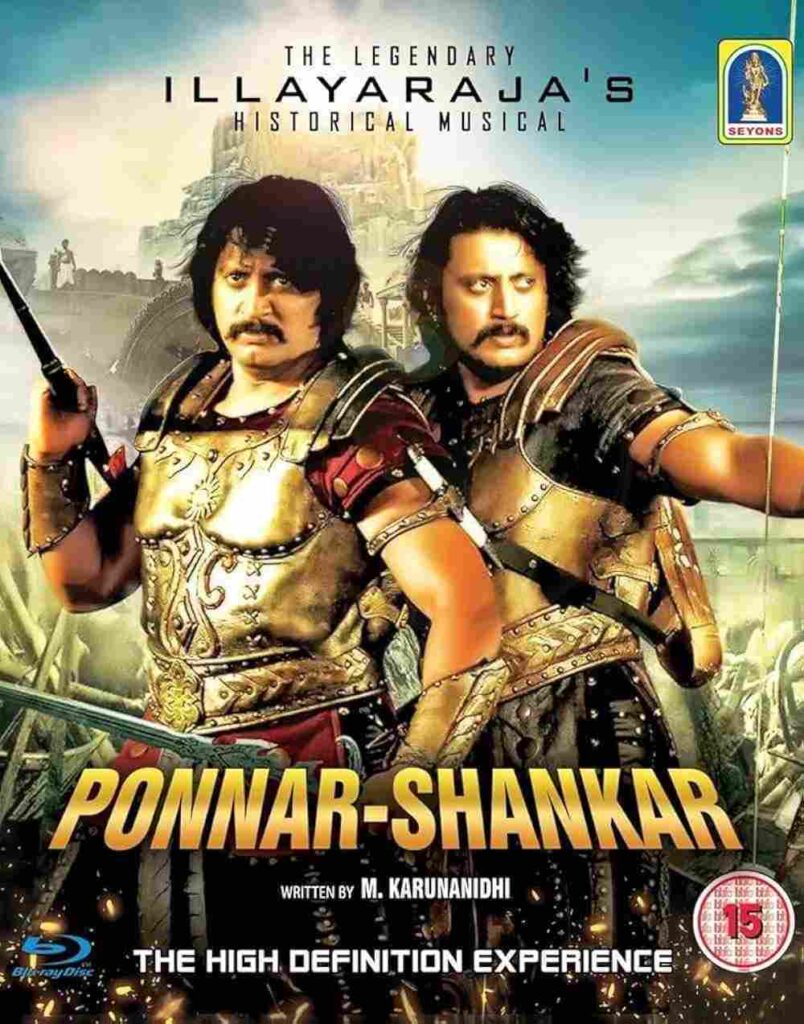
<p>A love affair between Thamarai Nachiyar and her maternal cousin Nellian Kodan is poorly received by their family, especially since he is not financially well off. Thamarai’s father, King Periyamalai Kozhundhu Gounder, arranges for her marriage to Mandhiyappan, the ruler of a neighbouring country. Thamarai rejects the arranged marriage, angering Mandhiyappan. She later marries her lover, who had come to see her marry Mandhiyappan, and challenges her brother Chinnamalai Kozhundhu to marry his daughters off to her sons (the marriage of is a custom). Periyamalai Kozhundhu disowns his daughter for choosing Nellaiyankondan and banishes them from his kingdom. Many years later, Mayavar, a chieftain of a village in Periyamalai Kozhundhu’s kingdom, encounters twin brothers Ponnar and Shankar, who are being tutored in by Rakki Annan. Ponnar and Shankar are valorous and compassionate to the sufferings of the poor. One day, the twins save two sisters, Muthaayi and Pavalaayi, from death. The girls are later revealed to be daughters of Chinnamalai Kozhundhu. Impressed with Ponnar and Shankar’s valour, Chinnamalai Kozhundhu agrees to marry his daughters off to them. A flashback reveals that Ponnar and Sankar are actually Thamarai’s sons and that Rakki, who was then a servant of Nellian Kondan, had saved the twins as small children from Mandhiyappan. Mandhiyappan had attempted to avenge himself on Thamarai for rejecting his hand in marriage. He learns that the twins are still alive and hatches a conspiracy to kill them. He tricks Kali Mannan and Periyamalai Kozhundhu into helping him. This leads to an intense battle which ends with good prevailing over evil. In early 2007, approached M. Karunanidhi with the intention of making a film on his adaptation of the Ponnar Shankar epic that he had written in the late 1970s. The latter accepted Thiagarajan’s offer and approved of his decision to cast his son, , in the dual lead roles. In July 2008, the project was officially announced in a press meet. The film subsequently began pre-production, with Thyagarajan opting to produce the film under his Sri Lakshmi Shanthi Films banner. The preliminary stages of the production took more than a year, with story-boarding, costume designs and colossal set designs all being finalized. Prashanth revealed that extensive research about the time period alone took a year and a half. Prashanth grew his hair out for his role in the film. At the launch of the film in July 2009, Thiagarajan announced that 36 prominent actors would play lead roles with a hundred others in supporting roles. The invitation cards for the launch had 3D holographic designs which won the awards of the year 2009. and were initially considered for the female lead roles, before 2009 and accepted the roles. The producers initially listed Sathyaraj in its cast, later replaced by . Approximately 5000 and 1000 artists from the annual had reportedly taken part in the film. For music, Thiagarajan approached in 2008, and eventually replaced him. Muthuraj was selected as the art director for the film and Shaji Kumar as cinematographer while Prashanth took care of visual effects. The film ran into production trouble in mid 2010 and was close to being shelved, with sources reporting that Thiagarajan sold the film to Santiago Martin to revive the project. The reports proved to be untrue, and Thiagarajan maintained that he was still the producer of the film. The film had also begun to surpass its budget, due to the casual nature of shooting and difficulties in creating historical sets. The first shots from the film and the video for three songs were unveiled publicly in March 2011, with the publicity campaign initiated after this. Filming commenced on 12 July 2009 at in , where an entire ancient township film set with temples, forts, a lake and palaces was created. Scenes containing actor and politician as the historical figure Thalaiyoor Kaali were shot there first. Thereafter, scenes featuring and were filmed, portraying characters which were considerably younger than they are in real life. Prashanth revealed that portraying a dual role meant that he had to change his costumes up to forty times a day to portray the twin brothers’ differences correctly. In March 2010, was roped in to play Arukaani, sister of the warrior twins, and her scenes were filmed. The climax scenes of the film were shot in the deserts of in February 2011. The final phase of filming was going on in the forests of with elephants and horses resembling the region in the 1500s, when the production team couldn’t make prompt payments to the onsite crew that consisted of more than 1000 members. The displeasure shown by the crew threatened to disrupt filming. Karunanidhi, the writer, visited the sets of the film in a studio in February 2011 to peruse over the scenes that had been shot at the time, and filming then moved on to in . The four battle sequences in the movie were shot in , near and in . The scene in Trichy took 28 days to complete, with 30,000 junior artists used as soldiers along with 3000 horses. Another battle scene was shot underwater. A few scenes in the film were reshot after the criticism it received at its premiere that Prashanth’s characters showed no emotions at the death of their parents. Ponnar and Shankar, believed to be chieftains, were rulers of the Ponni valanadu (now in the area), in medieval Tamil Nadu. They were said to be in good terms with the ruler, Vijaya Renga Chokkanathar (1706 – 1732 A. D), who was their contemporary. The legendary folk tale of these brothers, also known as Annamar Swamigal, has been passed down through many generations by means of village songs (known as Gramiya Padalgal) and traditional street theatre, known as Therukkoothu. Absence of reliable written historical records makes it difficult to ascertain the credibility of any of the above claims, along with the widely held legend which was popularised by M Karunanidhi’s novel on the subject. According to the legend, the brothers were born to Periyakaralanaka Mannudaiyak Kounden and Thamaraiyal of Manamadurai, belonging to the community. They had attained the kingdom with help from the then king of , which was the capital of early . Thalaiyur Kali, a neighbouring country king belonging to the rival Vettuva Gounder caste, hatched a conspiracy against the brothers which led to a war and the subsequent death of Shankar who was tricked into proving his innocence by falling over a sword. Grieving the loss of his brother, Ponnar entered the battlefield, killing Kali Mannan, before proceeding to kill himself. The brothers were then brought to life by their sister Arukaani with help from the Goddess Periyakandiamman. The brothers, however, were told by the Gods that their earthly duties were over which led to their leaving the mortal world. Arukaani followed suit by throwing herself along with her royal ornaments into a well in Valanadu, a village in . A temple was later erected in the spot (which falls in the present day Veerappur) where Shankar died, with Periyakandiamman as the presiding deity. There is also a belief that the well in Sadayandi Thoppu, near Veerappur, in which Arukaani drowned herself, still has her gold ornaments. This story has been the subject of poems, songs and a historical novel by . Karunanidhi’s novel drew inspiration from a 1971 work written by Kavignar Sakthikanal, who had researched and documented the references to Ponnar and Shankar in the ancient palm leaves he came across at . Today the brothers are worshipped as by people belonging to community as a tribute to the brave way the brothers defended their kingdom. The soundtrack for the film was composed by , and consisted of six tracks with lyrics written by , , , and Ilaiyaraaja. The album was released on 7 March 2011 at the in with presiding over the event. The film began its publicity campaign in February 2011 with the goal of releasing the film during the period of the to raise support of the (DMK) Party, led by the film’s writer, M. Karunanidhi. Criticism mounted against Karunanidhi for being more involved in his artistic pursuits than in his Chief Ministerial duties as the elections approached. Prior to release, the film also drew criticism from the (KMK) Party claiming that the film portrayed the traditional deities of the community in a bad light, showing them dancing with semi-nude women. Leading figures from the party wrote to the (CBFC) to ban the film, holding the promotional material used for the movie as evidence. When they received no response from CBFC, a petition was filed at , seeking its ban under of the Indian constitution. The petition was dismissed, given that Article 226 can only be used by a court on a body that falls within its jurisdiction. The film was released on 9 April 2011, four days before the election. It received a lukewarm response at the box office, opening at 14 theatres in Chennai where it collected (US$17,000) in the first three days. After a two-week run it collected (US$46,000) from Chennai, and was declared “average” by trade pundits. The film received a mixed reception from critics. The film was praised for its technical merit and art direction, ‘s cinematography, Ilayaraja’s re-recording, crisp editing and predominantly colloquial dialogues (unusual for Karunanidhi’s films), but criticised for its weak storyline and continuity problems. praised the “terrific” art direction and Shaji Kumar’s cinematography but stated that there were far “too many gaps in the story to ensure that the movie never rises above its mediocrity and ends up being an epic disappointment”, giving it two-and-a-half out of five stars. and compared the grandeur of the film to that of , noted for making high budget films in Tamil. gave it a positive review, lauding on all aspects of the film, particularly the film’s war scenes, highlighting that by using contemporary Tamil, instead of its ancient counterpart in its dialogues, the audience could better relate to it. Malathi Rangarajan’s review ( ) was fair, labelling the film an “alluring canvas”, praising the opulent sets, locations, rich costumes and imposing cast, yet noted that it was “too short to negate the many loopholes”. was appreciated in her debut role, while was credited as being “attractive too, but [her] expressions needed some honing”. Though ‘s stunt acts were appreciated, Rangarajan pointed out his character flaws, such as minimal expressions which were “barely a smirk” in the initial scenes, and the distinct lack of distinguishable traits between the twin characters he depicted. He also highlighted the lack of logic in Periyamalai Gounder’s ( ) animosity towards his daughter Thamarai ( ) and the cheerful appearance of Thamarai when she must have been sad and heartbroken in the wedding scene with Prakashraj. stated that the only good aspects of the movie were its expensive sets and its avoidance of boring archaic Tamil dialogues, common in other period films in Tamil, giving it a rating of 41 points out of 100. declared that “there is nothing even remotely historical about the movie”. It added that though the film is said to be based on Karunanidhi’s novel, the film’s commercialised look, along with “half clad women prancing around”, made it resemble ‘s 2008 film . It went on that “historical accuracy had been thrown to the winds” and that there were no references to actual places, kings or time periods. noted the historical inconsistencies, such as the presence of a constructed dam in a scene while the film is set in pre-colonial period, “wire stunts of Prashanth in action sequences”, revealing costumes donned by the lead actresses and also the bamboo dance sequence in the film which is actually native to . It summed that the film lacks attention to detail which is a necessary feature of historical films. called it a “pseudo historical”. Kavignar Sakthikanal, whose 1971 work was the basis for Karunanidhi’s novel, observed that the inaccuracies originated from the novel itself due its usage of like . He further stated that Ponnar and Shankar remained celibate throughout their lives while in the movie they were shown romancing with immodestly dressed women. They married only to avenge the ill treatment meted out to their mother and promptly sent their newly wed wives to prison denying coital relations with them, he added. Also, in the film the title characters were not shown committing suicide as in Sakthikanal and Karunanidhi’s version, but rather were depicted emerging victorious from the war unscathed.</p>
Details
🎬
Genres:
Drama
✍️
Writer:
M. Karunanidhi
👤
Producer:
Thiagarajan
🎵
Music:
Ilaiyaraaja
🎬
Director:
Thiagarajan
📸
Cinematography:
Shaji Kumar
👥
Starring:
Prashanth
📅
Release Date:
09-Apr-11
✂️
Edited By:
Don Max
💸
Budget:
🏭
Production Company:
📺
OTT Platform:
⏱️
Runtime:
2h 9m
🗣️
Language:
Tamil
💵
Box Office:
🌐
Other Languages:
📄
Screenplay:
🔒
Censorship:
Reviews
There are no reviews yet. Be the first one to write one.