
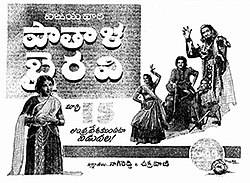
Directed by K. V. Reddy
• Music: Ghantasala
0
0 out of 5 stars (based on 0 reviews)
Excellent
Very good
Average
Poor
Terrible
Your Rating for
Pathala Bhairavi

Trailer
Soundtrack
Storyline
<p>The queen of is keen for her daughter Indumathi (alias Indu) to marry her brother Surasena, a timid and mentally unstable person. When the gardener’s son ‘Thota’ Ramudu assaults Surasena at a concert for irritating the common people, he is summoned by the king to the court. His boldness leaves a considerable impression, but when Ramudu declares his love for Indu a day before his death sentence for meeting Indu secretly, the king is reminded of the astrologers’ prediction that only a brave man can save her from a wicked sorcerer. He then challenges Ramudu to amass wealth equal to that of his to marry Indu, to which Ramudu agrees. He is released from prison. Ramudu meets a Nepali sorcerer during the latter’s magic show in a street. The sorcerer, who is ordered by Goddess Pathala Bhairavi during his prayers to sacrifice an intelligent and brave young man before her to be granted a statuette that grants any wish, feels that Ramudu is suitable for the sacrifice. While taking a holy bath in the nearby pond, Ramudu kills a crocodile that immediately transforms into a woman after being killed. The woman informs Ramudu that he had freed her from a ‘s curse and also reveals the sorcerer’s intentions. Just before the sacrifice, Ramudu sacrifices the sorcerer and wins the statuette, consequently amassing wealth equal to that of the king. In return, the king lives up to his promise and accepts Indu’s wishes to marry Ramudu. The sorcerer’s apprentice Sadajapa discovers his master dead at Pathala Bhairavi’s shrine and brings him back to life with the help of . Upon resurrection, the sorcerer makes a deal with Surasena, who was about to commit suicide, to bring the statuette in exchange for everything Ramudu has, including Indu. Surasena agrees and steals the statuette, then handing it over to the sorcerer which changes the fate of Ramudu and Indu, leaving the former penniless. Ramudu pledges to bring Indu his wealth back and leaves for the sorcerer’s lair along with his cousin, Anji. While they are unable to locate the sorcerer’s lair, Indu refuses the sorcerer’s proposal to marry him. With the help of the statuette, the sorcerer brings Ramudu to his lair and tortures him in front of Indu with the hope that she would succumb to his proposal to marry him. Posing as Sadajapa, Anji requests the sorcerer to shave his beard to win Indu’s heart. The sorcerer shaves his beard, losing his powers in the process. Afterward, Ramudu finds the statuette and wishes to bring the palace back to Ujjain. In a fight between Ramudu and the sorcerer mid-way in the sky, the latter is killed by Ramudu. The palace is back in Ujjain and Surasena apologises to both Ramudu and Indu before uniting them. While Anji marries Indu’s best friend, the film ends with the marriage of Ramudu and Indu. After making their debut with (1950), and of signed later in the year to make a folklore film. The film, , was based on a story from , written by . adapted the content and wrote the film’s story. and K. V. Reddy worked on the screenplay. Pingali was also inspired from the story of . was made as a bilingual film, shot in Telugu and Tamil simultaneously with both the versions having the same title. The Tamil version’s dialogues were written by . , who went on to make his directorial debut with (1952), worked as an assistant director for the film. also joined the film’s crew as an assistant director, along with K. Raghava as the film’s action choreographer. was recruited as the film’s cinematographer and the duo C. P. Jambulingam and M. S. Money edited the film. Madhavapeddi Gokhale and Kaladhar were the film’s art directors. composed the film’s music. Initially, director Reddy had in mind for the lead role. He later wanted to cast Raja Reddy in the lead role but replaced him with in the last minute, who made his debut by playing a minor character in (1949). Rama Rao was eventually signed as a part of his four-film contract with Vijaya Vauhini Studios after Reddy was impressed with Rama Rao when he met him on the sets of (1950). With this film, Rama Rao became the first actor to have acted in two languages simultaneously. was initially considered for the role of the sorcerer, the film’s antagonist. But with Rama Rao being signed as the protagonist, Reddy wanted to cast an actor without an image, thus was signed. Ranga Rao wore costumes reminiscent of a anti-hero and used the catchphrase “Sahasam Seyara Dimbhaka” ( ). He took inspiration from , the antagonist of Shakespeare’s play, , which he played when he was a stage-artist. Muthudhuta Peethambaram, who joined Vijaya Productions in 1945, helped Ranga Rao take on the appearance of a 105-year-old man with the use of make-up. was the first big budget film produced by Vijaya Productions. The entire production lasted for a whole year starting from 5 February 1950 until 8 February 1951, due to the film being shot simultaneously in Telugu and Tamil. Pasumarthi Krishnamurthy conducted the choreography for the song sequences. Major portions of the film were shot in large sets and many were used by Bartley during the process. Both versions were filmed using an 11 CBR Camera. For scenes in the film that featured the moon in the background, a circle was drawn on a screen which was lit to make it look like the moon. Though having other lights were not possible, Bartley made sure that all the characters in such scenes had their shadows away from the moon. Despite this, many of the transformations of elements in this film were shown using techniques. No lights were hidden behind the painted moon, as a source for lighting. According to in his book , the film begins with the theme of (Bravery gives wealth) which is present throughout the film. While the characters of Rama Rao and Ranga Rao epitomise heroism, the character of the princess played by Malathi epitomises innocence and sensuality. sets up an opposition between the worship of by the protagonist’s mother and the worship of Pathala Bhairavi by the sorcerer; the former being a frequent one inhabited in a domestic space while the latter being an uncivilised one. According to liberal studies faculty member S. V. Srinivas, was a blend of folklore and social drama. Srinivas stated that the depiction of the goddess Pathala Bhairavi before Ramudu sacrifices the sorcerer was reminiscent of the representation of worship by Dalits in the film (1938). He added that “ratifies certain social relationships by presenting them as natural and given” and “at the same time, some other practices are presented as inhuman and uncivilised”. The soundtrack of was composed by , the lyrics of which were written by Pingali and Thanjai N. Ramaiah Dass for the Telugu and Tamil versions respectively. The sound mixing process was supervised by A. Krishnan and Siva Ram. It was processed by N. C. Sen Gupta and was orchestrated by A. Krishnamurthy. The songs were composed using Mohana, and , with “Prema Kosamai Valalo Padene” and “Kanugona Galano” notably being modulated on the same raga. The soundtrack was released on 1 December 1950. Also, a digitally remastered version was released and marketed by in 2003; the album cover depicts a still image from the film featuring Rama Rao and Malathi. Relangi sang the comedy song “Vinave Bala Naa Prema Gola” which was filmed on himself. A costly was specially imported for this film which was played by Master Venu. For the Hindi dubbed version, sang the song “Sunloji Sardaro” (“Ithihasam Vinnaara” in Telugu) and sang the song “Bindiya Chamke” (“Vagaloi Vagalu” in Telugu). The latter became the first Telugu film singer to record a song for a Hindi film with this Hindi dubbed version of . The Telugu version of was released on 15 March 1951, and the Tamil version was released two months later on 17 May 1951. Both versions were commercially successful, with the Telugu version completing a theatrical run of 100 days. became the first Telugu film to run continuously for 175 days, and the first Telugu film to have a direct run of 200 days. It completed the 175th day of its theatrical run in a total of 13 theatres. acquired the film’s Hindi dubbing rights and reshot two song sequences – “Ithihasam Vinnara” and “Vagaloi Vagalu” in colour. The Hindi dubbed version was commercially successful. was the only South Indian film to be screened at the first held at on 24 January 1952. Sahitya Surabhi organised a programme at the Visakha Public Library in on 7 March 2015 on the eve of the 64th anniversary of this film’s release and writer Rambhatla Nrusimha Sastry attended the programme as the chief guest. received critical acclaim. A. Seshagiri Rao of writing his review on 16 March 1951 called a landmark film, not just for but for as well. He praised Reddy’s direction and observed that the team spirit of the cast and crew in making this film was visible. On 4 April 1951, opined that was a film made intelligently, and compared the story to that of a train which runs tirelessly without halting for a second. While praising the character of the Nepali sorcerer and Ranga Rao for his portrayal, the reviewer criticised the film for poorly developing the other characters, in contrast to . In his 1988 book , Srivastava Banerjee gave a polarised review of the film by calling it “an extraordinarily meaningless modern myth”. In late November 2007, a -based company named Goldstone Technologies acquired the rights of 14 Telugu films produced by Vijaya Vauhini Studios, including (1957) and , to release their digitally re-mastered versions in colour. After the success of the digitised and colourised version of released in January 2010, its makers announced that would be the next film to be remastered and re-released in colour. However Goldstone Technologies decided not to remaster the remaining 14 films including , saying that most of the producers who sold the rights of the negatives to TV channels lost control over them, adding that there were also a lot of legal issues over ownership and copyright issues whenever other producers try to do something on their own. ” s importance lies in laying the groundwork for the emergence in the Telugu film industry of the star-system as we know it today. offers a promise of fulfilment of certain expectations of the protagonist, expectations which are themselves introduced by the narrative.” achieved cult status in Telugu cinema; in July 2010, Hemanth Kumar of called a film that “took an entire generation by storm” and praised its special effects in particular, which Kumar felt were ahead of their time. The lines “Nijam Cheppamantara Abaddham Cheppamantara” (“Shall I say the truth? or shall I lie?”), “Sahasam Seyara Dimbhaka” (“Be adventurous man!”), “Naruda Yemi Nee Korika?” (“O Human, what is your desire?”) became popular and phrases such as “dingari” (“servant”) and “dimbhaka” (“fool”) later became a part of Telugu vernacular. The film’s story is regularly staged as a play by , known as . During a programme organised by the film society of , writer include actor placed among other cult films like (1913), (1932), (1938), (1953), and (1963) during a speech on the role of Telugu cinema in the hundred years of Indian cinema. On the centenary of Indian cinema in April 2013, included in its list, “The 100 greatest Indian films of all time”. The film is considered to be a film for both Rama Rao and Ranga Rao. Rama Rao later starred in other folklore films like (1953), (1954), and (1955); all of which were commercially successful. When the film’s unit was travelling by train to attend the 100th day celebrations of at Bellary, the then Union Home Minister was travelling in . When both the trains happened to halt at , people who had come to greet Rajagopalachari rushed to the other platform to have a glimpse of the film’s unit, which left Rajagopalachari amazed by the popularity that the film had attained. was also remade in Hindi, 34 years after the release of the original film, as (1985) starring and . inspired Vijaya Productions along with its collaborator to produce (1994) directed by starring Rama Rao’s son in the lead along with . In the pre-climax sequences of the Telugu film (2003), when Obul Reddy (played by ) is about to murder Ajay (played by ), the latter compares the former with Ranga Rao’s character in who was murdered by Rama Rao’s character. The film’s story was used as a play in the Telugu film (2012), which was based on the Surabhi theatre group.</p>
Details
🎬
Genres:
Drama
✍️
Writer:
👤
Producer:
Nagi Reddi, Chakrapani
🎵
Music:
Ghantasala
🎬
Director:
K. V. Reddy
📸
Cinematography:
Marcus Bartley
👥
Starring:
N. T. Rama Rao, S. V. Ranga Rao, K. Malathi
📅
Release Date:
15-Mar-51
✂️
Edited By:
C. P. Jambulingam, M. S. Money
💸
Budget:
🏭
Production Company:
📺
OTT Platform:
Prime Video
⏱️
Runtime:
3h 15m
🗣️
Language:
Tamil
💵
Box Office:
🌐
Other Languages:
📄
Screenplay:
🔒
Censorship:
Reviews
There are no reviews yet. Be the first one to write one.