
0
0 out of 5 stars (based on 0 reviews)
Excellent
Very good
Average
Poor
Terrible
Your Rating for
Newton

Trailer
https://www.youtube.com/watch?v=yU6zMPFd4UU
Soundtrack
Storyline
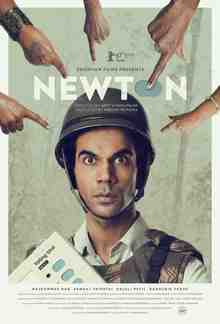
<p>Nutan “Newton” Kumar ( ), a rookie on reserve is sent on duty to a -controlled town in the -ridden jungles of , , when one of the main duty officers there is found to be facing heart problems. Faced with the apathy of the war-weary (CRPF) security forces, led by Assistant Commandant Aatma Singh ( ), and the looming fear of by insurgents, he tries his best to conduct free and fair despite the odds stacked against him. He is disappointed when the voters do not turn up for the election. Later when a foreign reporter turns up at the polling station, the CRPF force the villagers from the constituency to turn up to cast their votes. When one of the villagers enters the polling booth, he is bewildered by the voting machine and does not understand how to operate it. After talking to the villagers, Newton soon realizes that they have no idea what the election is about. Some thought they would earn from this, while others asked hopelessly about getting paid sufficiently for their work. He desperately tries to educate them but to no avail. Taking the lead, a frustrated Aatma Singh cuts off Newton aside and shames the villagers by telling them that these officers have risked their lives for their vote, and they should not turn them away. He tells them that the voting machine is a toy; there are symbols of elephants, cycles, etc. and they could press any symbol they like (leaving them uneducated about the fact that those symbols represent respective political parties). So while they vote for their favorite symbol, instead of politicians they have never heard about, the foreign reporter gets a good news report about . Newton wants to sit at the polling booth for the stipulated time but is forced to flee due to a Naxal ambush, which he later realizes was actually staged by the CRPF. Upon learning this, he tries to outrun his escort team back to the polling booth, but gets caught on both sides, and is forcibly taken back to safety. On the way back, Newton decides to collect the votes of four villagers who suddenly turn up from deep inside the forest. Aatma Singh is reluctant to let them do so. Taking his duty very seriously, Newton steals Aatma Singh’s rifle and holds the officer at gunpoint till the villagers cast their votes. Singh comments out of frustration that he did not want polling to be conducted in an area that was only secured by government forces 6 months ago, mentioning that there are still more landmines there than men. He tells Newton that he does not want to lose any more troops, especially when the government cannot even supply them with that they have been requesting for 2 years. Newton keeps him at gunpoint even after the voting for the remaining two minutes of his official duty (till 3 pm). The CRPF troops then beat him up out of frustration. The movie concludes with a shot of the area six months later, showing mining activity going on. Aatma Singh is shown shopping in civilian dress with his wife and daughter during holidays, suggesting he is humane and conditions in Naxal-affected areas made him a dispassionate and cynical person. Newton is shown in his office wearing a neck brace for his injury from the beating but otherwise happy, and keeping with his old ways. He is visited by the local election officer Malko ( ) who asks him what happened after she left as she is unaware of the events and Newton asks her to tell everything over tea, but only after five minutes, when Newton’s scheduled lunch break begins. was released to critical praise and was also a commercial success. On the website , 94% of 18 critics’ reviews are positive, with an average rating of 7.8/10. On the Indian film review aggregator website The Review Monk, received a 7.5 out of 10 average score based on 23 reviews. gave the film a rating of 4 stars out of 5 and said that, ” is relevant and timely without being boring or inaccessible. You could say it lays on its message too thick in the end, or that the pace occasionally slips. But these are minor nigglings that never dent the impact of its thrust.” Neil Soans of gave the film a rating of 4.5 stars out of 5, saying, ” has dared to take on an issue that our vast majority turns a blind eye to, and slaps us out of our blissful ignorance. Amidst laughing, it’ll leave you thinking, which – and we need to be reminded of this – is what good cinema should do. Both your funny bone and your grey cells will thank you for watching it.” Soans praised the performances of the cast – particularly that of Rao and Tripathi – and the screenplay by Masurkar and Tewari. Suhani Singh of gave the film a rating of 4 stars out of 5 and said that, ” is a dark comedy that gives you equal measures of dread and disillusionment and hope and hilarity. It makes you see the pitfalls of the democratic system but also tells you that it’s the only one capable of positive change. This is reality at its finest, with credible performances and backdrops that immerse viewers into the world and where even the faces of the background characters leave a heartbreaking impression.” Shubhra Gupta of gave the film a rating of 4 stars out of 5 saying that, “Director Amit V Masurkar and co-scriptwriter Mayank Tewari have crafted a strong black comedy. It is as sharp and subversive as the classic , and even though it is entirely sobering, it leaves us feeling just a little better about ourselves.” She also praised the performances of the actors saying, “Rajkummar Rao is enjoying a purple patch. After , here he is again stitching up a big performance full of small things: blinking, thinking, doing. He is at his most interesting when he is being quiet: he makes us watch. Pankaj Tripathi, as the head of the security detail, cynical yet doing the best he can, is lovely too. For once the talented Patil has been used well, and as for Raghubir Yadav, he gives us, after , another stand-out act, a lesson in How To Immerse Yourself Effortlessly In Your Role. Rohit Vats of gave the film a rating of 4 stars out of 5 and said that, “It is one of the finest political satires we have seen in the last couple of years. It refrains from taking sides and offers a humorous take on state versus the Maoists bloody battle. It raises questions on the importance of the electoral system we are so proud of. It takes us much beyond what we see. The team of Rajkummar Rao, Pankaj Tripathi, Raghuvir Yadav and Anjali Patil has come up with a top-notch performance.” Harish Wankhede calls Newton ‘A new Dalit Hero’ in the Indian Express review. He suggests that the most reviews of the film neglect the protagonist’s social identity, while emphasising the film’s creative aspects. “Newton, no doubt, is a refreshing entry in the genre of commercial art house cinema. However, more significantly, the director offers a new social imaginary to depict the film’s protagonist. A new Dalit hero is offered to the audience through the subtle use of certain symbolic gestures and social codes.” received a warm response at its premiere at the . It also won the Award for best film in the Forum Section. wrote ” is a touching, personal and very human film about the strength of one very resolute rookie election clerk to uphold the democratic process in a rebel-threatened area.” was India’s official entry for the 90th Academy Awards; it was also the first Indian film to receive a grant of Rs 1 crore from the . had its world premiere at the held from 9–19 February 2017 in , Germany while in India it got released on 22 September 2017. grossed Rs 11.75 crore net in the first week in India. The film grossed Rs 3.75 crore in its second weekend, taking the total to Rs 15.50 crore. It was a box office success. After the film’s release and its selection as India’s entry for the Oscars, was criticized for its striking similarities with the Iranian movie In defense, film-maker voiced his support to the team of , stating ” is as much a copy of , is of “. The producer and director of further clarified that is not a copy of his film. Anurag Kashyap started an online chat with the producer of Marco Müller, and he stated that “There’s not even a hint of plagiarism”. Kashyap then asked for his permission and shared a screenshot of the conversation on his account. Subsequently, the director of the Iranian film stated in an online interview that he “saw the film and there is no sign of plagiarism. These are completely different films.” Other commentators have noted a similarity between the film’s official poster and that for ‘s film . Director:</p>
Details
✍️
Writer:
Amit V
👤
Producer:
Manish Mundra
🎵
🎬
Director:
Amit Masurkar
📸
Cinematography:
Swapnil S. Sonawane, Swapnil S Sonawane, Swapnil S Sonawane, v, t, e, National Film Award for Best Hindi Feature Film, 1954–1960, Mirza Ghalib, (1954), Jhanak Jhanak Payal Baaje, (1955), –, (1956), Do Aankhen Barah Haath, (1957), Madhumati, (1958), Anari, (1959), Mughal-e-Azam, (1960), Certificate of Merit, Jagriti, (1954), Shree 420, and, Devdas, (1955), Basant Bahar, (1956), Mother India, and, Musafir, (1957), Lajwanti, and, Karigar, (1958), –, (1959), Jis Desh Mein Ganga Behti Hai, and, Kanoon, (1960), 1961–1980, Dharmputra, (1961), Sahib Bibi Aur Ghulam, (1962), Bandini, (1963), Dosti, (1964), Shaheed, (1965), Anupama, (1966), Hamraaz, (1967), Aashirwad, (1968), Satyakam, (1969), Anand, (1970), –, (1971), Maya Darpan, (1972), 27 Down, (1973), –, (1974), Nishant, (1975), –, (1976), Shatranj Ke Khilari, (, The Chess Players, ), (1977), Kasturi, and, Junoon, (1978), Sparsh, (1979), Aakrosh, (1980), Certificate of Merit, Gunga Jumna, and, Pyaar Ki Pyaas, (1961), –, (1962), Mere Mehboob, and, Gumrah, (1963), Yaadein, and, Geet Gaya Patharon Ne, (1964), Oonche Log, and, Guide, (1965), Discontinued after 1965, 1981–2000, Arohan, (1981), Katha, (1982), Ardh Satya, (1983), Paar, (1984), Anantyatra, (1985), Mirch Masala, (1986), Pestonjee, (1987), Salaam Bombay!, (1988), Salim Langde Pe Mat Ro, (1989), Drishti, (1990), Diksha, and, Dharavi, (1991), Suraj Ka Satvan Ghoda, (1992), Patang, (1993), Mammo, (1994), Bandit Queen, (1995), Gudia, (1996), Hazaar Chaurasi Ki Maa, (1997), Godmother, (1998), Shool, (1999), Zubeidaa, (2000), 2001–2020, Dil Chahta Hai, (2001), The Legend of Bhagat Singh, (2002), Raghu Romeo, (2003), Raincoat, (2004), Black, (2005), Khosla Ka Ghosla, (2006), 1971, (2007), Rock On!!, (2008), Paa, (2009), Do Dooni Chaar, (2010), I Am, (2011), Filmistaan, (2012), Jolly LLB, (2013), Queen, (2014), Dum Laga Ke Haisha, (2015), Neerja, (2016), Newton, (2017), Andhadhun, (2018), Chhichhore, (2019), Toolsidas Junior, (2020), 2021–present, Sardar Udham, (2021), Gulmohar, (2022), v, t, e, Filmfare Critics Award for Best Film, 1971–1980, Uski Roti, (1971), Ashadh Ka Ek Din, (1972), Maya Darpan, (1973), Duvidha, (1974), Rajnigandha, (1975), Aandhi, (1976), Mrigayaa, (1977), Shatranj Ke Khilari, {, The Chess Players, } (1978), Arvind Desai Ki Ajeeb Dastaan, (1979), Jeena Yahan, (1980), 1981–2000, Albert Pinto Ko Gussa Kyoon Aata Hai, (1981), Aadharshila, (1982), Masoom, (1983), Sookha, (1984), Damul, (1985), Aghaat, (1986), Om-Dar-B-Dar, (1989), Khayal Gatha, (1990), Kasba, (1991), Diksha, (1992), Idiot, (1993), Kabhi Haan Kabhi Naa, (1994), Bandit Queen, (1995), Bombay, (1996), Khamoshi, (1997), Virasat, (1998), Satya, (1999), Sarfarosh, (2000), 2001-present, Halo, (2001), Dil Chahta Hai, (2002), The Legend of Bhagat Singh, (2003), Munna Bhai M.B.B.S., (2004), Dev, and, Yuva, (2005), Black, (2006), Lage Raho Munna Bhai, (2007), Chak De! India, (2008), Mumbai Meri Jaan, (2009), Firaaq, (2010), Udaan, (2011), Zindagi Na Milegi Dobara, (2012), Gangs of Wasseypur, (2013), The Lunchbox, (2014), Ankhon Dekhi, (2015), Piku, (2016), Neerja, (2017), Newton, (2018), Andhadhun, (2019), Article 15, and, Sonchiriya, (2020), Eeb Allay Ooo!, (2021), Sardar Udham, (2022), Badhaai Do, (2023), Joram, (2024), v, t, e, Screen Awards, for, Best Film, Hum Aapke Hain Koun..!, (1995), Dilwale Dulhania Le Jayenge, (1996), Raja Hindustani, (1997), Border, (1998), Kuch Kuch Hota Hai, (1999), Hum Dil De Chuke Sanam, (2000), Kaho Naa... Pyaar Hai, (2001), Lagaan, (2002), Devdas, (2003), Koi... Mil Gaya, (2004), Veer-Zaara, (2005), Black, (2006), Lage Raho Munna Bhai, (2007), Chak De! India, (2008), Jodhaa Akbar, (2009), 3 Idiots, (2010), Udaan, (2011), The Dirty Picture, &, Zindagi Na Milegi Dobara, (2012), Paan Singh Tomar, (2013), Bhaag Milkha Bhaag, (2014), Queen, (2015), Talvar, (2016), Pink, (2017), Dangal, (2018), Newton, (2018), Stree, (2019), Gully Boy, (2020)
👥
Starring:
Rajkummar Rao, Pankaj Tripathi, Anjali Patil, Raghubir Yadav
📅
Release Date:
22-Sep-17
✂️
Edited By:
Shweta Venkat Mathew
💸
Budget:
10
🏭
Production Company:
📺
OTT Platform:
Prime Video
⏱️
Runtime:
1h 46m
🗣️
Language:
Hindi
💵
Box Office:
15
🌐
Other Languages:
📄
Screenplay:
Amit V. Masurkar, Mayank Tewari
🔒
Censorship:
Reviews
There are no reviews yet. Be the first one to write one.