
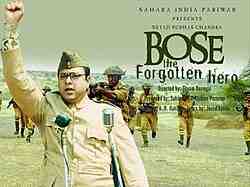
Directed by Shyam Benegal
• Music: A. R. Rahman
0
0 out of 5 stars (based on 0 reviews)
Excellent
Very good
Average
Poor
Terrible
Your Rating for
Netaji Subhas Chandra Bose: The Forgotten Hero

Trailer
https://www.youtube.com/watch?v=WczVepo7fKw&pp=0gcJCfwAo7VqN5tD
Soundtrack
Storyline
<p>Set in , after a political disagreement with , Bose’s arrest and subsequent release sets the scene for his escape to , via and the . A few days before his escape, he sought solitude and, on this pretext, avoided meeting British guards and grew a beard. On the night of his escape, he dresses himself as a to avoid being identified. Bose escapes from under British surveillance at his house in on 16 January 1941, accompanied by his nephew in a car. Bose journeys to with the help of the , where he was met by Akbar Shah and . Bose was taken to the home of Abad Khan, a trusted friend of Akbar Shah’s. On 26 January 1941, Bose begins his journey to reach through with Afghanistan. For this reason, he enlists the help of Mian Akbar Shah, then a leader in the . Shah had been out of India en route to the Soviet Union, and suggests a novel disguise for Bose to assume. Since Bose could not speak one word of , it would make him an easy target of Pashto speakers working for the British. For this reason, Shah suggests that Bose act deaf and dumb, and let his beard grow to mimic those of the tribesmen. Bose’s guide Bhagat Ram Talwar, unknown to him, is actually a Soviet agent. Supporters of the help Bose across the border into where he was met by an Abwehr unit posing as a party of road construction engineers from the who then aided his passage across Afghanistan via to the border with . After assuming the disguise of a insurance agent (“Ziaudddin”) to reach Afghanistan, Bose changes his disguise and travels to Moscow on the Italian passport of an Italian nobleman “Count Orlando Mazzotta”. From Moscow, he reached , and from there he travels to . Once in Russia the transport Bose to where he hope that Russia’s traditional enmity to British rule in India would result in support for his plans for a popular rising in India. However, Bose found the Soviets’ response disappointing and was rapidly passed over to the German Ambassador in Moscow, . He had Bose flown on to in a special courier aircraft at the beginning of April where he was to receive a more favorable hearing from and the Foreign Ministry officials at the . In Germany, Bose is attached to the under which was responsible for broadcasting on the German-sponsored . Bose initiates the Free India Center in Berlin, and created the (consisting of some 4500 soldiers) out of Indian prisoners of war who had previously fought for the British in prior to their capture by Axis forces. The Indian Legion is attached to the Wehrmacht, and later transferred to the . Its members swore the following allegiance to Hitler and Bose: “I swear by God this holy oath that I will obey the leader of the German race and state, , as the commander of the German armed forces in the fight for India, whose leader is Subhas Chandra Bose”. This oath clearly abrogates control of the Indian legion to the German armed forces whilst stating Bose’s overall leadership of India. He was also, however, prepared to envisage an invasion of India via the USSR by Nazi troops, spearheaded by the ; many question his judgment here, as it seems unlikely that the Germans could have been easily persuaded to leave after such an invasion, which might also have resulted in an Axis victory in the War. In all, 3,000 Indian prisoners of war sign up for the Free India Legion. But instead of being delighted, Bose was worried. An admirer of Russia, he was devastated when Hitler’s tanks rolled across the Soviet border. Matters were worsened by the fact that the now-retreating German army would be in no position to offer him help in driving the British from India. When he meets Hitler in May 1942, his suspicions were confirmed, and he comes to believe that the Nazi leader was more interested in using his men to win propaganda victories than military ones. So, in February 1943, Bose turned his back on his legionnaires and slipped secretly away aboard a submarine bound for Japan. This leaves the men he had recruited leaderless and demoralized in Germany. Bose lives in Berlin from 1941 until 1943. During his earlier visit to Germany in 1934, he had met , the daughter of an Austrian veterinarian whom he marries in 1937. Their daughter is . In 1943, after being disillusioned that Germany could be of any help in gaining India’s independence, he leaves for Japan. He travels with the German submarine around the to the southeast of Madagascar, where he is transferred to the for the rest of the journey to , The INA’s first commitment was in the Japanese thrust towards Eastern Indian frontiers of . INA’s special forces, the Bahadur Group, are extensively involved in operations behind enemy lines both during the diversionary attacks in Arakan, as well as the Japanese thrust towards and , along with the led by and . However, the Japanese Navy remains in essential control of the island’s administration. On the Indian mainland, an Indian Tricolor, modeled after that of the , was raised for the first time in the town in , in , in north-eastern India. The towns of and were placed under siege by divisions of the Japanese, Burmese National Army and the Gandhi and Nehru Brigades of INA during the attempted invasion of India, also known as Operation U-GO. However, Commonwealth forces held both positions and then counter-attack, in the process inflicting serious losses on the besieging forces, which were then forced to retreat back into Burma. When the Japanese were defeated at the battles of and , the ‘s aim of establishing a base in mainland India was lost forever. The INA was forced to pull back, along with the retreating Japanese army, and fought in key battles against the British Indian Army in its , notably in , , , Nyangyu and . However, with the fall of , Bose’s government ceases to be an effective political entity. A large proportion of the INA troops surrenders under Lt Col Loganathan. The remaining troops retreated with Bose towards or made for . Japan’s surrender at the end of the war also leads to the eventual surrender of the Indian National Army, when the troops of the were repatriated to India. On 17 August 1945, Bose leaves from Saigon to Tourane, French Indo-China in the twin-engine heavy bomber. Subsequently, on 23 August 1945, announces the and General of the Japanese in . The film ends with the at , the , and the resulting Independence in 1947. , which offered a controversial view of the life of Bose, sparked protest in India. Director Benegal was forced to cancel its premiere in Calcutta. The film was fiercely opposed by the party. The party was angry at the film’s suggestion that Bose secretly married an Austrian woman, , in 1937, and that he died in a plane crash in Taiwan rather than fleeing to Russia in 1945 as some people believe. BBC gave 3 stars out of 5 for . Critic Jaspreet Pandohar called it “an informative and fascinating lesson worth sitting through” and “an absorbing drama.” “Benegal is best known for his intimate portraits of Indian women, so it comes as some surprise that his latest film is a biopic of one of India’s most famous male icons, Subhas Chandra Bose. Benegal ensures Bose’s amazing but complex life story is peppered with just the right amount of detail so as to be easily understood. But what stops this film from becoming a [box-office] hit is its marathon length. At nearly three and a half hours, Sachin Khedekar’s gallant performance isn’t enough to make this a rousing affair,” Pandohar wrote in his analysis. Sachin Khedekar’s portrayal of Bose was praised by critics including Ziya us-Salam of newspaper. “Khedekar may not win too many international awards for portraying Bose but accolades in India should come in thick and fast,” she wrote in her review. “Benegal may not have put together an epic to challenge the lasting greatness of “Gandhi,” ‘s tribute to our father of the nation. But nor has he had the advantage of such resources. Where Benegal deserves credit is not in the canvas of his work but the intellectual honesty he has brought to the film. He refrains from either diluting or distorting history to serve his ends.” Salam also noted the limitations of a director working under a relatively small budget for a historical film.” The highly acclaimed music score that accompanies the film was composed by . The soundtrack features 20 pieces composed by Rahman, including 12 instrumentals and orchestral themes, six songs with lyrics by and a full orchestral version of . Most of the score was conducted by Matt Dunkley and performed by . Performers include the Western Choir Chennai (for “Aazadi”) and the Mumbai Film Choir (“Hum Dilli Dilli Jayenge”).</p>
Details
✍️
Writer:
Atul Tiwari, Shama Zaidi
👤
Producer:
Raj Pius, Barbara von Wrangell
🎵
Music:
A. R. Rahman
🎬
Director:
Shyam Benegal
📸
Cinematography:
Rajan Kothari
👥
Starring:
Sachin Khedekar, Kulbhushan Kharbanda, Rajit Kapur, Divya Dutta, Arif Zakaria
📅
Release Date:
03-Nov-04
✂️
Edited By:
Aseem Sinha
💸
Budget:
Navigation
🏭
Production Company:
📺
OTT Platform:
Netflix
⏱️
Runtime:
3h 28m
🗣️
Language:
Hindi
💵
Box Office:
Uncategorized
🌐
Other Languages:
📄
Screenplay:
🔒
Censorship:
Reviews
There are no reviews yet. Be the first one to write one.