
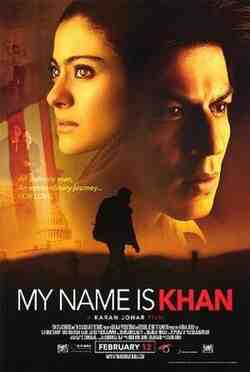

Trailer
https://www.youtube.com/watch?v=nqxgYT3TYzY
Soundtrack
Storyline
<p>Rizwan Khan, an , grows up with his younger brother Zakir and his widowed mother Razia in a middle-class family in , . His leads to special tutoring from a reclusive scholar and extra attention from his mother, all of which leads to a heightened level of jealousy from Zakir, who eventually leaves his family for a life in . Despite this, Zakir sponsors Rizwan to come and live with him after Razia’s death. Zakir’s wife Hasina diagnoses Rizwan with , and Rizwan begins to work for Zakir’s company, selling beauty products to salons. He meets and falls in love with Mandira Rathod, a hairdresser and Hindu woman, who has a young son, Sameer, born from a previous marriage. Despite Zakir’s uncertainty, Rizwan and Mandira get married and move to Banville, with Mandira and Sam taking Rizwan’s surname. They also live next door to the Garrick family; Mark, the father, is a journalist, and Sam is best friends and schoolmates with their young son Reese. A few years later, the Khans’ life gets disrupted following the . Mark goes to , but dies there. At the same time, the Khans begin to experience , and Reese begins to avoid and eventually turn against Sam after Mark is killed. In turn, Sam attempts to reconcile with Reese, which one day leads to a confrontation between the two that snowballs into a fight at their community soccer field, where a group of older students bully and attack Sam, despite Reese’s pleas for them to stop. One of them kicks a football at Sam, rupturing his and killing him. A grieving Mandira starts to blame Rizwan, stating that Sam died solely because of Rizwan’s surname. She tells Rizwan to “just go”, as she never wants to see him again, insinuating that their marriage is over. When Rizwan asks when he can come back, Mandira sarcastically says he may as well come back after telling all of America and the that his name is Khan and he is not a terrorist. Taking her request rather seriously out of naivéte, Rizwan ventures out on a road trip to meet President by following his campaign and fundraiser trail. While hitchhiking across the country, Rizwan earns a living through odd jobs and repairs. During his travels, he passes through Wilhemina, a fictional rural town in Georgia. There, he befriends a boy named Joel after helping him from a bike injury, thus earning the trust of his mother, Jenny, whom Rizwan calls “Mama Jenny”. Later, shortly before the president is due to speak, Rizwan enters a mosque in to pray. While there, he overhears violent rhetoric from a doctor, Faisal Rehman, who is quoting the Hadith but inspiring his followers to enact violence. Rizwan stands up and angrily defies Faisal’s statements, shocking the crowd and inspiring debate. He immediately walks out and reports Rehman to the . After doing so, Rizwan makes his way to the front of the crowd at to meet President Bush, where he repeatedly calls out, “My name is Khan and I am not a terrorist!”. The cry confuses and scares the crowd, who disperse in a panic. He is arrested due to misinterpretation as “I am a terrorist”, and is detained and interrogated for information about , which Rizwan naively wishes he knew more about, though Radha, the psychiatrist brought in by the FBI, believes he is innocent. He is released after a media campaign by Indian student reporters Raj and Komal, who find a journalist, Bobby Ahuja, to run their story for them. With the help of the students, Bobby proves Rizwan’s innocence by revealing his attempts to inform the about Faisal. After his release, Rizwan hears a news report of Wilhelmina being struck by a hurricane. He returns to Georgia to help Mama Jenny and Joel as well as the entirely flooded and destroyed town, thus attracting media attention for his bravery. Reese, seeing Rizwan on TV over weeks of small towns receiving hurricane recovery aid following his attempts, finally confesses to Mandira his knowledge of what happened to Sam, and reveals the identities of the boys who killed him. Mandira informs Detective Garcia, who has been assisting her on the case, and the boys, including Reese, are arrested. Mandira reunites with Rizwan in Wilhelmina, Georgia. Right as she arrives, however, Rizwan is stabbed by one of Faisal’s followers who accuses him of being a traitor to Islam, and he is hospitalized. Rizwan survives, and he meets , who tells him: “Your name is Khan and you are not a terrorist.” Rizwan responds by adding that his stepson, Sameer, was also not a terrorist; he also relays a sarcastic message from an airport security officer that he had promised to relay. After thanking Obama, Rizwan and Mandira walk home, united at last. The cast is listed below: “I am one of those people who is very open-minded about religion. I don’t have any prejudices. When there’s talk about Islam and terrorism, and the association between the two, I believe there are larger political reasons for everything. You can’t generalize about a religion. There are millions of people across the world who are Muslim, who are suffering on account of a faulty perception, and I felt very strongly that I wanted to tell that story.” Having worked on a number of romantic dramas and consequently become known for these, desired to experiment with a new genre. He wanted it to be one that would attract critical and commercial success, as well as help prove his ability of making non-romantic films to his audience. Eventually, the idea of making a socially relevant film came to his mind, “because that is what those kinds of people like”. He chose to depict Islam as a main topic of discussion — an action that he described as a “conscious decision” — since he felt there is an international unawareness and negative generalization towards the religion. While himself belonging not to the religion, he called himself educated and open-minded enough to understand that misconceptions against Islam exist. As a filmmaker, Johar wanted to communicate with his audience of his message, which is “correcting the world’s misconceptions about Islam”, in an emotional, yet effective, manner. In November 2007, reported a then-untitled upcoming project by Johar. The filmmaker told the entertainment portal that there would be possibility it would be rather titled or simply . In a July 2008 article in his personal blog, Johar confirmed the title as , breaking his tradition of initiating his works’ titles with the letter “K”. He said, “While deciding upon the title, I just went by my gut and decided on something which brings to fore the spirit of the film and the story that I wanted to tell. Everything was decided in true earnest. The right title of the film was and stays on as .” wrote the story and screenplay while penning the dialogues with Johar’s then-regular collaborator , thus making Johar’s first film he did not write himself, though he still helped her in the research. According to Johar, it gave him “a level of detachment from the proceedings and yet, a lot of attachment” and released “unexplored emotions”. In preparation, Bathija and Johar met a lot of people with autism, including those who have Asperger’s syndrome; Bathija also read books about their condition, including and , non-fictions about the life of a woman with his husband, who suffers from Asperger. Johar suggested to have a Muslim character in the lead and set the film in the September 11 attacks, which Bathija eventually agreed with. Geographically, the story is set in the , which came to Bathija’s inspirations because of her familiarity with the place while finishing her communication study at the between 1998 and 2000. Her motivation to use it as the film’s backdrop increased in 2007 after seeing many Bollywood films also being shot there. A fictional town, Banville, which she described as “a stereotypically white, upper-class Bay Area suburb”, was also added into the story. In an interview to the , Bathija recounted that while researching for the San Francisco Bay by from , she spotted , which fitted her criteria of a location that resembles a “small, very rich suburban town”. Beside that, Bathija also wrote the English-language dialogues, while wrote the Hindi ones. A number of Arabic phrases, mostly in religious context, were also added. The film was co-produced by Hiroo Yash Johar of Karan Johar’s and of Shah Rukh Khan’s . The partnership was announced in February 2009; on co-producing the film under his own banner, Shah Rukh Khan said he disliked to films, especially non-commercial ones, like , and wanted Johar to finish it without taking a loan as well as to collectively own the film. The budget was estimated to have been (US$12.03 million), according to the financial newspaper . The production was also handled in part with the American production houses and . Fox Star’s involvement to distribute the film was announced in August; however, the company’s exact paid amount for the rights was disputed, with unconfirmed estimations ranging from (US$17.71 million) to (US$21.87 million), and its executives refused to disclose the number. In February 2010, the -based Image Nation joined to distributed the film, and nine months later, the Hong Kong-based Huaxia Film Distribution followed. Shanoo Sharma and handled the casting of . The earliest press reports appeared in October 2007, when Shah Rukh Khan and Kajol were reported to be cast in the lead. Karan Johar, however, clarified that while Shah Rukh Khan had accepted the offer, he had not been able to confirm whether Kajol would be in the casting, saying that he had not talked with her yet. During this period, was reported to have offered herself to play opposite Shah Rukh Khan, until May 2008 at the time Kajol confirmed her presence. became Shah Rukh Khan and Kajol’s sixth collaboration, after (1993), (1995), (1995), (1998) and (2001), the latter two were also directed by Karan Johar. Before Jimmy Sheirgill, and then were originally chosen to play the role of Zakir, Rizwan’s younger brother. The latter left the film to prioritise his role in (2009). When filming began in December 2008, the United States authority refused to give Bashir a visa to travel to that because he did not mention his travel to Iran in the application form; since the , the country had been cautious of foreigners. The incident attracted considerable media attention, which led to his exclusion from the casting; he later worked with Johar 13 years later on , Johar’s first film without Khan. was initially cast for portraying Rizwan’s mother, Razia. However, owing to a delay caused by Shah Rukh Khan’s shoulder surgery in January 2009, Azmi opted out; she continued to shoot for -directed comedy-drama, (2010). The role eventually went to Zarina Wahab, with Azmi also ultimately working with Johar in . In January 2009, Pakistani actress Sonya Jehan was reported to join the casting to play the supporting role of university professor Hasina Khan. Unlike Jehan’s previous films that shows her in revealing clothes, this one has her wearing a , the traditional head-covering for Muslim women. She was particularly drawn to her character and expressed a desire to play similar roles in the future. Child artist Tanay Chheda played the role of young Rizwan. Chheda’s performance in the widely-acclaimed drama (2008), his resemblance of Shah Rukh Khan’s appearance and his familiarity with Mumbai slums were the basis for Karan Johar to cast him. Instead of putting the footages of then-President Barack Obama, an actor physically similar to him was chosen. was the original possibility for the role, but he declined owing to conflicting schedule and disinclination to play Obama who was still in his office. The role eventually went to , who was cast two months after an audition. Karan Johar and Bathija researched extensively for Shah Rukh Khan’s character in for two years, and this included their personal study of Asperger’s syndrome and contact with autistic people from various centers in , , and India. When interviewed by Bollywood Hungama, he admitted to have helped her by “just executing her vision”. Karan Johar and Bathija met Christopher and Gisela Slater-Walker, who wrote , and he described the former as having been their significant inspiration for the character. They also had a rendezvous with Chris and Maxine Aston ( writers), whom Karan Johar said to have been the “basis” for Rizwan and Mandira’s relationship. Their research also included gathering information related to the condition from videos. Shah Rukh Khan did his own research to his role, which Bathija stated to have been written specifically for him. He said that he was nervous but at the same time excited to play the type of role, which he had never done before. Karan Johar described him as being challenged, even considering Rizwan to be Shah Rukh Khan’s “most challenging” character. Shah Rukh Khan himself referred to it as “the most interesting part” of his career as an actor, seeing that he could spread awareness about a condition that is rarely suffered from. His film characters are mainly secular; they are not especially focused on their religious background, but the one in is. Alluding to its autism, he referred to his character as a “neuro-atypical mind, who could do less and say more”. Karan Johar sent Shah Rukh Khan to the centers he had previously visited with Bathija; the director wanted the actor to socialize with autistic people, predominantly those with Asperger, and make his own Rizwan based on these interactions. Beside videos, Shah Rukh Khan continued his research with reading books about the syndrome, including the mystery novel . Karan Johar observed that Shah Rukh Khan’s research for the character was particularly extensive, admitting that it astonished him: “I was zapped by how much he knew on the subject. And he brought all the knowledge on the sets.” While playing his character, the actor maintained expressionless eyes even when he was saying his dialogues, which he found difficult. To get it right, he practiced in bathroom for ten consecutive days. “My challenge is here is a character who does not feel love, who does not know how to cry or laugh, sing or dance, and yet in this film, I am going to be the most romantic hero … You will at the end of the film feel, ‘Oh my god, I wish he could be in love with me’, knowing fully well my character does not feel love, he does not cry. I don’t think I can succeed in convincing you that he is a lovable guy. And yet you feel for this man, you love him. That is the challenge I have in this film.” Los Angeles-based Robin Slater, who had worked in films including (2000), (2005) and (2006), was appointed to be Shah Rukh Khan’s makeup artist by producer . Slater described his look as “a natural sun-kissed one, very natural. He looks fresh and they all thought he looked much younger.” She did his makeup in six steps and six minutes, starting with using a to get rid of the flaws from his face. She then the on, put sunburn stipple around his chin, cheekbones, forehead, jaw and nose, and shaded the nose and jawline. After using powder gel to make him as if he wore no makeup, Slater removed airbrush overflow on his eyebrows and eyelashes. Kajol was given with the role of Mandira, Rizwan’s Hindu wife with a son from her previous marriage. She found to be thematically similar to Karan Johar’s previous films, noting for instance. However, she added “there was more in them” in comparison to , which she called his deepest one. The complexity of her character, Mandira, made her emotionally engaged to it, and Kajol stated that this experience eventually gave her a life lesson: “It is okay to be imperfect as a human being.” She described as an intense collaboration with her friend, Karan Johar, who asked her to lose weight for characterization. In an interview to , Johar said that Kajol had always been the one in his mind while casting for an actress to play Mandira. On her spontaneous nature, he commented, “There is no method to her madness. She is sheer brilliance. Her expressions connect you immediately. She is all real, all woman, all human on screen and I don’t think any living actress has the quality that Kajol has.” His frequent collaborator, , was specifically chosen as her costume designer. As to her role as a -based hairstylist, Kajol wore colourful clothes, including jackets and trousers; while her character is at home, she would be given more tracks and sweaters. In one of her scenes, she featured in a red , which was not Malhotra’s design but was bought from a shop. Johar said that she did not want the fashion to distract the film’s messages. Shiraz Siddique handled the rest of the cast’s costumes. was commenced by on 18 December 2008 in Los Angeles. and Sham Kaushal provided the choreography and action respectively; served as the production designer; Mohammed Kasim and Mansi Dhruv Mehta were the art directors; and , who would later make their film debuts with Johar’s next directorial venture , also presented by Shah Rukh Khan, served as assistant directors. In January 2009, after a one-month schedule, Shah Rukh Khan went on to shoot an action scene in (2010) but faced an accident that injured his shoulder. He underwent a , and in the next month a surgery that made the shooting was delayed until the next month. After filming was continued, he faced severe but only taking pills to relieve these. When the pain worsened he checked up to a doctor; his migraines were proven to have been the result of being in leaning position and raising his eyebrows for hours, which were required for his character. In January 2010, he had another physical therapy. The Los Angeles schedule began in March 2009. In the next month, the slum scenes were shot in . The next two days, the film was shot at a mosque in . Filming then moved to San Francisco in May 2009 for a 40-day schedule. Coinciding with the start of the , it was done secretly to avoid public attention, and finished a month afterwards. In August 2009, the cast and crew moved to for shooting the hurricane scene. For the sets, Josh Maidain designed a dam of 135 by 240 metres (443 ft × 787 ft), along with churches and small houses. A 150 by 150 feet (46 m × 46 m) tank was also made, and approximately 12 thousand liters of water were used for the scene. This schedule, which was the last of the production, began on 1 September and was completed in a month. During the filming, a snake reportedly entered the tank and panicked all the workers. was edited by , while Dileep Subramaniam and Anuj Mathur were involved in the sound design. The film’s final cut runs for 155 minutes. composed the soundtrack to , while Iyengar and (uncredited) provided the lyrics. features eight singers: , , , , , , and . The film has six original songs and four additional songs taken from Karan Johar’s previous films, which are played in background without . The album was released on 6 January 2010 by to positive reviews and was a commercial success. was screened as part of ‘s Official Selection in February 2010, out of competition. The website auctioned the tickets for the film’s screening at the Berlin Film Festival for a record price of £1,000 ( 60,000) each. All the tickets were sold out in five seconds. The first look of unveiled at a grand ceremony at Mumbai by Johar, Khan and Kajol and was then beamed across 70 countries worldwide on the . Johar was excited and noted, “This is a first in the history of Bollywood – that the promos of a film will play across such a wide platform. And, this has mainly been made possible because of our synergy with Fox Star Studios … and also the first time an Indian company is tying up with a mainstream American studio. So, there are many firsts to this venture.” The trailer of the film was released at the premiere of (2009). marked the first instance of a film using the roadblock advertising technique to market a film, in which the three-minute trailer was aired on all leading television channels simultaneously. I will add that is a very special topic about humanity in the garb of a Muslim character … The film is made on a large canvas and the subject material is adapted in terms of humanity in a very entertaining way … the message of love, the way it has been shot internationally and the way of releasing it, might have all the possibilities of an international release. It is going to be released in a way no Hindi film has been released internationally before created an entire to promote the film. On 1 February 2010, Khan and Kajol became the first Indian film stars to ring the opening bell of the New York stock exchange . They were invited by Fox Searchlight Pictures to do so as part of their promotion for . Khan also appeared on as part of its promotion in the UK, becoming only the second Indian after to do so. debuted in , on 10 February 2010. It released globally in cinemas on 12 February 2010. had a two phase release. To begin with, it had a mainstream release in India coupled with a regular Diaspora release in UK, US, Gulf, Australia and various other countries. “After that in the months of April and May, we would be looking at a mainstream theatrical release in countries like Germany, Poland and other parts of North America”, detailed Johar. On 7 August 2009, Khan signed a worldwide distribution deal for the film with for (equivalent to 2.5 billion or US$30 million in 2023). Fox Star Studios distributed the film in India, while its sister studio distributed it in the United States. acquired the rights to the film’s soundtrack. The film was released in India on on 21 April 2010, in India, plus a DVD release worldwide followed on 17 August 2010. In the United Kingdom, it was 2012’s sixth most-watched foreign-language film on television with 210,000 viewers on , and the year’s second most-watched (below the Chinese film ). ASTPL, an Indian software developer, also released a based on the film. received widespread acclaim from overseas publications, most of which echoed the same sentiments as of domestic critics. On the website , 86% of 29 critics’ reviews are positive, with an average rating of 6.7/10. The website’s consensus reads: ” rests on powerful performances to tell an affecting story that blends timely themes and old-fashioned Bollywood melodrama.” , which uses a , assigned the film a score of 50 out of 100, based on 7 critics, indicating “mixed or average” reviews. received highly positive reviews upon release, with particular praise directed towards its direction and the leads’ performances, and has often been referred to as Johar’s . In a -star review, wrote that Shah Rukh Khan’s performance was his career’s best so far and “no amount of praise can do sufficient justice to his portrayal”. Adarsh also praised the decision to cast Kajol, whom he regarded as the one with the strongest chemistry with Shah Rukh Khan, and described her as having given “a powerhouse performance”. ‘s Raja Sen said Karan Johar had made “his first grown-up film”, and described it as one “that will inspire, make aware, make happy”. wrote of the character Rizwan as “the epitome of goodness and surprisingly, the filmmaker tones down his sense of drama several notches, showing great restraint for at least two-thirds of the film”. Writing for , Bhavishek Shah called the film a landmark to the careers of the director and its lead actors. The critic opined Shah Rukh Khan succeeded in playing his part: “Completely getting under the skin of the character, Shah Rukh has picked up every single nuance of an Asperger’s syndrome patient without making it appear labored.” Savera R. Someshwar of wrote that Kajol delivered a fine performance, taking note of her “laughter, her determination, her , her grief, her anger — Kajol brings it all to life. And, if I may say so, Kajol, no one runs up a hill dressed in a night suit, wearing floppy slippers, with no make-up on, as well as you do.” of wrote that Shah Rukh Khan is outstanding and called his presence to be emotional equilibrium, and was excited to see him collaborating once again with Kajol. Writing for the , Minty Tejpal saw the film was intended for an international market, noting its story that includes Islamophobia and African-American community. “But the real bravery award should go to director-producer Karan Johar, who dispenses with the designer preciousness of his previous films to come as close as this to something real, something important. He sets it all up beautifully, and looks set to carry it through but loses his conviction towards the end by drumming up a forced climax. In trying to make Rizwan Khan more heroic than he already is … the smooth arc of the film is derailed.” ‘s Manish Gajjar believed Shah Rukh Khan had shown his versatility as an actor within his emotional performance and considered it to be his best. On Kajol, Gajjar thought she had given an equally commendable performance, especially in the second half where her character, Mandira, is shown as being egocentric after losing her son. Minu Jain of complimented Karan Johar for exploring a genre that is not romance-centric and labelled the film “a road journey through a troubled post 9/11 America towards humanism”. of the also praised his move to experiment outside the typically musical Bollywood cinema; Shekhar wrote positively of Bathija’s screenplay, which he called compelling enough for praise. referred to the film as “a flawless work, as perfect in content, tone and treatment as any film can get”. lauded story, claiming that it had been able to made her cry. said Shah Rukh Khan’s character Rizwan as the greatest part of the film. Sukanya Venkatraghavan of asserted, “To say is a warm-the-cockles film about a man with Asperger syndrome who overcomes all odds and triumphs would be to pigeonhole it. The movie has a larger picture-one of humanity, tolerance, redemption and above all love.” Kaveree Bamzai of said the film deserves to be watched not for its message but Shah Rukh Khan. Alike views were shared by , who encouraged people to watch it for the cast; Masand further stated that the message of religious tolerance is significant but not unique. Sarita Tanwar argued, “In a near-perfect film, the only over-the-top part is Rizwan’s return to a flood-hit small town to save the African-American family. It’s stands out because everything else is so understated.” A scathing opinion was expressed by Ajit Duara of magazine, who labelled it “an expensive and empty vessel”, attributing it to “the naivete of its treatment and the hack job that Karan Johar does with all the actors in this huge production”. In a review to , Indroneil Sarkar disliked the film for its heavy subject and commented that the flood scene of the second half should have been edited out in entirety. Vinod Mirani of criticized the film as “an average film, lavishly made”, and remarked, “As a director, Karan has treated the subject too leisurely, and consequently the pace slows down and the film drags at time. He’s trying to say too many things.” Ajay Brahmatraj of , while commending Karan Johar for this time picking a complex subject, found the story not well written. wrote, “It works only in the first half. Post interval there’s too much drama, in particular the flood scene. They were trying to make a hero of an ordinary man. That spoilt the effect of the first half.” of dismissed the film as being not one “that will evoke an instant reaction”, concluding: “After a while, instead of feeling sympathetic, you are put off.” Rachel Saltz of states, ” is one of a handful of Hindi films ( , ) about Indians living in a paranoid, post-9/11 America, and there’s something fascinating about looking at this country through a lens, even when the story is a kind of fairy tale. (Most interesting here is the link made between black Americans and Indians, especially Muslims.) Skilfully directed by Karan Johar and with an evocative score by Shankar, Ehsaan & Loy, jerks tears with ease, while teaching lessons about Islam and tolerance.” According to Kirk Honeycutt of , is, “a film that delves compellingly into Americans’ anti-Muslim hysteria” as it tackles “a subject American movies have mostly avoided – that of racial profiling and the plight of Muslim-Americans. It also allows Shah Rukh Khan to display his talent to an even wider audience. It’s well worth the 162-minute journey.” Jay Wesissberg of describes as a “riotously overstuffed and enormously enjoyable drama” with “confident camerawork [which] is matched by exceptional production design” He also states that Shah Rukh Khan and Kajol are a “delight together and her natural warmth makes the relationship even more believable.” “Western screenwriting guru gets a credit for story consultancy, but the film is still very much structured according to Indian traditions. For instance, the interval is still used as the point where the film changes gear. As usual, the first half is more soap opera, spending plenty of getting-to-know-you time with the appealing characters before putting them through the wringer in the more politicized second section.” In spite of being critical of the film’s flood subplot and topics not fully explored, such as the , wrote Shah Rukh Khan carried out the film despite its flaws. Itrath Syed of called “a multilayered, politically nuanced, and emotionally demanding film”. Syed noted there are “places where Johar leans too heavily on melodrama. Yet he does reveal an American experience in which fear and suspicion are commonplace, and to which people of color have simply adjusted.” Mark Jenkins of wrote the film “transplants Bollywood’s audacious style and brazen sentimentality to Hollywood’s America”. Jenkins, however, was ambivalent of Shah Rukh Khan, whose characterization of Asperger syndrome the critic found to be dubious. opened very well in most places across the world, and set many records in the process. However, the performance of the film could not sustain beyond the first or second week in some places, including India and USA. The film’s performance in India was quite good but still is generally regarded as “below expectations” due to the high budget, while the overseas performance of the film has been record breaking. By 4 April 2010, the worldwide for from the box office was 36,145,870. Domestically in India, generated a of (equivalent to 1.9 billion or US$22 million in 2023) and a gross of (equivalent to 2.6 billion or US$31 million in 2023). The film’s final worldwide gross was (US$48.86 million), including ( ) overseas. In India, the film opened with a massive (US$6,356,688), which was the third-highest weekend net for a Bollywood film, behind and . It recorded the third-highest first day business across India, behind and at the time of release. The film broke the record of for the biggest opening weekend in the first quarter of the year. The film was reported to have done very well in multiplexes, but comparatively on the lower side in single screens. The film managed to net (equivalent to 1.0 billion or US$12 million in 2023) in its first week. In rankings based on distributor share, My Name Is Khan comes in fifth behind , , and ; in a way bearing out Sajid Khan’s boast that will surpass MNIK in India. The film managed to retain the No. 1 spot at the Indian box office for two consecutive weeks, and remained in the top five for six consecutive weeks. At the end of its theatrical run, the film earned (US$18.05 million) in India. The film faced considerable falls in collections after its first week. The drops in collections became evident from the fact that 63% of the film’s net collections came from the first week, as compared to 54% for , 56% for , 49% for and 39% for . In spite of this, the film managed to retain the No. 1 position at the box office for two consecutive weeks. It was in the top 5 list of the Indian box office for six consecutive weeks. Though the mid-week collections saw a drop of 60% from the opening weekend, it held up well against other major releases and secured the highest first quarter collections, a record previously held by . Thus, the film is a financial success owing to its record-breaking overseas collections and healthy domestic collections. grossed US$23.5 in the overseas markets. The film grossed the biggest opening day overseas, taking an estimated (US$21.65 million), beating the overseas opening day collections of . The film also grossed the biggest opening weekend overseas, taking an estimated (US$5.58 million), again beating the overseas opening weekend collections of which grossed (US$4.05 million). In its first week, it grossed (US$8.59 million). As of August 2010, the film has grossed $4,018,771 in the United States and $37,</p>
Details
🎬
Genres:
✍️
Writer:
MusicBrainz release group
👤
Producer:
Hiroo Yash Johar, Gauri Khan
🎵
Music:
🎬
Director:
📸
Cinematography:
Ravi K. Chandran
👥
Starring:
0
📅
Release Date:
10-Feb-10
✂️
Edited By:
Deepa Bhatia
💸
Budget:
85
🏭
Production Company:
📺
OTT Platform:
Netflix
⏱️
Runtime:
2h 41m
🗣️
Language:
Hindi
💵
Box Office:
223.44
🌐
Other Languages:
📄
Screenplay:
Shibani Bathija
🔒
Censorship:
Reviews
There are no reviews yet. Be the first one to write one.