
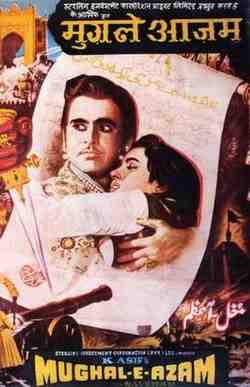
Movie Info
ℹ️ More Movie InfoTrailer
Storyline
Emperor , who does not have a male heir, undertakes a pilgrimage to a shrine to pray that his wife give birth to a son. Later, a maid brings the emperor news of his son’s birth. Overjoyed at his prayers being answered, Akbar gives the maid his ring and promises to grant her anything she desires. The son, , grows up to be spoiled, flippant, and self-indulgent. His father sends him off to war, to teach him courage and discipline. Fourteen years later, Salim returns as a distinguished soldier and falls in love with Nadira, daughter of the maid who brought the emperor news of his son’s birth. Nadira was renamed by the emperor as , meaning pomegranate blossom. The relationship is discovered by the jealous Bahar, a dancer of a higher rank, who wants prince Salim to love her so that she may one day become empress. Unsuccessful in winning Salim’s love, she exposes his forbidden relationship with Anarkali. Salim pleads to marry Anarkali, but his father refuses and imprisons her. Despite her treatment, Anarkali refuses to reject Salim, as Akbar demands. Salim rebels and amasses an army to confront Akbar and rescue Anarkali. Defeated in battle, Salim is sentenced to death by his father, but is told that the sentence will be revoked if Anarkali, now in hiding, is handed over to die in his place. Anarkali gives herself up to save the prince’s life and is condemned to death by . Before her sentence is carried out, she begs to have a few hours with Salim as his make-believe wife. Her request is granted, as she has agreed to drug Salim so that he cannot interfere with her entombment. As Anarkali is being walled up, Akbar is reminded that he still owes her mother a favour, as it was she who brought him news of Salim’s birth. Anarkali’s mother pleads for her daughter’s life. The emperor has a change of heart, but although he wants to release Anarkali he cannot, because of his duty to his country. He therefore arranges for her secret escape into exile with her mother, but demands that the pair live in obscurity and that Salim is never to know that Anarkali is still alive. The wrote a play about the love story of Salim and Anarkali in 1922, based more on a 16th-century legend than on fact. A stage version was soon produced, and screen versions followed. made a silent film, , in 1928, and remade it with sound in 1935. In the early 1940s, the tale of Anarkali inspired producer Shiraz Ali Hakeem and young director K. Asif (Karimuddin Asif) to make another film adaptation which they would title . They recruited four Urdu writers to develop the screenplay and dialogue: Aman ( ‘s father, also known as Amanullah Khan), , , and Ehsan Rizvi. It is not known how the writers collaborated or shared out their work, but in 2010 said that their “mastery over Urdu’s poetic idiom and expression is present in every line, giving the film, with its rich plots and intricate characters, the overtones of a Shakespearean drama.” As the script neared completion, Asif cast , , and for the roles of Akbar, Salim, and Anarkali, respectively. Shooting started in 1946 in studio. The project faced multiple hurdles, which forced its temporary abandonment. The political tensions and communal rioting surrounding stalled production. Shortly after partition, Shiraz Ali migrated to , leaving Asif without a financier. The actor Chandra Mohan suffered a heart attack and died in 1949. Shiraz Ali had previously suggested that business tycoon Shapoorji Pallonji could finance the film. Although Pallonji knew nothing about film production, in 1950 he agreed to finance the film because of his interest in the history of Akbar. Production was then restarted with a new cast. Believing that the film had been cancelled, Kamal Amrohi, one of the scriptwriters who was also a director, planned to make a film on the same subject himself. When confronted by Asif, he agreed to shelve the project. Another unrelated film production based on the same stage play was Nandlal Jaswantlal’s , starring and , which became the highest grossing Hindi film of 1953. Asif had initially rejected Dilip Kumar for the part of Prince Salim. Kumar was reluctant to act in a period film, but accepted the role upon the insistence of the film’s producer. According to Kumar, “Asif trusted me enough to leave the delineation of Salim completely to me.” Kumar faced difficulty while filming in owing to the heat and the body armour he wore. The part of Anarkali had first been offered to , who declined it; was considered for the role but eventually it went to Madhubala, who had been longing for a significant role. Upon signing the film, Madhubala was advancely paid a sum of 1 lakh, which was the highest for any actor/actress at that time. She suffered from , which was one of the reasons why at times she fainted on set; she also endured skin abrasions while filming the prison sequences, but was determined to finish the film. To become the character of Emperor Akbar, Prithviraj Kapoor was reported to have “relied completely on the script and director”. Prior to make-up, Kapoor would declare, ” ” (“Prithviraj Kapoor is now going”); after make-up, he would announce, ” ” (“Akbar is now coming”). Kapoor faced difficulty with his heavy costumes, and suffered blisters on his feet after walking barefoot in the desert for a sequence. Lance Dane, a photographer who was on set during the filming, recalled that Kapoor struggled to remember his lines in some scenes; he mentioned one scene in particular that Kapoor required 19 to get right. At the time of filming, Kapoor who was on a diet, was told by Asif to regain the lost weight for his portrayal of Akbar. Durga Khote was cast as Akbar’s wife Jodhabai, and Nigar Sultana as the dancer Bahar. , who later became a maestro, had initially been considered for the part of the young Prince Salim, but it became the debut role of , who later performed on the song “Mehbooba Mehbooba” from (1975). The of the film, led by art director M. K. Syed, was extravagant, and some sets took six weeks to erect. The film, mostly shot in studio sets designed to represent the interior of a Mughal palace, featured opulent furnishings and water features such as fountains and pools, generating the feel of a Hollywood historical epic of the period. The song ” ” was filmed in Mohan Studios on a set built as a replica of the in the . The set was noted for its size, measuring 150 feet (46 m) in length, 80 feet (24 m) in breadth and 35 feet (11 m) in height. A much-discussed aspect was the presence of numerous small mirrors made of Belgian glass, which were crafted and designed by workers from . The set took two years to build and cost more than 1.5 million (valued at about US$314,000 in 1960), more than the budget of an entire Hindi film at the time. The film’s financiers feared bankruptcy as a result of the high cost of production. Artisans from across India were recruited to craft the props. The costumes were designed by Makhanlal and Company, and -based tailors skilled in embroidery stitched the Mughal costume. The footwear was ordered from , the jewellery was made by in , the crowns were designed in , and blacksmiths from manufactured the armoury (which included shields, swords, spears, daggers, and armour). The zardozi on costumes were also stitched by designers from . A statue of , to which Jodhabai prayed, was made of gold. In the scenes involving an imprisoned Anarkali, real chains were placed on Madhubala. The battle sequence between Akbar and Salim reportedly featured 2,000 camels, 400 horses, and 8,000 troops, mainly from the ‘s Jaipur cavalry, 56th Regiment. Dilip Kumar has spoken of the intense heat during filming of the sequence in the desert of Rajasthan, wearing full armour. Principal photography for began in the early 1950s. Each sequence was reportedly filmed three times, as the film was being produced in / , , and English. The film was eventually in Tamil and released in 1961 as , but that version’s commercial failure resulted in the abandonment of the planned English dubbing, for which British actors were considered. Asif was accompanied by an extensive crew, which included his assistant directors S. T. Zaidi, , (assisting primarily for the English version), and five others. Additional crew members included cinematographer R. D. Mathur, choreographer , production manager Aslam Noori, cameraman M. D. Ayub, editor Dharamavir, makeup artists P. G. Joshi and Abdul Hamid, and sound director Akram Shaikh. Some film sequences were shot with up to 14 cameras, significantly more than the norm at that time. There were many difficulties with the film’s ; cinematographer Mathur reportedly took eight hours to light a single shot. In total, 500 days of shooting were needed, compared to a normal schedule of 60 to 125 shooting days at the time. Owing to the very large size of the Sheesh Mahal set, the lighting was provided by the headlights of 500 trucks and about 100 reflectors. The presence of the mirrors on the set caused problems, as they sparkled under the lights. Foreign consultants, including British director , told Asif to forget the idea since they felt that it was impossible to film the scene under the intense glare. Asif confined himself to the set with the lighting crew, and subsequently overcame the problem by covering all the mirrors with a thin layer of wax, thereby subduing their reflectivity. Mathur also used strategically placed strips of cloth to implement “bounce lighting”, which reduced the glare. Such was the all-round commitment that nobody saw the delay as tiresome. We were experienced enough to know that a film involving such overwhelming craftsmanship, minute detailing, massive gathering of artistes and unit hands, strenuous schedules with large units of artistes and trained animals, day and night shoots cannot be a simple affair. A number of problems and production delays were encountered during filming, to the extent that at one point Asif considered abandoning the project. Kumar defended the long duration of filming, invoking the massive logistics of the film and explaining that the entire cast and crew were “acutely conscious of the hard work [they] would have to put in, as well as the responsibility [they] would have to shoulder.” The production also suffered from financial problems, and Asif exceeded the budget on a number of occasions. The final budget of the film is a subject of debate. Some sources state that cost 10.5 million to produce (about US$2.25 million at the time) while others state that it cost 15 million (about $3 million). This made the most expensive Indian film of the period. A number of estimates put the film’s inflation-adjusted budget at 500 million to 2 billion. The budget situation strained the relationship between Asif and Pallonji, while the production also faced troubled relationships among other crew members; differences crept up between Asif and Kumar when the former married the latter’s sister. Another source of trouble was the romantic relationship and ultimate break-up of Kumar and Madhubala, who had been dating for nine years. ‘s (1953) was the first Indian film to be shot in colour, and by 1957, colour production had become increasingly common. Asif filmed one reel of , including the song “Pyar Kiya To Darna Kya”, in . Impressed by the result, he filmed three more reels in Technicolor, near the story’s climax. After seeing them, he sought a complete re-shoot in Technicolor, but financiers refused. Asif subsequently released partially coloured, although he still hoped to see the full film in colour. By the end of filming, more than a million feet of negative had been used, necessitating significant editing. A number of songs were edited out owing to the running time, which in the end was 197 minutes. Almost half of the songs recorded for the film were left out of the final version. is a family history highlighting the differences between father and son, duty to the public over family, and the trials and tribulations of women, particularly of . According to Rachel Dwyer, author of the book , the film highlights religious tolerance between and . Examples include the scenes of Hindu Queen Jodhabai’s presence in the court of the Muslim Akbar, the singing of a Hindu devotional song by Anarkali, and Akbar’s participation in the celebrations, during which Akbar is shown pulling a string to rock a swing with an idol of Krishna on it. Film critic Mukul Kesavan has remarked that he was unable to recall a single other film about Hindu-Muslim love in which the woman (Jodhabai) is Hindu. Scholars Bhaskar and Allen described the film as a of “Islamicate culture”, evidenced in its ornate sets, musical sequences such as the scene, and chaste Urdu dialogues. Throughout the film there is a distinct depiction of Muslims as the ruling class who not only dressed differently but also spoke in complex dialogue. They are made to appear “distinct and separate from the mainstream.” Film scholar Stephen Teo posits that is a “national allegory”, a stylistic way of appropriating history and heritage to emphasise the national identity. He believes the arrogance of Bahar represents the power of the state and that Anarkali’s emotion, which is highly personal, represents the private individual. Teo states that the theme of romantic love defeating social class difference and power hierarchy, as well as the grandeur of the filming, contribute to the film’s attractiveness. Author has commented on the poetic quality of the dialogue, saying that “the characters of do not just speak – they refine communication, they distil it, they crystallize it into many faceted glittering gems, they make poetry of ordinary language.” Gowri Ramnarayan of has also emphasised the power of the dialogues in the film, in that they “create not only the ambiance of this period drama, but also etch character and situation. Every syllable breathes power and emotion.” , a scholar at the , has stated that while the theme of the conflict between passionate individual love and family duty may be very common in Hindi film making, with endless cinematic permutations, K. Asif’s “excessive elaboration of the theme remains in a class by itself.” Further, Emperor Akbar struggles between his personal desires and his duties to the nation. Ashis Nandy noted that apart from the conflict between Akbar and his son, there is also an “unwritten alliance” between Akbar and Bahar that compounds the problems of Anarkali. He also thought it highlighted the “idea of justice and the notion of unconditional love” to uphold tradition. The song “Pyar Kiya To Darna Kya” sung by Anarkali was an indication of her defiance of societal norms. A major difference from the original story is that while the earlier Anarakali films based on Imtiaz Ali Taj’s story ended as tragedies, K. Asif created a relatively happy ending in that Akbar gives amnesty to Anarkali by allowing her to escape through a secret route of tunnels below a false bottom of her prison wall, although his son is made to suffer in believing her to have perished. The film is based on a legend, but it is given credence by at least two texts that assert Anarkali’s existence during the historical period of Emperor Akbar (1556–1605). One of the books states that in 1615 in by Salim, when he had become Emperor Jehangir. On the tomb is a Persian inscription that reads: (“Ah! could I behold the face of my love once more, I would give thanks to my God until the day of resurrection”). The author of the stage play on which the film is based, Imtiaz Ali Taj, believed that the legend had no historical base, but historians have suggested that Anarkali may have been a painter, a dancer, or a courtesan, or one of Akbar’s wives and the mother of Salim’s half-brother Prince Daniyal. While an earlier film version of the story, (1952), contained a disclaimer stating that the story had no foundation in history, made no such claim. takes numerous liberties with historical fact. Historian says that although the real Salim was a heavy consumer of alcohol and opium from the age of 18, he was not necessarily a mischievous boy, as depicted in the film. When the film’s Salim returns from his time in the military, he is depicted as a gentle and romantic hero, in contrast to the real Salim, who was documented as a brutal drunk who would often beat people to death. The real Salim did lead a rebellion against his father, tried to replace him as emperor, and had Akbar’s friend murdered in 1602, but the film ascribes these actions to his desire to marry Anarkali, which is historically inaccurate. Further, there were also discrepancies in sets, costumes, and music of the film. The Sheesh Mahal, actually the royal bath of the queen, was depicted in the film as a dancing hall, and much larger. Music and dancing styles from the 19th century were depicted, although the story takes place in the 16th century. For example, , a semi-classical music form developed in the 19th century, is adopted in a dance sequence in style, which is a 16th-century dance form. The soundtrack was composed by music director , and the lyrics were written by . After conceiving the idea of the film, Asif visited Naushad and handed him a briefcase containing money, telling him to make “memorable music” for . Offended by the explicit notion of money as a means of gaining quality, Naushad threw the notes out of the window, to the surprise of his wife. She subsequently made peace between the two men, and Asif apologised. With this, Naushad accepted the offer to compose the film’s soundtrack. As with most of Naushad’s soundtracks, the songs of were heavily inspired by and , particularly such as , , used in the composition of “Pyar Kiya To Darna Kya”, and , used in “Bekas Pe Karam Keejeye”. He also made extensive use of western classical orchestras and choruses to add grandeur to the music. The soundtrack contained a total of 12 songs, which were rendered by and classical music artists. These songs account for nearly one third of the film’s running time. The painter was lured away from ‘s to paint the posters. Kamble also created cinema displays at theatre. Asif needed to buy all available stocks of Winsor & Newton paint in India at a cost of 6 lakh to enable Kamble to produce quality art for his hoardings. Kamble, who was offered a large sum of 8 lakh for his work on the stills of , did not receive any compensation in the end due to fraud. “Asif’s logic was very clear – he had made a film which everyone associated with it would be proud of for generations. And he was proved right.” At the time of the release of , a typical Hindi film would garner a distribution fee of 300,000–400,000 (about US$63,000–84,000 in 1960) per territory. Asif insisted that he would sell his film to the distributors at no less than 700,000 per territory. Subsequently, the film was actually sold at a price of 1.7 million (US$356,000) per territory, surprising Asif and the producers. Thus, it set the record for the highest distribution fee received by any Hindi film at that time. The premiere of was held at the then-new 1,100-capacity Maratha Mandir cinema in . Mirroring the nature of the film, the cinema’s had been decorated to resemble a Mughal palace, and a 40-foot (12 m) cut-out of Prithviraj Kapoor was erected outside it. The Sheesh Mahal set was transported from the studio to the cinema, where ticket holders could go inside and experience its grandeur. Invitations to the premiere were sent as “royal invites” shaped like , which were written in Urdu and made to look like the , the official chronicle of the reign of Akbar. The premiere was held amidst great fanfare, with large crowds and an extensive media presence, in addition to hosting much of the film industry, although Dilip Kumar did not attend the event owing to his dispute with Asif. The film’s reels arrived at the premiere cinema atop a decorated elephant, accompanied by the music of and . The day before bookings for the film opened, a reported crowd of 100,000 gathered outside the Maratha Mandir to buy tickets. The tickets, the most expensive for a Hindi film at that time, were dockets containing text, photographs and trivia about the film, and are now considered . They sold for 100 (valued at about US$21 in 1960), compared to the usual price of 1.5 (US$0.31). Bookings experienced major chaos, to the extent that police intervention was required. It was reported that people would wait in queues for four to five days, and would be supplied food from home through their family members. Subsequently, the Maratha Mandir closed bookings for three weeks. was released on 5 August 1960 in 150 cinemas across the country, establishing a record for the widest release for a Hindi film. It became a major commercial success, earning 4 million (US$839,000) in the first week, eventually earning a net revenue of 55 million (US$11,530,000), and generating a profit of 30 million for the producers. also experienced a long theatrical run, screening to full capacity at the Maratha Mandir for three years. The film thus became the by surpassing (1957), and retained this record until (1975) surpassed its net revenue. In terms of gross revenue, earned ( ). According to of in 2009, was the highest-grossing Hindi film of all time if adjusted for inflation. According to the online box office website in January 2008, the film’s adjusted net revenue would have amounted to , ranking it as an “All-Time Blockbuster”. According to Box Office India in June 2017, may have had more than 100 million footfalls at the domestic box office more than films like (1994) and (2017). According to financial newspaper , the adjusted net income of is equivalent to ( ) in 2017. In 2011, it was ranked as the highest grossing Hindi film by a distance, when adjusted to -price inflation by with adjusted nett gross of ₹1234.95 crore. The list was compiled using the relative price of gold in different years to arrive at a hypothetical current value of box-office collections of past films, which as per the trade magazine was a more appropriate measure of comparison as compared to official ticket-price inflation rates. received universal acclaim from Indian critics; every aspect of the film was praised. A review dated 26 August 1960 in called it a “history-making film … the work of a team of creative artists drawn from different spheres of the art world”. It was also described as “a tribute to imagination, hard work and lavishness of its maker, Mr. Asif. For its grandeur, its beauty, and then performances of the artists it should be a landmark in Indian films.” Another contemporary review from focused on the acting and dancing “gifts” of Madhubala. Since 2000, reviewers have described the film as a “classic”, “benchmark”, or “milestone” in the history of Indian cinema. In 2011, called it “the best Hindi film ever made” and “the apotheosis of the Hindi film form”, noting specifically the performances, father-son drama and song sequences. of called the film a must-see classic, saying “a work of art is the only phrase to describe this historical whose grand palaces-and-fountains look has an epic sweep and whose heart-wrenching core of romance has the tenderness of a feather’s touch.” Sujata Gupta of gave the film nine out of ten stars, calling it a “must see” that “has captured interest of people over generations”. K. K. Rai, in his review for stated, “it can be said that the grandeur and vintage character of cannot be repeated, and it will remembered as one of the most significant films made in this country.” Ziya Us Salam of described as a film people will want to watch over and over again. Raja Sen of Rediff compared the film to (1960) and said, ” is awesomely, stunningly overwhelming, a magnificent spectacle entirely free of CGI and nonlinear gimmickry, a gargantuan feat of … of … well, of Mughal proportions!” Laura Bushell of the rated the film four out of five stars, considering it to be a “benchmark film for both Indian cinema and cinema grandeur in general”, and remarking that was an epic film in every way. Naman Ramachandran, reviewing the film for the , noted the depiction of religious tolerance and said the film had a tender heart. , author of , compared the film to the diamond for its enduring worth to Indian cinema. , in 2008, and , in 2011, both declared that the scene in which Salim brushes Anarkali with an ostrich feather was the most erotic and sensuous scene in the history of Indian cinema. At the 1961 , won the . In the 1961 , was nominated in seven categories: , (Asif), (Madhubala), (Mangeshkar), (Naushad), (Mathur), and (Aman, Wajahat Mirza, Kamaal Amrohi, and Ehsan Rizvi), winning the awards for Best Film, Best Cinematography, and Best Dialogue. was the first black-and-white Hindi film to be and the first to be given a theatrical re-release. The Sterling Investment Corporation, the negative rights owner and an arm of the , undertook and colourisation of and assigned Deepesh Salgia as Project Designer and Director. They initially approached Hollywood executives for help, but found the sales quotations, ranging from $12–15 million, too high. In 2002, Umar Siddiqui, managing director of the Indian Academy of Arts and Animation (IAAA), proposed to enhance it digitally at a fraction of the cost. To convince the Shapoorji Pallonji Group, one of India’s wealthiest companies, of the commercial viability of the project, the IAAA colourised a four-minute clip and showed it to them. They approved and gave the project the go-ahead. Shapoorji Mistry, grandson of producer Shapoorji Pallonji Mistry, thought it a fitting tribute to complete his grandfather’s unfinished dream of colourising the entire film. The first step towards colourisation was the restoration of the original , which were in poor condition owing to extensive of the negative during the original theatrical release. Costly and labour-intensive restoration was essential before colourisation could be carried out. The negative was cleaned of fungal growth, damaged portions were restored, and missing parts of frames were re-instated. After cleaning, each of the 300,000 of the negative was scanned into a 10 -sized file and then was digitally restored. The entire restoration work was undertaken by Acris Lab, Chennai. The dialogues in the original soundtrack were also in a bad state of preservation, which necessitated having the sound cleaned at Chace Studio in the United States. The background score and the entire musical track was recreated by Naushad and Uttam Singh. For the songs, the original voices of the singers like Lata Mangeshkar, Bade Ghulam Ali Khan and Mohammed Rafi were extracted from the original mixed track and the same were recreated with re-recorded score in 6.1 surround sound. The process of colourisation was preceded by extensive research. The art departments visited museums and studied the literature for background on the typical colours of clothing worn at that time. Siddiqui studied the technology used for the colourisation of black-and-white Hollywood classics. The team also approached a number of experts for guidance and suggestions, including Dilip Kumar, production designer , and a historian from the in Delhi. To undertake the colourisation, Siddiqui brought together a team of around 100 individuals, including computer engineers and software professionals, and organised a number of art departments. The entire project was co-ordinated by Deepesh Salgia, who partnered with companies including Iris Interactive and Rajtaru Studios to execute the colourisation. The task was controlled and supervised by the producers, who received daily updates and progress reports. The colourisation team spent 18 months developing software for colouring the frames, called “Effects Plus”, which was designed to accept only those colours whose would match the shade of grey present in the original film. This ensured that the colours added were as close to the real colour as possible; the authenticity of the colouring was later verified when a costume used in the film was retrieved from a warehouse, and its colours were found to closely match those in the film. Every shot was finally hand-corrected to perfect the look. The actual colourisation process took a further 10 months to complete. Siddiqui said that it had “been a painstaking process with men working round the clock to complete the project.” The exact cost of the colourisation is disputed, with a wide variety of estimates ranging from (US$240,000) to 50 million, or 100 million. The film’s colour version was released theatrically on 12 November 2004, in 150 prints across India, 65 of which were in . The new release premiered at the in Mumbai. Dilip Kumar, who had not attended the original premiere, was in attendance. The colour version was edited to a running time of 177 minutes, as compared to the original version’s 197 minutes. The new release also included a digital reworked soundtrack, produced with the assistance of Naushad, the original composer. The release on the festive weekend came with three other major releases: , , and . It became the 19th highest grossing Hindi film of the year, behind and (the top grosser), but ahead of . became the first full-length feature film colourised for a theatrical re-release; although some Hollywood films had been colourised earlier, they were only available for home media. It was subsequently selected for seven international film festivals, including the . Upon release, the film drew crowds to the cinemas, with an overall occupancy of 90 per cent. Subsequently, it completed a 25-week run. While some critics complained that the colours were “psychedelic” or “unnatural”, others hailed the effort as a technological achievement. Film critic Kevin Thomas of the remarked that while colourising was not a good idea for most black-and-white classics, it was perfect in this particular instance. He compared it to films by and to (1939) for its larger-than-life storytelling. said that although the new version was an improvement, “the fake colours tend to look flat and brash, detracting from cinematographer RD Mathur’s elegantly composed shots.” The BBC’s Jaspreet Pandohar, observing that the film was “restored in appealing candy-colours and high quality sound”, considered it a “cross between and “. Other critics have said that they prefer the black and white version. In 2006, became only the fourth Indian film certified for showing in Pakistan since the , and was released with a premiere in . It was distributed by Nadeem Mandviwala Entertainment, at the request of Asif’s son, Akbar Asif. is one of only two films directed by Asif; one of his unfinished projects was released posthumously as a tribute. Over time the title has become part of Hindi film vernacular, used to describe a project that is taking too long to complete. Art director Omung Kumar, who has designed sets for major Indian films such as (2005) and (2007), said that he and others in his field look to as a source of inspiration for art direction. It has also been used as a model for the perfect love story, requiring directors to ensure lovers overcome obstacles. Following her success in the film, Madhubala could have gone on to land further major roles, but she was advised not to overwork owing to her heart condition, and had to withdraw from some productions that were already underway. in 2013 cited as a “landmark of cinema” despite its historical inaccuracies, and the BBC stated in 2005 that it is “widely considered one of Bollywood’s most iconic films”. Imtiaz Ali of in 2010 called it the “most proto-typical, high involvement, expensive, passionate piece of work that Hindi cinema has ever produced”, one that “set the standard for everything that will ever come after it”. It continues to be regarded by critics as the Indian equivalent of . Filmmaker was quoted in 2010 as saying that a film like this could never be repeated: ” is an all-time classic and has been the ultimate love story in Hindi cinema at all levels. So it will always remain alive for generations to come.” To commemorate the film’s anniversary, the actor and producer had his company produce a documentary video titled . Hosted by Khan, it includes interviews with Asif’s family and Hindi film stars. Artist created a series of paintings for the video, in which he re-imagined some memorable scenes. Interested in preserving the film for future generations, Khan noted that his father was originally cast in the film but did not complete it. When asked if should be remade, he retorted: “It is the mother of all films; mothers cannot be remade”. No sequels have been made,
Details
Reviews
There are no reviews yet. Be the first one to write one.