
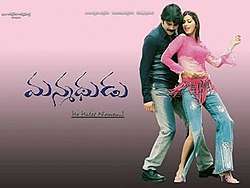
0
0 out of 5 stars (based on 0 reviews)
Excellent
Very good
Average
Poor
Terrible
Your Rating for
Manmadhudu
Streaming On
Trailer
https://www.youtube.com/watch?v=mf7sk4IydGo
Soundtrack
Storyline
<p>Abhiram is a manager at an who harbours a deep disdain for women, which he openly expresses every day. His workplace, however, is filled with women, forcing him to navigate this uncomfortable environment. Prasad, the chairman of the company and Abhiram’s paternal uncle, appoints Harika as a new assistant manager. Abhiram resents her presence and begins to bully her, even going as far as bugging her desk to steal her idea for a lipstick advertisement. He belittles her and accuses her of being careless in her work. Eventually, Harika, fed up with Abhiram’s abuse, decides to resign and approaches Prasad to submit her resignation. Prasad, sympathising with her, asks her to reconsider and reveals the reasons behind Abhiram’s hatred for women. He explains that Abhiram lost his parents at the age of two and was raised by his grandfather. As the only heir to his family business, Abhiram lived a carefree life until he met Maheswari, the niece of the family’s accountant. Abhiram fell in love with her, but Maheswari’s uncle, fearing that Abhiram was not serious about her, took her away and arranged her engagement with another man. Abhiram, angered by this, interrupts the engagement ceremony and insists that he intends to marry Maheswari. However, during a car ride with Maheswari, they are involved in an accident, leaving Abhiram unconscious. When he wakes up, his grandfather tells him that Maheswari has gone ahead with the marriage, and Abhiram feels betrayed. This event shapes his belief that all women are superficial and untrustworthy. After learning about Abhiram’s painful past, Harika decides to stay at the company. As a result, Prasad promotes Harika to manager and demotes Abhiram to assistant manager. Although upset, Abhiram is forced to accompany Harika on a business trip to . While working together, Harika helps Abhiram overcome his fear of deep water, and they grow closer. Abhiram begins to develop feelings for Harika, but his emotions are complicated when she reveals that she is engaged to be married. Upon their return to India, Abhiram becomes withdrawn and childish, unable to cope with his disappointment. Meanwhile, Harika, who reciprocates his feelings, remains uncertain about marriage, as Abhiram has not expressed his emotions toward her. Abhiram’s aunt later reveals that Maheswari died in the car accident, and that the family had concealed her death, fearing that Abhiram would be unable to handle the news. Overcome with guilt for hating women, Abhiram is too shocked to confess his feelings to Harika. On the morning of Harika’s wedding, she calls Abhiram to inform him that the marriage is her parents’ decision, not hers, and indirectly signals that she is open to being with him if he expresses his feelings. Prasad, noticing the mutual affection between Abhiram and Harika, encourages Abhiram to confess. However, Abhiram insists that it is Harika who should speak first, as his previous attempts at taking the lead in a relationship ended in heartbreak. Harika eventually confesses her feelings over the phone, but due to a network issue, Abhiram is unable to respond. Believing that he has rejected her, Harika decides to go through with the wedding. Abhiram, determined to stop the wedding, rushes to the wedding venue but finds that Harika and her party are already far off on a boat. In a moment of courage, he jumps into the river and swims toward the boat. Harika, seeing Abhiram in the water, jumps in to join him. Overjoyed, she breaks off her engagement and marries Abhiram. In a , during their first night together, Harika recalls realising their connection when Abhiram’s lipstick ad concept matched hers. Abhiram admits he had placed a bug under her desk to steal her idea. Harika playfully scolds him and gives him a lighthearted punch. After the success of (2001), actor and producer offered director and writer the opportunity to work on a new film, which resulted in the making of . The film was conceived with Nagarjuna in mind for the lead role. Vijaya Bhaskar and Trivikram worked together to craft a fresh narrative that would highlight Nagarjuna’s romantic persona while introducing a unique character trait: a protagonist who dislikes women. This premise formed the core of the film’s story. The story is set in an , an unexplored backdrop in that adds humour and character interaction without delving deeply into industry specifics. The hero’s disdain for women is explained through a subplot, providing context for his behaviour. To create an engaging dynamic, the hero’s workplace is populated by female employees, leading to comedic situations and conflicts. The female lead is portrayed as a strong character who frequently challenges the hero. She starts as an assistant manager and is later promoted to a higher position than the hero, establishing a “tit-for-tat” relationship between them. The plot further developed as the story shifted abroad, where the hero and heroine, working in the same agency, were given opportunities to spend time together. This setting allowed for the gradual development of romantic feelings, despite their initial animosity. The hero’s attitude toward women evolves in phases, with the narrative maintaining a smooth flow to ensure the changes feel natural to the audience. The climax of the film is intentionally simple, avoiding typical action sequences. The story concludes with the resolution of the protagonists’ feelings for each other. A post-climax scene introduces the “mike experiment” subplot, offering closure to the narrative. The filmmakers chose not to extend the film with unnecessary scenes, such as the introduction of the heroine’s fiancé, keeping the focus on the main characters and their love story. The story primarily focuses on romance and comedy, with only two key scenes highlighting Nagarjuna’s mass appeal. The storyline of bears resemblance to ‘s novel , which was also adapted into a film of the same name in 1981. In both, the protagonist becomes misogynistic after the death of his lover. Some scenes were inspired by the 2000 American film . A set resembling a corporate advertising agency was built on the first floor of by Srinivasa Raju. The set featured enlarged advertisements from magazines, backlit to enhance their appearance. A large vinyl poster of and was placed opposite the agency’s building to simulate its location near Birla Mandir. The building’s entrance featured an A-shaped glass door, symbolizing the letter “A” from the character name Abhi. Filming also took place in , , and the Godavari districts in India. In Paris, the crew faced difficulties obtaining permission to film on the due to heightened security after the . Initially, the team was permitted to shoot only in front of the tower. However, with significant effort from Nagarjuna, the necessary permissions were secured, reportedly making the first Indian film to shoot inside the Eiffel Tower. The climax was filmed in , where Nagarjuna performed a stunt by jumping into a river without a . Before the jump, he ensured the safety of the location with a local expert and was informed about the water’s depth. Known for his love of swimming, Nagarjuna chose to do the stunt himself. During the shot, he briefly stayed underwater to create dramatic tension, which concerned the crew. The local expert, worried about his safety, jumped in after him. As a result, the scene had to be cut shorter than originally planned. The songs “Naa Manasune” and “Gundello Emundo” were filmed in . The song “Don’t Marry Be Happy” was the last to be filmed during the final schedule. Shankar choreographed the flashback song “Nenu Nenuga Lene,” while Raja Sekhar worked on “Don’t Marry” and “Andamaina Bhamalu.” choreographed the “Naa Manasune” and “Gundello Emundo.” The final song, “Chelia Chelia,” was directed by K. Vijaya Bhaskar, with Krishna Reddy handling the dance sequences. The costumes for Nagarjuna were designed by , and Sonali Bendre’s outfits were styled by . The music for the film was composed by . The soundtrack was released under the Sohan Audio label. Five out of six songs had lyrics by . Sitarama Sastry introduced an experimental structure with the song “Don’t Marry”. Unlike traditional compositions, the song features a and a narrative (katha) instead of conventional . The narrative portion lacks a fixed , making it a unique addition to the soundtrack. The soundtrack was released on 6 December 2002. The audio launch event was held at an open dais outside the Glass House at Annapurna Studios. The function was attended by 450 winners of a contest conducted by . The event was anchored by singer . A critic from described Devi Sri Prasad’s music as “average-to-good tunes with proper orchestration,” highlighting the interludes with classical instruments. The film was released with 90 prints. Nagarjuna in an interview with in 2019 revealed that it was an above average grosser. The film had a re-release in on 29 August 2023 on the eve of Nagarjuna’s birthday. Jeevi of rated the film 4.5 out of 5 stating, “Nagarjuna dominated the show and won accolades from audiences. It’s a must recommended hilarious film for all Telugu film lovers.” gave an extremely positive review and wrote, “Though the story is wafer thin, the director has been able to package the film well with an innovative presentation. The film is out to wallop some fun ‘n’ frolic.” It gave a verdict that it is a “Rip-Roaring Entertainer”. Kiran Nadella of rated the film 7.5 out of 10 stating, “All things considered, if you can stomach the thirty minutes of echoing flashback, Manmathudu makes for one intense and rousing entertainment, and if you’re on its quirky wavelength, it might just strike you as one of the funniest movies you’ve ever seen!” wrote, “Vijayabhaskar strengthens the weak storyline with his taking aided by Trivikram’s pen-power and Devisri Prasad’s music. A movie that can be a good pastime, and can be worth a watch, or even more for fans of Nagarjuna”. ’s blend of satire, quirky characters, and memorable dialogues has kept it relevant over the years. Its witty “counters” became iconic and continue to be frequently referenced in memes and discussions within the Telugu film community. The film introduced memorable moments, such as the escalator scene and Nagarjuna’s interactions with his co-stars, which remain popular in popular culture. The title “Manmadhudu” became closely associated with Nagarjuna, while Trivikram Srinivas further solidified his position as a prominent writer in Tollywood with this film. The film was later remade in as (2006), which marked the debut of , and also remade in as (2006). A to the film, titled , also starring Nagarjuna, was released in 2019.</p>
Details
🎬
Genres:
Drama
✍️
Writer:
👤
Producer:
Nagarjuna Akkineni
🎵
Music:
🎬
Director:
K. Vijaya Bhaskar
📸
Cinematography:
Sameer Reddy
👥
Starring:
Nagarjuna Akkineni, Sonali Bendre, Anshu
📅
Release Date:
20-Dec-02
✂️
Edited By:
A. Sreekar Prasad
💸
Budget:
🏭
Production Company:
📺
OTT Platform:
⏱️
Runtime:
🗣️
Language:
Telugu
💵
Box Office:
14.00 crore
🌐
Other Languages:
📄
Screenplay:
🔒
Censorship:
Reviews
There are no reviews yet. Be the first one to write one.