
0
0 out of 5 stars (based on 0 reviews)
Excellent
Very good
Average
Poor
Terrible
Your Rating for
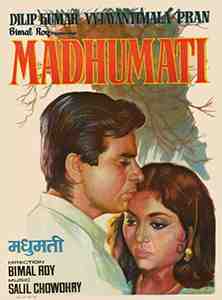
Madhumati
Streaming On
Trailer
https://www.youtube.com/watch?v=6-oDTR_gJlI
Soundtrack
Storyline
<p>On a stormy night, engineer Devendra drives down a hill road with his friend to fetch his wife and child from a railway station. A landslide blocks their path and they take shelter in an old mansion. Devendra finds the house eerily familiar. In the large front room, he finds an old portrait, which he recognizes. He’s joined by his friend and the old caretaker. Devendra, experiencing flashbacks of another life, sits down to tell his story while the storm rages outside. Anand is the new manager of Shyamnagar Timber Estate. An artist in his spare time, he travels to the hills and falls in love with Madhumati, a tribal woman whose songs have haunted him from a distance. Anand’s employer, Raja Ugra Narain is a ruthless, arrogant man; Anand, who refuses to bend to his will unlike others, is on the receiving end of his wrath. Anand has enemies among his staff. After he’s sent away on an errand, he returns to find that Madhumati has disappeared. He learns that she has been taken to Ugra Narain and confronts him, but his men beat him unconscious. While taking Anand’s body out of the palace, they come across Madhumati’s father, who fights to stop his own daughter’s death. Although he comes out on top in the fight, he dies on the road shortly after, while Charandas hides and takes Anand’s body to a hospital. Anand lives but his mind wanders. One day, he meets a woman who looks exactly like Madhumati. She introduces herself as Madhavi but Anand refuses to believe her. He tries to reason with her and is beaten by her companions. Later, Madhavi finds a sketch of Madhumati and realizes Anand was telling the truth. She takes the sketch with her and tries to learn his story. Meanwhile, Anand is haunted by the spirit of Madhumati, who tells him Ugra Narain is responsible for her death. He appeals to Madhavi, who agrees to pose as Madhumati before Ugra Narain and make him confess to her murder. Anand returns to Ugra Narain’s palace and seeks permission to paint a portrait of him the next evening. The day after, at the stroke of eight, Ugra Narain sees Madhavi posing as Madhumati in front of him. Ugra Narain is shaken; he confesses his part in her death and is arrested by police waiting outside the room. Anand realizes that the questions Madhavi posed to Ugra Narain, especially about Madhumati ‘s burial place, were things she could not have known; even Anand did not know. Madhavi smiles and moves towards the stairs. The real Madhavi, dressed as Madhumati, then rushes into the room. She is late because her car broke down on the way. Anand realizes he saw Madhumati’s ghost and not Madhavi. He runs to the terrace, where the ghost beckons to him. Madhumati had fallen from the same terrace, trying to escape Ugra Narain. Anand follows the ghost and falls to his death. After telling the story of Anand and Madhumati, Devendra receives news that the train on which his wife was traveling has met with an accident. The road is cleared and they rush to the station. Devendra walks through the station fearing the worst but is relieved to see his wife Radha, emerging from the train unharmed. Radha is the reincarnation of Madhumati, and Devendra informs her, based on his recent recollections, that they have been partners through several births. ‘s 1955 film was commercially unsuccessful, jeopardising his company Bimal Roy Productions; he needed a commercial success to survive. The story of was written by the Bengali filmmaker . He shared the story with Roy, who immediately liked it and started developing the film with Debu Sen as the assistant director. The dialogues were written by in the . Manohari Singh was selected for composing the film’s music after Roy heard him playing in Kolkata. Roy had previously signed Vyjayanthimala and Dilip Kumar for two films. The first, , based on the , received much critical acclaim and a despite being commercially unsuccessful. Kumar and Vyjayanthimala were selected to play the lead roles in . The former was eager to work again with Roy after their previous film and accepted the role. Vyjayanthimala agreed to work on the film after learning that was a part of the cast. Unlike another film noir, which was mostly filmed indoors, Roy decided to film outdoors and at a hill station. It had a six-week schedule at a location in , . Some scenes were filmed in near Nainital. When the negatives were developed, most of the footage was found to be . Since a reshoot in far-away Uttarakhand was not possible, sets were created near , . The art direction team, led by , created fake pine trees, which were planted to match the location in Nainital. A large part of the film was filmed in , a small forested area in Mumbai. A scene in which Dilip Kumar looks for Vyjayanthimala in the woods was filmed in Igatpuri. The foggy effect was recreated using gas bombs. The costumes of the film were designed by Yadugiri Devi, Vyjayanthimala’s grandmother; these were later approved by the art director Sudhendu Roy. Vyjayanthimala wore silver jewelry from her collection in the film. The actress had also hurt her foot while dancing. Due to s extensive outdoor shooting, the film went over budget by 8.1 million, adding to the troubles of Bimal Roy Productions, which organized a film preview and lunch for the distributors. Roy told them about the company’s financial problems and that he had decided to forego 70,000 of his director’s fee to make up for the loss. All of the distributors pitched in with money and made up for the deficit. Film critics and academics have analyzed in several ways. In the book , said reviewers of the late 1950s had described the film’s theme as “a conventional plot, a typical Hindi [f]ilm [p]otboiler, in which the hero experiences a sense of déjà vu leading to his flashback of a former life”. In the book , Vijay Mishra states that the film has a “gothic noir” feel. According to Mishra, there is a more direct relationship between rebirth, spirits, and ghosts, which naturalizes the Indian Gothic. Analysts from the compare the initial meeting of the main characters, stating that it resembles the meeting in ‘s film (1984), where the woman “stands in for nature and unspoiled folk tradition and the villain for exploitative ( ) culture, with the hero as an intermediary”. They also write, “Anand’s own progressivism, coupled with his sympathy for Madhumati and her family, soon sets him on a collision course with the Raja, who takes revenge through a malevolent scheme”. According to Jayson Beaster-Jones and Natalie Sarrazin, was one of the first Hindi films to use the now-common “narrative of the plain-based hero entering the mountains and being seduced by a tribal girl.” Rajadhyaksha said the imagery is similar to that of the film (1957), writing that links “the beautiful Madhumati with nature and tribal cultures beyond the grasp of capitalist appropriation”. Film critic Bharati Pradhan said stepped away from “the standard Roy themes of as seen in his (1953), (1954) and (1955)”. The soundtrack features 11 songs composed by . wrote the lyrics and Mukesh, Lata Mangeshkar, Manna Dey, Mohammed Rafi, Mubarak Begum, Asha Bhosle, Sabita Chowdhury, Ghulam Mohammed, and Dwijen Mukhopadhyay provided the vocals. The music was composed before the lyrics were written. Folk music sung in the tea gardens of was used in the soundtrack and Polish folk music was used for the song “Dil Tadap Tadap Ke Keh Raha Hai”, which was adapted from the 18th century Silesian song “Szla Dzieweczka do Gajeczka”. The song “Aaja Re Pardesi” was adapted from the background score of (1956). , writing for , said, “The music and the tonal correctness of the performances hold us in thrall”. The soundtrack of became the best-selling Hindi film soundtrack of 1958. Salil Chowdhury won his first for . is one of the most popular songs by recording artist Mukesh and is regularly played at functions. Filmfare started giving the best playback singer award in this year and won this award for the song “Aaja re Pardesi”. She thus became the first singer ever to win the Filmfare award for a playback singer since, in the beginning, there was only one award given to a playback singer, male and female singers included. All lyrics are written by ; all music is composed by . premiered at the Roxy Cinema near on 12 September 1958; the film was a huge blockbuster and helped Bimal Roy Productions recover its losses. It became the first Indian film to be released abroad after its release in the Theatre in . According to Gowri Ramnarayan of , “Dilip Kumar faced the camera, while Soviet actress Tatyana Konjuchova, switched on the camera. Polish actress acted as clapper-boy.” On 18 April 2010, the film was screened at the for the Dignity Film Festival held in Chennai; other films also screened included (1964), (1964), (1966) and (1968). was the . It grossed ( ), including a of . Adjusted for inflation, its gross was equivalent to $92 million ( ) in 2016. Writing for , Dinesh Raheja noted how “beguile[s] the senses” while describing it as “the grandmother of such famous reincarnation films (1967), (1976), (1980), (1981), (1988), (1995)” and (2007)” . Writing for , calls “poetry in black-and-white” and praises Roy, writing “the songs and their picturization – Bimal Da’s mastery exudes in every frame”. She described the song as “mysterious and melancholic”. According to of , the film sustains its suspense even with the flashback-within-the-flashback frame story, has socio-realistic themes, and is similar to the films (1940) and (1958). Lutgendorf praised the performances of Kumar and Vyjayanthimala, and said, “Kumar gives an appropriately haunted performance as the two incarnations of Devendra / Anand, and Vyjayanthimala is alternately earthy and ethereal in the various permutations of the title character”. from praises Chowdhury’s music, calling it the “soul of the movie” and “enchanting and timeless”. Writing for , Karan Bali commended Roy’s ability to “recreate just the right mood and ambiance”, especially praising few scenes as “luscious romantic interludes outdoors or the swinging chandeliers”, “dark shadows within the haveli” and “several documentary like establishing shots”. Bali’s view is shared by Manisha Lakhe of , who wrote, “Bimal Roy’s masterstrokes are evident when you watch the long shadows of trees falling on that stone with fascination”. led the with 12 nominations and won 9 awards, a record it held for 37 years. Since its release, it had multiple screenings at the Tenth Bite – The Mango Film Festival (2004), the 4th (2006) and the (2011). Vyjayanthimala become the first ever actor to receive dual nominations in an acting category in the for her work in and , winning for the latter. The nominations also makes her the first-ever multi-nominee across all categories, a record she shares with . This win also makes her the first performer in Filmfare history to win in both leading and supporting categories. The film got music director Salil Choudhary and playback singer Lata Mangeshkar, their career-first Filmfare awards respectively. Before this there was no Filmfare award for female playback singers. was selected as for at the , but it was not nominated. intricate web of reincarnation, suspense and thrill against a traditional romantic setup between Dilip Saab and Vyjayanthimala, treated with gorgeous cinematography and exquisite songs, continues to inspire Bollywood to this date. — Sukanya Varma of Rediff.com on became a source of inspiration for many later works dealing with reincarnation in , , and perhaps . According to , is one among the top three or four romantic films ever made in Hindi cinema. He was quoted by Akshay Manwani of as saying, “Even after Bimal Roy’s death, s success provided for his family. The earning from this film continue[s] even today. It is a terrific film.” According to Vyjayanthimala, who played the film’s titular character, was one of the “most memorable films” of her career. Wendy Doniger believes that may have inspired the American film (1975), which in turn was remade into the Hindi film (1980); both of them dealt with reincarnation and have been influential in their respective cultures. Karan Bali notes that the famous “crossing of paths” in (1995), where and cross each other’s paths without noticing the other until the end of the sequence, is present in , which was produced 37 years earlier. Parts of the Hindi film (2007) including the whole climax sequence were heavily inspired from , which led to Bimal Roy’s daughter accusing the latter film’s producers of plagiarism and threatening them with legal action. In celebration of the 50th anniversary of the film, the Bimal Roy Foundation, headed by Roy’s daughter , hosted a screening of at the Globus Cinema in Mumbai on 11 April 2008. The occasion saw the reunion of the film’s cast, including Vyjayanthimala. Subsequently, Bhattacharya published a book about the making of the film, titled .</p>
Details
✍️
Writer:
Bengal Famine, (1943), Udayer Pathey, (1944), Hamrahi, (1945), Anjangarh, (1948), Mantramugdha, (1949), Pehla Aadmi, (1950), Maa, (1952), Do Bigha Zamin, (1953), Parineeta, (1953), Naukari, (1954), Biraj Bahu, (1954), Baap Beti, (1954), Devdas, (1955), Yahudi, (1958), Madhumati, (1958), Sujata, (1959), Parakh, (1960), Nader Nimai, (1960), Immortal Stupa, (1961), Prem Patra, (1962), Bandini, (1963), Life and Message of Swami Vivekananda, (1964)
👤
Producer:
Bimal Roy
🎵
Music:
Salil Chowdhury
🎬
Director:
Dilip Kumar, Vyjayanthimala
📸
Cinematography:
Dilip Gupta
👥
Starring:
Vyjayanthimala, Dilip Kumar, Pran, Johnny Walker
📅
Release Date:
12-Sep-58
✂️
Edited By:
Hrishikesh Mukherjee
💸
Budget:
Default Profile
🏭
Production Company:
📺
OTT Platform:
⏱️
Runtime:
2h 46m
🗣️
Language:
Hindi
💵
Box Office:
40
🌐
Other Languages:
📄
Screenplay:
Ritwik Ghatak, Rajinder Singh Bedi
🔒
Censorship:
Reviews
There are no reviews yet. Be the first one to write one.