

Trailer
https://www.youtube.com/watch?v=AuGqgr7N7ZA&pp=0gcJCfwAo7VqN5tD
Soundtrack
Storyline
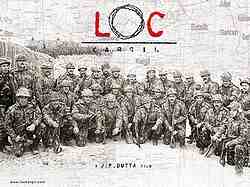
<p>The film opens with a shot of an Indian soldier’s wireless set chirping frantic commands from one of the army bases, calling a patrol to report in while the radio operator lies dead. After attempts from battalions to locate their lost patrols, the HQ in decides to deploy more troops. Lts. and Amit Bharadhwaj are sent on reconnaissance patrols along the (LoC). Lt. Kalia’s patrol is wiped out while Lt. Bharadhwaj’s patrol suffers heavy casualties but manages to return to their base. Pakistani forces begin shelling across the LoC, targeting (NH-1A). The Indian Army decides to deploy more troops but suffers a rude shock when the company and even battalion-sized patrols are beaten back by the Pakistani intruders who have occupied peaks around the , , , Kaksar and . After these terrible reverses, the decision is taken to go ahead with maximum mobilization and move the army’s best fighting units into the area of operations. However, orders from Delhi are that Indian soldiers are barred from crossing the LoC during their operations. Most mobilized battalions are completely unaware of the nature and size of the threat. Thus the rationale behind maximum mobilization is questioned by all the battalion commanders. The first unit deployed is the 1st battalion, (1/11 GR), who are specialists in high-altitude warfare. 1/11 GR’s commanding officer is Col. , and the battalion has the charismatic and brave Lt. leading one of its platoons. Subsequently, the 18th battalion, (18 Grenadiers), which was in the Kashmir Valley guarding against terrorist infiltration, are deployed in Kargil. The battalion is led by Col. Khushal Thakur, and among the officers and soldiers are men like Lt. Col. R. Vishwanathan, Maj. , Lt. Balwan Singh, Capt. Sachin Nimbalkar, and Grens. . 18 Grenadiers are followed by the 17th battalion, (17 Jat) led by Col. Umesh Singh Bawa with Capt. leading one of its units. 17 Jat is followed by the 13th battalion, (13 JAK Rif) commanded by Maj. turned Lt. Col. (Joe) with Lt. leading one of its units. Other battalions are subsequently inducted into the theatre of conflict. The launches photographic reconnaissance missions in order to identify the intruders. The first assault was carried out by the 1/11 GR advance platoon, led by Lt. Pandey, who first captured Yaldar village and linked up with a beleaguered and severely mauled company from the 3rd battalion, (3 Punjab). JCOs from 3 Punjab reveal that earlier patrols from 3 Punjab and 16 Grenadiers had gone missing in the Kukarthang sector. Lt. Pandey’s platoon followed the patrol paths and launched an attack on Kukarthang post, a very heavily defended enemy position supported by mortar units and artillery batteries on the Pakistani side of the LoC. The Gorkhas captured Kukarthang after taking 9 casualties. It is later revealed that the size of the infiltration was much larger than previously thought. Indian Army planners believe that approximately 3,000 members of the ‘s were involved. The second battle was at the strategic mountain, which sits astride , the main supply route for the entire northern Kashmir sector, including and . 18 Grenadiers linked up with the severely beaten 16 Grenadiers and got the first-hand knowledge of the situation. A company from 18 Grenadiers, led by Maj. Adhikari, attacks Tololing. The company is held up midway due to heavy fog; it waits for clear weather. Intense enemy shelling occurs while the men are resting, causing panic and casualties. They try to move up the mountain but are pushed down by heavy small arms fire from intruders who are well entrenched atop the feature. Subsequent attacks from the Indians are stifled by stiff resistance, and in the absence of artillery support, Maj. Adhikari and Lt. Col. Vishwanathan get killed. 18 Grenadiers make a total of 4 attempts to recapture Tololing but are repeatedly beaten back. Meanwhile, a unit from 17 Jat led by Maj. Deepak Rampal captures a Pakistani mortar position. They subsequently liberate an important peak, but suffer casualties. Col. Bawa tasks them to capture Pt. 4850. 18 Grenadiers are relieved by the 2nd battalion, (2 Raj Rif), commanded by Col. Ravindranath, which moves in with an artillery battery of 110 mm field artillery and acclimatized troops. They launch a multi-pronged attack with artillery support which ends in success but at a heavy cost, with Capt. Vijayant Thapar, Maj. Padmapani Acharya, Maj. Vivek Gupta and Captain Nemo killed. All this happens while 13 JAK Rif stands by in case 2 Raj Rif fails. Meanwhile, the Indian Air Force launches combat sorties ( ) and bombs enemy positions. 13 JAK Rif is blooded at Rocky Knob, where they take the field after suffering heavy casualties. They follow it up with another victory at Point 5140, where Lt. Batra distinguishes himself by taking the south face of the peak without any casualties and is promoted to Captain. The decisive phase of the war arrives. 18 Grenadiers are assigned to take , 17 Jat to Three Pimple Complex feature, 1/11 GR to Khalubar Ridge, and 13 JAK Rif to Point 4875. After a heavy artillery barrage, 18 Grenadiers take Tiger Hill, spearheaded by a daring stealth attack by the elite Ghatak section, which includes both Grens. Yogendra Singh Yadav. However, only one member of the section, Gren. Yadav (Manoj Bajpayee), survives (despite being shot several times) to link up with the rest of the battalion. 17 Jat suffers heavy casualties with Capt. Nayyar and several others killed and injured but are able to secure Three Pimple Complex. 1/11 GR link up with 22 Grenadiers at the base of Khalubar Ridge after braving an intense creeping barrage of artillery. Lt. Pandey somehow keeps the sagging morale of the weary unit up till the battalion begins its attack. The plans go awry when Col. Rai, is injured by machine gunfire. Lt. Pandey volunteers to take out the bunkers which are holding up the attack. The machine guns are taken out, but Lt. Pandey and his platoon sergeant Hav. Bhim Bahadur are killed. The last battle is fought by 13 JAK Rif at Bunker Complex. The unit gets split up – Capt. Batra is sent to link up with Capt. Nagappa has captured one bunker and is surrounded by the enemy. Batra links up with Nagappa but is pinned down by the heavy enemy fire. He single-handedly takes out two bunkers but is mortally wounded. 13 JAK Rif pursues the fleeing enemy to the LOC, but Lt. Col. Joe stops due to orders not to cross it. After that, the 18 Grenadiers, 8 Sikhs, and 1/11 Gorkha Rifles launch their final attack on , and they manage to capture it. 17 Jat captures Three Pimple Complex. 13 J&K Rifles capture Point 4875. 1/11 GR capture Khalubar Ridge. Finally, India declares Operation Vijay on 14 July 1999 a success. Just like J. P. Dutta’s previous war film , the Indian military provided technical and material assistance during the production and filming of . Weapons depicted were those used in the Kargil war, like different variants of the family as well as Swedish artillery guns and multiple rocket launchers. Indian Air Force planes like in bombing roles and helicopters like and were shown in casualty evacuation roles. Pakistani artillery depicted were Indian field guns and 81 mm mortars. stood in for the rifles used by the Pakistan Army. was first offered ‘s role, but things couldn’t be worked out. was the initial choice for ‘s role. and were signed for the film, but both walked out later. was signed for the film but dropped out later. was the original choice for ‘s role. was signed for the film but was later replaced by . was signed for the film but later opted-out; replaced him later. The music of this movie was composed by , with lyrics written by . The music was released by label. According to the Indian trade website , with around 15,00,000 units sold, this film’s soundtrack album was the year’s eighth highest-selling. of called LOC:Kargil “Wasted effort” and wrote, “Stretching to more than four hours, the film feels almost as long as the actual conflict.” Anita Bora for wrote, “The battle scenes are gruesome, loud and hammer at you, much like the blazing guns in the background. But a lot has gone into making the scenes as realistic as possible. … The one negative factor is its length. This might deter many from watching the movie. Possibly a slightly edited version, keeping it within 3 hours is called for”. Kavitha K of wrote, “The movie has crisp dialogues (O.P. Dutta), good cinematography (Karim Khatri), well executed war sequences (Bhiku Verma), but fails to keep the viewer riveted for four long hours because of the surfeit of cameos, canons and caterwauling damsels.”</p>
Details
✍️
Writer:
J. P. Dutta
👤
Producer:
J. P. Dutta
🎵
Music:
Anu Malik
🎬
Director:
J. P. Dutta
📸
Cinematography:
Karim Khatri
👥
Starring:
Mohnish Bahl, Sanjay Dutt, Ajay Devgn, Saif Ali Khan, Akshaye Khanna, Sunil Shetty, Sanjay Kapoor
📅
Release Date:
12-Dec-03
✂️
Edited By:
💸
Budget:
33
🏭
Production Company:
📺
OTT Platform:
Prime Video
⏱️
Runtime:
4h 15m
🗣️
Language:
Hindi
💵
Box Office:
31.67
🌐
Other Languages:
📄
Screenplay:
🔒
Censorship:
Reviews
There are no reviews yet. Be the first one to write one.