
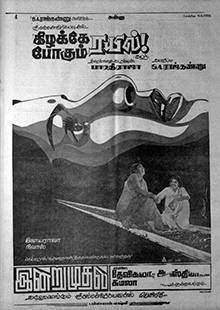
Directed by Bharathiraja
• Music: Ilaiyaraaja
0
0 out of 5 stars (based on 0 reviews)
Excellent
Very good
Average
Poor
Terrible
Your Rating for
Kizhakke Pogum Rail
Streaming On
Trailer
https://www.youtube.com/watch?v=8LTxIPP3zds
Soundtrack
| Song Name | Singer(s) | Lyricist | Video |
|---|---|---|---|
| Poovarasam Poo | S. Janaki | Gangai Amaran | |
| Neeyum Naanum Onnu Endra | Malaysia Vasudevan and Chorus | Kannadasan | |
| Mancholai Kilithano | Jayachandran | Muthulingam | |
| Kovil Mani Osai | Malaysia Vasudevan and S. Janaki | Kannadasan | |
| Malargale Naadhaswarangal | Malaysia Vasudevan and S. Janaki | Sirpi Balasubramaniam | |
| Edho Paattu Edho Raagam | Ilayaraja | Gangai Amaran |
Storyline
<p>A young woman Panchali gets off a train named ‘Kizhakke Pogum Rail’ (Eastbound Train) and lands in the village Thamaraikulam, which follows strict rules. There, she is accommodated by her sister Karuthamma and brother-in-law Ramaiah. Panchali informs Karuthamma that their mother died a couple of days ago. Ramaiah starts to have an eye on Panchali. Paranjothi is an unemployed graduate who lives with his father Maruthu and sister Kanniyamma. Maruthu is a barber and considers Paranjothi a good-for-nothing like all the villagers. After getting married, Kanniyamma leaves her birth home to live with her husband’s family. Panchali and Paranjothi slowly fall in love with each other. One day, the villagers spot Paranjothi running behind Panchali. At the , the panchayat members blame Paranjothi for trying to misbehave with Panchali. Only the retired military man Pattalathaar and the farmer Ponnandi support him, but the panchayat members overlook them and punish him. Maruthu shaves off Paranjothi’s hair, and the latter parades on a donkey in the streets of the village, whereas Ramaiah forces Karuthamma to burn Panchali’s arm with a piece of wood. After the humiliation, Maruthu commits suicide in the village’s lake. Paranjothi decides to leave the town, and he promises Panchali that he will come back to marry her. He also informs her that he will write a message on the last compartment of the ‘Kizhakke Pogum Rail’. In the city, after several interviews, he finally finds a decent job. Meanwhile, at the village court, Ramaiah complains that Karuthamma is a barren woman, and he expresses his wish to marry Panchali. A few days later, the village is battered by heavy rains. To stop the rain, the villagers contrive the way to stop it, executing an ancient belief: one virgin woman has to walk naked around the village at sunrise. Unexpectedly, Panchali is chosen to be that woman. The day of the ritual, Paranjothi gladly returns at his village, and he sees Panchali completely naked. He gives her clothing, and they both run away from the angry villagers. Pattalathaar helps the couple by stalling the villagers, but he is killed in the process. The lovers manage to catch the running ‘Kizhakke Pogum Rail’, evading the villagers. was the second film directed by , and the debut film of and (credited as M. R. Radhika) as actors. The male lead role was originally offered to , who declined, while was originally cast as the lead actress but later opted out. Radhika’s screen test was done with Sridevi’s clothes from (1977) since she did not have any Indian clothes after coming from London. Radhika contemplated leaving the film throughout the shoot, but was “offered chocolates” to complete the film. It was also the Tamil debut for , and the feature film debut of Usha. The producer originally offered to direct, but he declined as he wanted to finish at least two more films as an assistant. Bhagyaraj remained as an assistant director. One part of the song “Poovarasampoo” was filmed at a temple off , while the rest of the song was filmed at . revealed the initial story for had the character of Panchali character arriving to Chennai to visit Paranjothi, get molested by four young people by which she gets mentally affected and meets with an accident with Paranjothi saving her; however Selvaraj felt something was missing in the script and conveyed this to Bharathiraja for which he stopped the shoot. Selvaraj read a French novel where a queen will be walking naked at night on the streets to abolish tax which he added in the script. After changing the complete screenplay, the shoot was restarted. Bharathiraja was discontent with Radhika’s then-sounding “baby” voice but after trying twenty dubbing artists, he decided to use her original voice. The soundtrack was composed by , with lyrics written by , , and . The song “Kovil Mani Osai” is set to the known as , “Malargale” is set to , “Poovarasam Poo Poothachu” and “Mancholai Kilithano” are set to . was released on 10 August 1978, and distributed by Sri Amman Creations. rated the film 55 out of 100, appreciating its latter half and the climax for its realism. Naagai Dharuman of praised the acting of cast, music, direction, dialogues, and visual poetry. The film became a major commercial success, completing a 365-day run in theatres, and Radhika became popularly known by the sobriquet “Rayil Radhika”. Malaysia Vasudevan won the for singing in the film. was remade in as (1979) by Bapu, and in as (1986) by Bharathiraja himself.</p>
Details
🎬
Genres:
Drama
✍️
Writer:
👤
Producer:
S. A. Rajkannu
🎵
Music:
Ilaiyaraaja
🎬
Director:
Bharathiraja
📸
Cinematography:
P. S. Nivas
👥
Starring:
Sudhakar, M. R. Radhika
📅
Release Date:
10-Aug-78
✂️
Edited By:
T. Thirunavukkarasu
💸
Budget:
🏭
Production Company:
📺
OTT Platform:
⏱️
Runtime:
2h 4m
🗣️
Language:
Tamil
💵
Box Office:
🌐
Other Languages:
📄
Screenplay:
🔒
Censorship:
Reviews
There are no reviews yet. Be the first one to write one.