
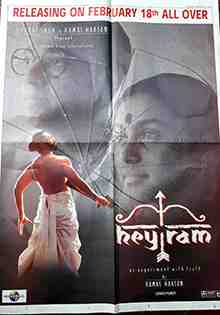
Directed by Kamal Haasan
• Music: Ilaiyaraaja
0.0
0.0 out of 5 stars (based on 0 reviews)
Excellent0%
Very good0%
Average0%
Poor0%
Terrible0%
Your Rating for
Hey Ram

Trailer
https://www.youtube.com/watch?v=GKLvKk_uXzA
Soundtrack
Storyline
<p>In 1999, an 89-year-old man named Saket Ram is on his death bed in , . He is being taken care of by his grandson Saket Ram Jr., a famous novelist who writes historical fiction, and their family doctor, Munawar. Saket Ram Jr explains how he grew up listening to his grandfather’s stories and proceeds to narrate one of his grandfather’s strange stories that he plans to use for his next novel. As his grandson narrates the story, the older Saket Ram relives it. In 1946, Ram and his friend, Amjad Ali Khan are archaeologists working together under in , . Relations are good between the Indians and the English. Ram and Amjad do not approve of the planned and the upcoming . Although many Indian Muslims plan to move to the new , Amjad decides to stay in India as he believes it is his homeland. After the archaeological site is shut down out of fear of riots, young Ram returns to , to his wife, Aparna. On his way home, he witnesses the riots and chaos during . While out to get some food, Ram manages to save an innocent girl from a Muslim mob. When he returns to his house, he is attacked and held hostage by his family tailor, Altaf and a group of Muslims. They rape Aparna, but upon discovering that the police are entering the building, slit Aparna’s throat and flee. Unable to cope with his tragic loss, Ram takes his gun and attempts to follow them. He manages to find Altaf, who begs for mercy, although Ram kills him. Ram continues to shoot at Muslims committing violence in the streets until he runs into Shriram Abhyankar, a who is leading a group of a Hindus. Realising that they are both Hindu and thus not enemies, Abhyankar offers Ram a chance to join his . Abhyankar informs Ram that the individual responsible is none other than and gives him a banned book on anti-Gandhi rhetoric to read. In 1947, now having returned to his hometown of , , Ram’s brother Bhashyam and sister Vasantha urge him to remarry. He is then married to the daughter of family friends, Mythili. While his wedding is being celebrated across the village, Ram tells his childhood friends Vedha and Yegham that he has no reason to be happy since the world’s biggest political divorce is going on with the partition of India. During his first night, he learns that Mythili, like her family, are supporters of Gandhi and that the Mahatma will be visiting Calcutta a few days later on the anniversary of the bloody riots. Ram travels to Calcutta alone, where he visits his old home and laments at his loss. Then he joins a mob that confronts Gandhi and , the , about the bloody riots. When questioned about whether they take full responsibility for the riots, both of them accept it and ask for forgiveness. The mob forgives them, but Ram refuses to. Although Ram remains aloof at first, he slowly falls in love with Mythili. However, on their honeymoon in , Ram and Mythili bump into a disguised Abhyankar, who introduces them to a dethroned Maharaja. During a hunting trip with Abhyankar and the Maharaja, Ram is reunited with his old friend from Calcutta, Manohar Lalwani, who lost his family and home in the riots. After seeing Lalwani’s misery, Ram realises he has still not gotten over Aparna’s murder and his hatred is reignited. Abhyankar and the Maharaj’s group hold the belief that Gandhi is solely responsible for the division of India and the violence between two religions, and believe him to be a traitor for supporting and protecting Muslims rather than his own Hindu people. As extremist Hindu fundamentalists, they plot to murder Gandhi and task Ram with performing the deed. Due to a horse-riding accident, Abhyankar is left and has Ram swear that he will renounce personal relationships and carry on his work of killing Gandhi. Back in the present, Ram’s situation worsens. His grandson and Dr. Munawar take him to the hospital, but are stopped by the police since there are bomb blasts in due to Hindu-Muslim communal riots, as the day is anniversary of the , prompting the elderly Ram to remark how the Hindu-Muslim violence is still rampant in present day. A police officer makes them hide in an underground shelter for their safety. As they try to stay silent to avoid being attacked by the mob, Ram reminisces about how he plotted to kill Gandhi many decades ago. Back in newly independent India, Ram begins to prepare to assassinate Gandhi once he returns to . A pregnant Mythili becomes worried as her husband grows more distant and invites her parents and in-laws over to cheer him up. However, Ram has made up his mind to kill Gandhi and leaves Mythili, traveling to , where he goes through a purification and renouncement ritual. Then, he heads for and unknowingly stays at the same hotel as another fundamentalist planning to kill Gandhi, . When the police arrive to question Godse, a paranoid Ram hides his gun on a delivery truck, which departs from the hotel. Later on, Ram goes to the soda factory in in order to retrieve his gun. In Chandni Chowk, Ram is reunited with Amjad, who takes him to the soda factory. It is revealed that many Muslims civilians, including Amjad’s wife Nafisa and their children, are hiding there out of fear of being attacked by Hindus during curfew. When it is discovered that Ram came there for a gun, the Muslims, suspicious that he might be out to kill them, attack him. A fight ensues that triggers a series of violent events in the area. While trying to escape both Hindu and Muslim mobs, Amjad learns that Ram is in Delhi to assassinate Gandhi and he tries to convince him to not do it. He reveals that his father did not die of natural causes, but was murdered by a Hindu mob and asks Ram to end his hatred. Just then, they are cornered by a Hindu mob who try to kill Amjad. Despite Ram’s attempts to protect him, Amjad is struck on the back of the head with a hammer and Ram takes him back to the soda factory. Together, they then help protect the Muslims hiding in the soda factory until the authorities arrive to control the situation, although Amjad is shot. While in the hospital, Amjad is questioned by a police officer about the Hindu man whom eyewitnesses state started the violence. Amjad lies that he has never seen that man before, and all he knows is his brother Ram who despite everything, saved his life. He then dies holding Ram’s hand. Subsequently, Ram runs into his father-in-law and his friend who are there to meet Gandhi. He learns that his uncle and elder sister have died after learning he has left. Gandhi requests to see Ram to invite him on his long walk to Pakistan after finding out he helped save innocent Muslims. Ram ultimately changes his mind about Gandhi after seeing that his teachings are all about love and non-violence. He decides against assassinating the leader, and attempts to confess the truth to him in order to beg for forgiveness. Gandhi interrupts him, informing Ram that they can talk about it during their long walk to Pakistan. However, seconds later, Gandhi is . Ram then attempts to shoot Godse, but is moved by how one person prevents the people from attacking Godse, who is arrested. Then on, Ram lives by . As the situation on the streets starts to cool down, Ram whispers his last words to his grandson and eventually dies. During Ram’s funeral, Gandhi’s great-grandson comes over and visits Ram Jr’s private room, which is full of historical photos. Ram Jr hands over Gandhi’s footwear and spectacles which his grandfather had previously collected from the place of the shootout and had treasured throughout his life. had spent all of 1998 on filming , which ended up in due to lack of funds, and did not act in any other film during the period (barring ), much to the dismay of his fans. To please them, he sought to begin and finish another film before resuming work on , which became . Another motivation for Haasan to do the film was because, although he was born in a family of people devoted towards , he himself was not initially a devotee, and had a critical view of Gandhi even as a teenager. Haasan initially intended to title the film as ( ), a reference to the title of Gandhi’s autobiography, published in English as , but later decided on , the last words allegedly spoken by Gandhi when he was by . The film was produced by Haasan and his brother under their banner , and was the company’s first film to be shot simultaneously in Tamil and Hindi. The dialogues for the Hindi version were written by . Cinematography was handled by , and editing by . Haasan chose the actor to portray the character Amjad Ali Khan, partly because the actor’s father was a Pathan who was from . Though not a native Tamil speaker, Khan dubbed in his own voice. It marks Khan’s debut in . He did not ask for any remuneration from Haasan, as he considered it an honour and privilege to work with one of his mentors. The actor was initially cast as Shriram Abhyankar; he had started working on the film in Madras but died suddenly due to a heart attack. Haasan later chose , another Marathi actor, to do the role. , who had reduced acting in films by then, accepted to act as Ambujam after being offered the role by Haasan. For the role of Ambujam’s daughter Mythili, Haasan initially wanted Malini’s daughter ; the role ultimately went to . It is her first major appearance in a Tamil film. Hassan’s daughter made her acting debut portraying the role of Vallabhai Patel’s daughter. Haasan initially considered having British actor , who portrayed Gandhi in a , to reprise the role in but dropped the idea as he felt “it would be cliched and the film wouldn’t be honest”. He later approached , who portrayed Gandhi in a play. Shah was initially reluctant due to the long hours of makeup required, but eventually accepted. Haasan wanted a woman to portray Saket Ram’s Bengali wife Aparna, and chose , also because of her Bollywood stardom. was cast as a character Lalwani after Haasan was impressed with his performance in (1998). , who portrayed Saket Ram’s father-in-law Uppili Iyengar, recommended , who portrayed Godse in the Marathi play , to Haasan for reprising his role in the film. Gandhi’s great-grandson wanted to join the film, and Haasan accepted; Tushar plays himself. Mohini Mathur, who was 13 years old when witnessing Gandhi’s assassination, accepted Haasan’s request to play Amjad Ali Khan’s mother Haajra. began on 22 March 1999. The then of Kanchi had filmed an interview scene for the film but later requested that his portions be removed to avoid controversy. To achieve on-site dubbing of dialogues, Haasan hired Srivastav from Mumbai. Production of the film cost a total of ₹11 crore (worth ₹92 crore in 2021 prices), excluding Haasan’s salary. In order to show Mohenjodaro of ancient times, the crew recreated a set at a village near Chennai as the original location was located in Pakistan which the crew felt was impossible to go to, for political reasons. Initially Haasan chose to compose music for the film. Haasan completed shooting the whole film along with the song sequences that were composed by Subramaniam. According to Haasan, when he approached Subramaniam for the final sound for mixing, he had asked for ₹1 crore, which was not the amount agreed upon earlier. So Haasan went to to help him solve this situation. Haasan told Ilaiyaraaja that the songs had already been shot with the music composed by Subramaniam and he wanted to remove the songs and re-shoot them with Ilaiyaraaja’s. On hearing that, Ilaiyaraaja told Haasan that he could fix it without Haasan needing to re-shoot any footage or songs; Haasan agreed after initial reluctance. Subramaniam said he left the project, fearing that his association with the film may offend people due to its contentious storyline. The lyrics for the songs were not changed, but Ilaiyaraaja composed new tunes for the songs that would be in sync with the already shot footage. The background music and the songs were recorded in Hungary’s and thus became the first Tamil film and the second Indian film to be re-recorded with a foreign symphony orchestra. The first one was Ilaiyaraaja’s own score for the film (1997). The song “Isaiyil Thodangudhamma” was not present initially, but Ilaiyaraaja had seen an opportunity for a possible song in the scene and asked Haasan to give him a chance to add one. But Haasan, being the writer-director of the film, did not see it. Then Ilaiyaraaja convinced Haasan to trust him with this and brought Hindustani singer Ajoy Chakrabarty to sing “Isaiyil Thodanguthamma” and also writing the lyrics for the same. wrote, “The album, with its rich acoustic score, is one of his [Ilaiyaraaja’s] best efforts”. S R Ramakrishna of wrote “Ilaiyaraja’s score brings back the grandeur, allusiveness and haunting beauty of his best work. Hey Ram is an exciting album”. was released simultaneously in and on 18 February 2000. A digitally remastered version of the film was released on 8 November 2019 on . Internationally, the film was screened at the and at the 2000 . In 2015, was screened at the Habitat Film Festival. The film was re-released at on 8 November 2019. There were protests and press releases by political parties in select centres against the perceived negative depiction of Gandhi. received widespread critical acclaim. T. Krithika Reddy from wrote, “Live sound, prosthetic make-up (Micheal Westmore), splendid cinematography (Thiru), magnificent art work (Sabu Cyril) and painstakingly designed costumes (Sarika) are some of the other highlights of this magnum opus, which is distinct in style and content…The chemistry between Kamal and Rani is explosive to say the least. Shah Rukh Khan, as usual comes up with an impeccable performance. Vasundhara, as the stoic second wife makes an impressive debut. Naseerudin Shah as Gandhi steals a clear march over the others in supporting roles.” wrote, “The starting of 2000 itself has given a great joy to Tamil cinema! A Tamilian has created a film that caters to international standards.” Methil Renuka of praised the film’s “technical wizardry” and cast performances but called it “difficult to categorize”. K. N. Vijiyan of said, “To this writer, the message of the need for unity among various religious faiths was well told by Kamalhaasan”. S. Chandramouli of praised the acting of Kamal Haasan, crisp dialogues, art direction for recreating old times, symbolism but felt other characters speaking different languages gives an impression of watching a film from other language while also felt Kamal who slowly built up his character realistically went hurried with the character’s change of heart and concluded saying this film will be enjoyed by urban audience but language will definitely be an issue in villages in spite of that, if this film wins, it will be good for the country and for the world of Tamil cinema. wrote “Hey Ram is a film not to be missed. For though it`s too long and too simplistic it is part of us, and a landmark for every thinking Indian”. The Hindi version of grossed ₹8.91 crore in India and $550,000 overseas. The Hindi version opened on 18 February 2000 across 115 screens and netted ₹2.39 crore in opening week and ₹5.32 crore lifetime. It was the 35th-highest-grossing film of 2000 in India. At the overseas box office, the Hindi version grossed $350,000 in opening week and $550,000 lifetime.</p>
Details
✍️
Writer:
Kamal Haasan (Tamil dialogues), Manohar Shyam Joshi, (Hindi dialogues)
👤
Producer:
Kamal Haasan, Chandrahasan
🎵
Music:
Ilaiyaraaja
🎬
Director:
Kamal Haasan
📸
Cinematography:
Tirru, Tirru
👥
Starring:
Kamal Haasan, Shah Rukh Khan, Hema Malini, Rani Mukerji
📅
Release Date:
18-Feb-00
✂️
Edited By:
Renu Saluja
💸
Budget:
11
🏭
Production Company:
📺
OTT Platform:
Prime Video
⏱️
Runtime:
3h 30m
🗣️
Language:
Hindi
💵
Box Office:
11.3
🌐
Other Languages:
📄
Screenplay:
Kamal Haasan
🔒
Censorship:
Reviews
There are no reviews yet. Be the first one to write one.