
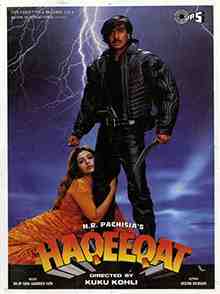
Directed by Chetan Anand
• Music: Dilip Sen-Sameer Sen
0.0
0.0 out of 5 stars (based on 0 reviews)
Excellent0%
Very good0%
Average0%
Poor0%
Terrible0%
Your Rating for
Haqeeqat
Streaming On
Trailer
https://www.youtube.com/watch?v=7xK6nv1iIl8
Soundtrack
Storyline
<p>Set against the , the film’s main plot concerns a small platoon of Indian soldiers in the hilly terrain of . Captain Bahadur Singh ( ) is a keen young soldier who is in-charge of his platoon in Ladakh. On a visit to Kashmir and Ladakh Brigadier Singh ( ), receives news of creeping encroachment by Chinese troops along the border and orders Major Ranjit Singh ( ) to send his officers to secure the posts. Thus begins the struggle of the soldiers, who await further instructions while facing a wily adversary. The region is disputed, with China claiming it as their own. The Indian soldiers have orders not to fire first and as a result the Chinese soldiers manage to effectively surround them and open fire first. Outnumbered and out-positioned, the Indian soldiers try retreating but the weather is against them. Captain Bahadur Singh makes all efforts to ensure his soldiers retreat safely sacrifices his life in the process. Soon after his soldiers are killed as well. As a parallel mini-story, before his death, Captain Bahadur Singh falls in love with a Ladakhi girl, Angmo ( ), while posted in the region. Bahadur Singh also takes Angmo’s brother Sonam under his wing as the boy dreams of becoming a soldier one day. The film was made with government and army assistance. Parts of the film were shot on location in Ladakh, thus becoming the first Bollywood film to be shot there. The “left-leaning” artists, belonging to , did not charge any money for their work on the film. This included director , Noel Corke (Director-2nd In Charge) actor , lyricist and actress . The colour version, converted by Chetan Anand’s son Ketan Anand, was released in 2012. The conversion, undertaken by an Indo-Australian collaboration (Q Lab of India and Time Brush Films of Australia), was a first. The film duration was also edited down. The film is based on the 1962 , a war that started out as a cartographic battle fought over ownership of territory. The film is constructed around the battle of Rezang La, a battle which was considered the only part of the war in which India came out on top. Out of the 120 Indian soldiers who fought in Rezang La, 114 were killed. It is said that 1300 Chinese soldiers were also killed. While Major led Ahir Company of 13 Kumaon, Brigadier was in-charge of the brigade in which included 13 Kumaon. Brigadier TN Raina was awarded a and went on to become India’s ninth in 1975; unlike the fate of many other generals of the 1962 war who “faded away in ignominy and disgrace”. The Sino–Indian war is a story of Indian soldiers being treated as “sacrificial lambs”, while a nation celebrated Diwali and a government was distracted with other foreign relations in Africa and South Korea. Gita Vishawnath writes that film has scenes which “represent the active male hero and the passive female collaborator reinforce the gendered narratives of war”. Scenes including the portrayal of a “nationalist mother” who must produce sons for the battlefield and sisters-in-laws who are angry with their brother “because they do not want another woman in the family to suffer from long years of separation”. In the film, Angmo ( ) is raped by an enemy soldier, however she goes on to kill a number of enemy soldiers, thus “avenging the violation of her body”, her territory, before dying. Seen as a possession of man, the film shows her lying beside her lover Bahadur Singh, a win for love. Despite the “national shame” surrounding losing a war, such scenes helped cover the loss of territory to China, just as Angmo had been forced on by the enemy. To be a patriotic soldier, Brigadier Singh must be ready to put his son in harms way. By showing that Brigadier Singh ( ) and Captain Bahadur Singh (Dharmendra) are father-son duo, the film wades through the family versus nation dilemma, and shows contradictions of serving both family and nation. The film tries to show a “moral victory for India”. Credits adapted from . The music of this film has several notable songs. The music is composed by and all of the songs are written by . In a 2012 interview with for , composer Madan Mohan’s son Sanjeev Kohli recalls that Chetan Anand had given the music director a brief which went something like, “Indeed at the back of the mind was the lost war, but the anguish and suffering of the armed forces and the nation was all pervading. Thus, the music had to be pathos-laden, with an air of despondency. But at the end, it needed to celebrate the contribution of those that laid down their lives.” The music begins with lively romantic tunes and moves to more epic war, sad and celebratory tunes. The song “Ab Tumhare Hawaale Watan Saathiyon” sung by has become synonymous with patriotism in India; with the lyrics going as “Kar chale ham fida jan-o-tan sathiyon, Ab tumhare havale vatan sathiyon” ( ). This song, over five minutes long, comes at the end of the film with visuals of dead Indian soldiers all over the landscape. comments that the song “Ho Ke Majboor Mujhe Usne Bhulaya Hoga” has become a famous tune for weary soldiers, as a distraction from the ravages of war. “Ho ke Majboor” went on to inspire ” ” from the film written by , Kaifi Azmi’s son-in-law. Their portrayal of the soldier’s psyche, both in war and in peacetime, is ummatched for realism. Stark shots of jawans in Haqeeqat, bereft of equipment, numbers, supplies, artillery of air support, who die defending their posts in sub-zero temperatures against an external enemy… The reports that in 1964, , on seeing the film, had told the director, “Chetan, I saw Haqeeqat. Strong visuals, excellent music, but no story”. Reportedly Chetan Anand replied, “Haqeeqat is not a story. It is a mosaic.” In 1965 critic Edith Laurie said that Haqeeqat “is the first movie treatment of India’s war with China,” is full of “patriotic cliches”. He said the enemy was depicted as per the national narrative and that “the eye-rolling Chinese are reminiscent of sinister Japanese in America’s World War-II movies”. In the film, director and writer Chetan Anand accepts India’s defeat in the war, showcasing the overpowering grief that comes as a result. Film-maker , a brother of Chetan Anand, said “the film glorified the in its moment of grief. It was a tribute to our soldiers […] You need guts to make a film like this”. The film made about (equivalent to 73 crore or US$8.7 million in 2023). is widely remembered as one of India’s greatest black and white war films, if not the greatest. Despite India losing the war and history fairly blaming Nehru for the loss, Haqeeqat “makes its admiration for Nehru clear” and in the film Anand goes along with the government line that the war and its outcome was the fault of the Chinese. However Nehru died before the film could be released in 1964. Chetan Anand dedicated the film to Jawaharlal Nehru and the soldiers in Ladakh. The film has been called a “cultural document about an event that had severe long-term impacts on the country”. For most, Haqeeqat is the only film reference of the war. In 2012 wrote in that Haqeeqat was to be “a reminder of China’s betrayal” and the feelings that came along with this were reflected in the film, such as the scene of a bayonet stabbing ‘s . In 2016, the film was screened at the by the and the . On in 2017, ZeeTV premiered the film on . In the backdrop of the Haqeeqat was again remembered by the Indian media as a comparison for 1962 and the current tensions; to be specific the last stand of Ahir Company, 13 Kumaon led by Major at . In the backdrop of the , on 6 July 2020, an article in by Pankhuri Shukla comments on the “unsanitized” two-hour long portrayal of war in the film. The fights are not “sugarcoated” and the internal conflict of what is means to be a soldier are depicted. In July 2020, listed Haqeeqat as one of Bollywood’s top war films.</p>
Details
✍️
Writer:
Chetan Anand
👤
Producer:
Chetan Anand
🎵
Music:
Dilip Sen-Sameer Sen
🎬
Director:
Chetan Anand
📸
Cinematography:
Sadanand, [, 1, ]
👥
Starring:
Dharmendra, Balraj Sahni, Priya Rajvansh, Sanjay Khan, Vijay Anand, Jayant, Sudhir
📅
Release Date:
17-May-05
✂️
Edited By:
M. D. Jadhav Rao
💸
Budget:
🏭
Production Company:
📺
OTT Platform:
⏱️
Runtime:
3h 4m
🗣️
Language:
Hindi
💵
Box Office:
🌐
Other Languages:
📄
Screenplay:
🔒
Censorship:
Reviews
There are no reviews yet. Be the first one to write one.