
Streaming On
Trailer
https://www.youtube.com/watch?v=vl8_5mMybXQ
Soundtrack
Storyline
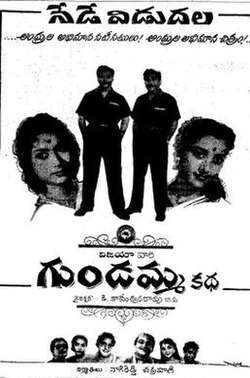
<p>Gundamma is a rich widow who ill-treats her stepdaughter Lakshmi, a selfless person who is reduced to working as a maid. Gundamma has a daughter Saroja and a son Prabhakar. Gundamma has a half-brother Ghantayya, a cunning but weak milk vendor. Ghantayya wants Gundamma to marry off Saroja to his criminal son Bhoopati, who is in prison. To achieve this goal without the knowledge of Gundamma, he spoils every marriage proposal Saroja receives. Saroja’s arrogance and Lakshmi’s courteous attitude indirectly help Ghantayya. Gundamma decides to marry off Lakshmi to a vagabond and Saroja to the son of Ramabhadrayya, a wealthy man living in a faraway town, Veerapuram. Ramabhadrayya knows about Saroja (Gundamma’s daughter) through a marriage broker and goes to Gundamma’s home after finding that her late husband was a friend of his, who had aided him in convincing his in-laws to let him marry their daughter. After observing the situations in Gundamma’s house with the help of Ghantayya, Ramabhadrayya sends his elder son Anjaneya “Anji” Prasad to Gundamma’s house as a servant to get him married to Lakshmi, who he finds innocent and docile. He sends his younger son, Raja, to marry Saroja. Raja then meets Saroja through his cousin Padma, Saroja’s friend and Prabhakar’s classmate and lover. Anji and Lakshmi get married, and Raja and Saroja fall in love. Ramabhadrayya writes a letter to Gundamma opposing the marriage of Raja and Saroja upon the former’s instructions, and Anji conducts their marriage against Ghantayya’s wishes. Shortly afterward, Prabhakar and Padma’s marriage is conducted. Raja acts like a drunkard and masquerades as Ramabhadrayya’s son seeking to gain Saroja’s wealth. A rift develops between Anji and Gundamma, and he leaves with Lakshmi. Anji, Raja, and Ramabhadrayya reveal the truth to Lakshmi later. Raja storms out of Gundamma’s house and Saroja follows him; they join Ramabhadrayya’s house as gardeners and Raja ensures Saroja is unaware of their employer. In the process, Saroja’s character transforms from one of arrogance to one of a hardworking, courteous person. Gundamma is tortured by Padma’s ruthless, confidence-trickster aunt Durga. Bhoopati is released from prison and Ghantayya asks Gundamma to give him some money. Because of Gundamma’s arrogance, Prabhakar and Padma leave for . Durga steals the money in the locker, accuses Gundamma of robbery, and locks her in a room behind the house. Lakshmi and Anji visit Gundamma and become aware of her condition. Lakshmi and Gundamma coerce Durga and retrieve the money she stole. Bhoopati comes to Durga’s rescue but is defeated by Anji in a duel and is hospitalised. Saroja meets Ramabhadrayya, her employer, and walks out after a heated argument. She meets Lakshmi on the way and learns about Raja’s plans and that Ramabhadrayya is her father-in-law. The film ends with Gundamma staying with her daughters in Ramabhadrayya’s house. of helped in the production of (1958), the latter’s directorial debut in . As an act of gratitude, Vittalacharya sold the remake rights to Nagi Reddi. revolves around the life of a rich woman whose brother marries off her daughter to a criminal when she chooses a mentally challenged person as her step-daughter’s life partner. Nagi Reddi chose to remake the film in Telugu and discussed it with ; it was the first time Vijaya Productions decided to remake a film. After the script was ready, Nagi Reddi approached to direct the remake after considering . Pullayya was not appreciative of Narasa Raju’s treatment of the script and Nagi Reddy met his partner to develop the script further. Chakrapani decided to retain only the background of Gundamma’s family from the original and rewrote the remaining script, taking inspiration from , . Chakrapani killed the character of Gundamma’s cowardly husband because he felt that a husband who cannot answer his wife’s questions was not eligible for inclusion. was chosen to direct the film. Chakrapani named the central character Gundamma in the remake after one of the characters in the original, despite a lack of nativity. Nagi Reddi’s family members and the employees of the Vijaya Vauhini Studios used to ask him “Gundamma Katha Entha varaku vachchindi?” (What is the progress in Gundamma’s story?), which prompted Nagi Reddi to title the film after considering various options. was recruited as the ; G. Kalyana Sundaram and D. G. Jayaram edited the film. composed the soundtrack and score. Madhavapeddi Gokhale and Kaladhar were the film’s art directors. M. Pithambaram and T. P. Bhaktavatsalam provided the make-up. was chosen to play Gundamma and Chakrapani suggested Kameswara Rao not to make any special efforts to make her character look ruthless because Suryakantham had an aggressive body language. and were chosen as the male leads Anjaneya “Anji” Prasad and Raja, making their 10th film together; the film was Rama Rao’s 100th film as an actor and Nageswara Rao’s 99th. and were chosen as the female leads Lakshmi and Saroja, respectively. Saroja was created by Chakrapani for the film, taking cues from . , and were cast in the supporting roles of Ramabhadrayya, Ghantayya and Bhoopati. and were chosen to play Gundamma’s son Prabhakar and daughter-in-law Padma, while appeared as Padma’s aunt Durgamma. I can understand [ ] or [ ] having classical dances, because one was a mythological and the other a historical. But Telugu producers insisted that if I acted in a film, there had to be a dance. In , for example, a dance was included in the last minute at the producer’s insistence. The production phase of lasted nearly a year, with one of the reasons being that both Rama Rao and Nageswara Rao had delays in giving bulk dates for the project. A house set was erected in Vijaya Vauhini Studios, Madras (now ) where scenes featuring Gundamma and other key characters were filmed. C. Kuppuswami Naidu and K. Srinivasan supervised the erection of sets. The film’s shooting was severely affected by scheduling conflicts; Chakrapani would make telephone calls to all the key artistes, and sequences were filmed based on their availability. The filming of the song “Kolo Koloyanna” was significantly affected by this; all four lead actors were supposed to take part in the song’s shoot; the film’s editor took care to ensure a smooth flow in the sequences during the phase. The scene before the song that features Anji and Raja communicating with whistles was conceptualised by Narasaraju. Harbans Singh supervised the film’s special effects. Since Vijayalakshmi was a trained dancer, an elaborate dance sequence with no connection to the film’s story was introduced as a stage performance and Nageswara Rao, Jamuna, and Haranath were made to sit along with the audience. The song “Prema Yatralaku” was filmed in the gardens near the Vijaya Vauhini Studios after abandoning plans to film it in either or , . During the film’s shoot, a tournament was held in Madras; this inspired Chakrapani and Kameswara Rao to add a fight sequence between Rama Rao and Kaleswara Rao. Pasumarthi Krishnamurthy conducted the choreography for the song sequences. The film was processed at Vijaya Laboratory and was recorded on equipment. Its total length was approximately 14,999 feet (4,572 m) in 18 reels, with a running time of 166 minutes. is based partially on William Shakespeare’s play . It focuses on a widow named Gundamma and her two daughters. The film’s main theme is the step-daughter Lakshmi facing problems because of the widow, and the former’s suitor teaching the latter a lesson. Using the first conversation between Gundamma and Lakshmi, in which the former abuses the latter for disturbing her sleep, Narasaraju introduces Gundamma’s mindset and behaviour. Further incidents include the dismissal of a server fired from a hotel after refusing to work as a servant in Gundamma’s house, and Ghantayya explaining Gundamma’s character to Ramabhadrayya. According to s V. V. S. R. Hanumantha Rao, true friendship is the theme of the film. Most of the film’s dialogue, especially that between Ramana Reddy and , are satirical and provide references to Indian society during the 1960s. The song “Lechindi Nidra” is about the empowerment of women and their role in areas of the government. In her article “Manifestation of devotion” about the importance of the festival, Rajeswari Kalyanam of said the lyrics and photography of the song “Aligina Velane Choodali” recall the romantic side of that every woman sees in her husband or the person she loves. It also recalls the bond Krishna shared with his foster mother . The official soundtrack of was composed by Ghantasala; it consists of eight songs whose lyrics were written by . The sound mixing process was supervised by A. Krishnan and V. Sivaram, and the soundtrack was processed by N. C. Sen Gupta. Ghantasala provided vocals for Rama Rao and Nageswara Rao; and provided the vocals for Savitri and Jamuna. The songs “Entha Hayi” and “Mounamuga Nee” were composed in the . The song “Aligina Velane” is based on raga. The soundtrack was marketed by ; it was successful and all eight songs were well received. “Lechindi Nidra”, “Kolu Koloyanna”, “Aligina Velane Choodali”, and “Prema Yatralaku” achieved cult status in Telugu cinema, particularly for their lyrics. M. L. Narasimham of noted that all songs from the film “are being enjoyed even today by music lovers.” was released on 7 June 1962. In the opening credits, images of the film’s cast were used instead of their names; the leads and Ranga Rao’s images are screened first, and are followed by those of Suryakantham and the other supporting cast. was a profitable venture for Vijaya Productions; it completed a 100-day run in 17 theatres across , and completed a silver-jubilee run at the Durga Kalamandir, . It became the first film to be run for 100 days with three screenings per day in . The silver-jubilee celebrations were not held, and the planned budget for the event was donated to a fundraiser who was active during the . Upon release, many critics praised for its story, screenplay and performances of the lead cast, while some criticised its poor character development. Krishnanand, writing for on 15 June 1962, praised Suryakantham’s role in particular and said, “Justifying the film’s title, the makers have placed utmost importance on Gundamma’s character, and Suryakantham who breathe life into that character, has equally mesmerized the audience with her performance.” On the same day, an article from opined that the film was filled of humour, “The screenplay, each and every scene, and every character in the story is purposefully made for humour; Humour in anger, humour in brawl – humour everywhere!” it stated. Earlier on 8 June, a critic from praising the film, wrote, “This isn’t Gundamma’s story, rather the story we see everyday – Our story.” In an essay by V. Chakravarty writing for in 2012, it was expressed that the characters played by Jamuna and Suryakantham were poorly written and under-developed. Chakravarty also found the characters played by Haranath and Vijayalakshmi out of place. Similar views were expressed after a special screening at residence but Chakrapani was confident of the film’s success when he saw children clapping in response to Rama Rao’s performance in comical sequences. Narasimham wrote in his review of the film for in 2016, “With more emphasis on banter in the story, the actors, without straining a nerve, sailed smoothly through their characters.” was remade in as (1962) by Vijaya Productions. Chakrapani directed the remake and replaced Rama Rao, while Nageswara Rao, Savitri and Jamuna reprised their roles. was Nageswara Rao’s 100th film as an actor; became a notable film for both Rama Rao and Nageswara Rao as they completed 100 films as actors with two versions of the same film. Unlike the original film, was a commercial failure. Vijaya had also planned to remake in , but this plan never came to fruition. However it was remade in Hindi as in 1980. Rama Rao’s son and Nageswara Rao’s son , who established themselves as actors in Telugu cinema, planned to remake but withdrew after failing to find a suitable replacement for Suryakantham. In 2012, planned to produce the remake of the film with Rama Rao’s grandson and Nagarjuna’s son playing the leading male characters but the plans were cancelled. In April 2016, expressed interest in remaking the film with his son and . He added that would direct the remake which he would announce after acquiring the rights. After release, Chakrapani wrote a story named “Gundamma Gari Kootulla Katha” (The Story of Gundamma’s Daughters). It was serialised in magazine. Its plot involves Ghantayya creating a rift between Lakshmi and Saroja. Readers expected Chakrapani to produce a sequel to but he showed no interest. In 1982, Rama Rao and acted in a film, , whose story resembled “Gundamma Gari Kootulla Katha”. In November 2007, a Hyderabad-based company named Goldstone Technologies acquired the film negative rights to 14 Telugu films produced by Vijaya Vauhini Studios, including (1957) and , to release colourised, digitally remastered versions. The remastered and colourised version of , released in January 2010, was commercially successful but Goldstone Technologies decided not to remaster the remaining 13 films, including , saying most of the producers who sold the rights to the negatives to television channels lost control over them. Goldstone further explained that a number of legal issues over ownership and copyright issues arise whenever producers try to do something on their own. is regarded as the last film of Vijaya Productions’ “Golden Age”. In commemoration of the Centenary of Indian Cinema, listed , (1951), (1955), , (1965), (1967), (1975), and (1982) as the iconic films produced by Nagi Reddi. is a notable film in the careers of Suryakantham and Ramana Reddy; Nagi Reddi said the latter played a key role in the film’s success. Various words and phrases, such as “dush propaganda” and “alludirikam” (Mother-in-law staying at son-in-law’s house), later became part of Telugu vernacular. In an interview with in December 2005, Telugu actor cited the film and as examples of incidental comedy, arguing that the situation and the subject should go “hand in hand”. In May 2012, Radhika Rajamani of mentioned for the letter G in her list, “The A to Z of Telugu Cinema”, calling it an “unforgettable film”. In November 2012, listed alongside unrelated films , , , and (2006) in its list of “Telugu classics to watch along with family this Deepavali”. The commentator for stated that “touches many layers of human [emotions] and situations” and features “top class actors, a strong script, melodious and meaningful songs”. (2013), which was rumoured to be a remake of , adapted the style of its opening credits—use of images rather than text to credit its principal cast. In their 2013 book , K. Moti Gokulsing and Wimal Dissanayake wrote that , along with (1959), and (1964), “represented the scope comedy had in the 1950s and 60s.” The story and treatment of inspired many other Telugu films, resulting in stereotypes in narration. The filmmaker stated that had good dialogue and production design but lacked a proper story to narrate. In her review of screenwriter ‘ film (2013), Sangeetha Devi Dundoo of expressed hope that Srinivas “will give us something more innovative than relying on a story that’s been rehashed since the time of “. In August 2015, the filmmaker admitted that the Telugu film industry is stuck with two types of narratives and concepts—hero-centric films and those similar to . During the promotion of (2015), its director A. S. Ravikumar Chowdary said comedy is a dominant element in Telugu films, citing and (1987) as examples.</p>
Details
✍️
Writer:
Pingali
👤
Producer:
Nagi Reddi
🎵
Music:
🎬
Director:
Ghantasala
📸
Cinematography:
Marcus Bartley
👥
Starring:
N. T. Rama Rao, Akkineni Nageswara Rao, Savitri, Jamuna
📅
Release Date:
07-Jun-62
✂️
Edited By:
G. Kalyana Sundaram
💸
Budget:
🏭
Production Company:
📺
OTT Platform:
⏱️
Runtime:
🗣️
Language:
Telugu
💵
Box Office:
🌐
Other Languages:
📄
Screenplay:
🔒
Censorship:
Reviews
There are no reviews yet. Be the first one to write one.