
0
0 out of 5 stars (based on 0 reviews)
Excellent
Very good
Average
Poor
Terrible
Your Rating for
Fire

Trailer
https://www.youtube.com/watch?v=W5iUQ4ZVLKQ&pp=0gcJCfwAo7VqN5tD
Soundtrack
Storyline
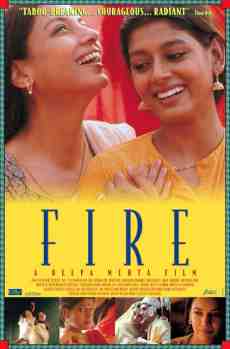
<p>The film opens with young Radha sitting in a mustard field with her parents. Her mother tells her a tale of a person who wanted to see the ocean, but Radha says that she does not understand the moral of the story. The film flashes forward to Sita, a newly married woman on honeymoon with her husband Jatin, who is distant and shows little interest in Sita. Jatin is in a typical joint-family arrangement – he lives with his older brother Ashok, his sister-in-law Radha, his paralysed mother Biji and the family servant Mundu. Ashok and Jatin run a small store that sells food and rents videotapes. Jatin shows no care for Sita, and she learns that he only agreed to the arranged marriage in order to put an end to Ashok’s nagging. Jatin continues to date his modern Chinese girlfriend, and Sita does not rebuke him. The rest of Jatin’s home is not rosy either. Biji is immobile and speechless after a stroke, and Sita and Radha must constantly attend to her. Sita spends her days slaving in the hot kitchen, and finds herself lonely and frustrated at night because Jatin is out with his girlfriend. She yearns to break out of this stifling situation. It is revealed that Radha faces a similar problem. Many years ago, Ashok had come under the influence of Swamiji, a local religious preacher, who teaches that desires are the cause of suffering and must be suppressed. Ashok is completely taken by these monastic teachings and suppresses all his desires. He also donates large sums from the meager store income to treat the Swamiji’s condition. The Swamiji teaches that sexual contact is permitted only as a means for procreation, and Radha is infertile. Accordingly, Ashok aims to stamp out all his desires and has not slept with Radha for the past thirteen years. He puts Radha through an excruciating ritual in which they lie motionless next to each other whenever he wants to test his resolve. Radha is racked with guilt over her inability to have children and driven to frustration by the ritual. While the older Radha remains bound by tradition and subdued into silence, the younger Sita refuses to accept her fate. Sita’s attitude slowly spills over onto Radha, who becomes slightly more assertive. One evening, shunned by their husbands and driven to desperation by their unfulfilled longings, Radha and Sita seek solace in each other and become lovers. Overjoyed at finding satisfaction in this manner, they continue it in secret. They eventually realise their love for each other and start looking for ways to move out. The pair’s daily antics and adventures are witnessed by Biji, who disapproves, but is unable to stop them. After some time, Mundu becomes aware of their relationship, and he causes Ashok to walk in on Radha and Sita. Ashok is horrified. He is also shattered when he finds this incident has stoked his own long-dormant desire. Sita decides to pack her belongings and leave the house immediately, while Radha stays behind in order to talk to her husband. The women promise to meet each other later that night. Ashok confronts Radha, who overcomes her subservience and pours out her emotions. Amid this argument, Radha’s sari catches fire, and Ashok angrily watches her burn without helping. Radha puts out the flames and recalls her mother’s advice from when she was young – she can finally see her ocean. An injured Radha leaves Ashok, moving out in order to join Sita. The film had a budget of $800,000 and the crew deferred their salaries, worth $450,000. was passed uncut by India’s film certification board (the ) in May 1998 with a rating of , the only condition being that the character Sita’s name be changed to Nita. The board made their decision based on what it called the importance of the story for Indian women. The film was first screened on 13 November 1998 and ran to full houses in 42 theaters in most metropolitan cities throughout India for almost three weeks. On 2 December, more than 200 stormed a Cinemax theatre in suburban in , smashing glass panes, burning posters and shouting slogans. They compelled managers to refund tickets to moviegoers. On 3 December, a Regal theatre in was similarly stormed. Mina Kulkarni, one of the Delhi protesters explained the reasoning behind their actions: “If women’s physical needs get fulfilled through lesbian acts, the institution of marriage will collapse, reproduction of human beings will stop”. workers with invaded Rajpalace and Rajmahal in Surat, breaking up everything in sight and driving away frightened audiences. Some of the rioters set fire to theatres screening the film. Theatres in Surat and Pune stopped screening the film on the same day. When attackers attempted to shut down a screening in , however, ushers and audience fought back and the movie stayed open. Twenty-nine people were arrested in Mumbai in connection with these incidents. Chief Minister supported the actions to shut down screenings of : “I congratulate them for what they have done. The film’s theme is alien to our culture”. On 4 December, the film was referred back to the Certifying Board for a re-examination by the . The Indian government was criticised for siding with the vandals. On 5 December a group of film personalities and free speech activists, including , Indian movie star , and director , submitted a 17-page petition to the Supreme Court asking that a “sense of security” be provided, in addition to basic protection, so that the film could be screened smoothly. The petition referenced articles 14, 19, 21, 25 of the , which promise the right to equality, life and liberty, freedom of speech and expression, freedom of conscience, free expression of religious practice and belief, and the right to hold peaceful meetings. On being asked the reason for discomfort, said that he has not seen the film and was not much concerned about its content but rather the kind of vandalism that takes place on their cultural life, whenever such issue comes up. On 7 December, Mehta led a candlelit protest in New Delhi with activists from 32 organisations, including CALERI, against the withdrawal of , carrying placards, shouting anti- slogans and crying for the freedom of right to expression. On 12 December about 60 Shiv Sena men stripped down to their underwear and squatted in front of ‘s house to protest his support of . 22 were arrested and Kumar, as well as others involved in the production of the film were provided with police security. Cinemax reopened screenings of on 18 December, but a hundred members of the (BJP) vandalised posters at the Sundar Theatre in despite the police commissioner’s reassurance that protection has been arranged. was re-released without cuts by the Censor Board on 12 February 1999. Theatre screenings were resumed on 26 February and continued without incident. and the conversation that began around the movie’s general reception, both by supporters and detractors, encouraged lesbians and gay rights activists in India to be more vocal about their existence and the erasure of queerness from India’s historical heritage. The release of this movie corresponded with the beginning of widespread national conversation about lesbian and gay rights. A new lesbian rights group, calling themselves the Campaign for Lesbian Rights (CALERI), formed in response to the backlash. This group held their own peaceful gatherings across India. The soundtrack was composed and performed by except for tracks “Ramayan” and “Allah Hu”. “Julie’s Theme” and “China Town” were added as bonus tracks and were not used in the movie. A. R. Rahman reused or reworked some of his acclaimed songs from . In the weeks following its release, reviewers praised the film’s explicit depiction of a homosexual relationship as “gutsy”, “explosive”, and “pathbreaking”. Following the attacks on the film, prominent party members said had been targeted because it was an “immoral and pornographic” film “against Indian tradition and culture”. The lesbian relationship depicted in the film was criticised as “not a part of Indian history or culture”. Other politicians of the Hindu right voiced fears that the film would “spoil [Indian] women” and younger generations by teaching “happy wives not to depend on their husbands” and informing the public about “acts of perversion”. Speaking on the dangers of , Shiv Sena chief compared lesbianism to “a sort of a social AIDS” which might “spread like an epidemic”. Furthermore, Thackery claimed that the film was an attack on because the protagonists were named and , both significant goddesses in Hindu belief, and that he would withdraw his objections to the film if the names were changed to Muslim names. A statement issued from the Shiv Sena’s women’s wing said: “If women’s physical needs get fulfilled through lesbian acts, the institution of marriage will collapse, reproduction of human beings will stop”. Critics charged the Shiv Sena of committing “cultural terrorism” and of using the rhetoric of “Indian tradition” to protest images of female independence and suppress freedom of speech: “The justification for [Shiv Sena’s] action… demonstrates that Indian ‘culture’ for the is defined essentially in terms of male control over female sexuality”. Gay activist criticised the Shiv Sena’s protests as “gay-bashing” and disputed their claims that lesbianism was “against Indian tradition”, indicating that homosexuality is in fact abundantly present in and that the criminalisation of homosexuality in India was a legacy of and . Pointing to evidence of lesbianism in Indian tradition, he said: “What’s wrong in two women having sex? If they think it doesn’t happen in the Indian society they should see the sculptures of or “. Feminist critics of Mehta’s films argue that Mehta’s portrayal of women and gender relations is over-simplified. Noted Indian feminist authors Mary E. John and wrote in 1999 that reduces to the denial and control of female sexuality. The authors make the point that the film traps itself in its own rendering of patriarchy: Control of female sexuality is surely one of the planks on which patriarchy rests. But by taking this idea literally, the film imprisons itself in the very ideology it seeks to fight, its own version of authentic reality being nothing but a mirror image of patriarchal discourse. ends up arguing that the successful assertion of sexual choice is not only a necessary but also a sufficient condition—indeed, the sole criterion—for the emancipation of women. Thus the patriarchal ideology of ‘control’ is first reduced to pure denial – as though such control did not also involve the production and amplification of sexuality – and is later simply inverted to produce the film’s own vision of women’s liberation as free sexual ‘choice’. (1999:582) Whatever subversive potential might have had (as a film that makes visible the ‘naturalised’ hegemony of in contemporary culture, for example) is nullified by its largely assumption that men should not neglect the sexual needs of their wives, lest they turn lesbian (1999:583). The authors additionally argue that viewers must ask tough questions from films such as that place themselves in the realm of “alternative” cinema and aim to occupy not only aesthetic, but also political space (Economic and Political Weekly, 6–13 March 1999). , then-editor of , wrote a highly critical review of , finding fault with the depiction of the characters in the film as a “mean spirited caricature of middle class family life among urban Indians”. She claimed that homosexuality was socially accepted in India as long as it remained a private affair, adding that “did a disservice to the cause of women… by crudely pushing the Radha-Sita relationship into the lesbian mould”, as women would now be unable to form intimate relationships with other women without being branded as lesbians. expressed frustration in interviews that the film was consistently described as a lesbian film. She said “lesbianism is just another aspect of the film… is not a film about lesbians”, but rather about “the choices we make in life”. In 2010, veteran film critic and activist Shoni Ghosh wrote a book named that studies in detail the movie as well the controversies ignited by the film. The book detail the situations that lead to the chaos and its aftermath.</p>
Details
🎬
Genres:
Action
✍️
Writer:
Deepa Mehta
👤
Producer:
Bobby Bedi, Deepa Mehta
🎵
Music:
A. R. Rahman
🎬
Director:
Deepa Mehta
📸
Cinematography:
Giles Nuttgens
👥
Starring:
Nandita Das, Shabana Azmi
📅
Release Date:
06-Sep-96
✂️
Edited By:
Barry Farrell
💸
Budget:
Rathina Shiva
🏭
Production Company:
📺
OTT Platform:
Prime Video
⏱️
Runtime:
1h 48m
🗣️
Language:
Hindi
💵
Box Office:
Kadhal Sukumar
🌐
Other Languages:
📄
Screenplay:
🔒
Censorship:
Reviews
There are no reviews yet. Be the first one to write one.