
0
0 out of 5 stars (based on 0 reviews)
Excellent
Very good
Average
Poor
Terrible
Your Rating for
Eega
Streaming On
Trailer
https://www.youtube.com/watch?v=x-1ZoU1xB4I
Soundtrack
Storyline
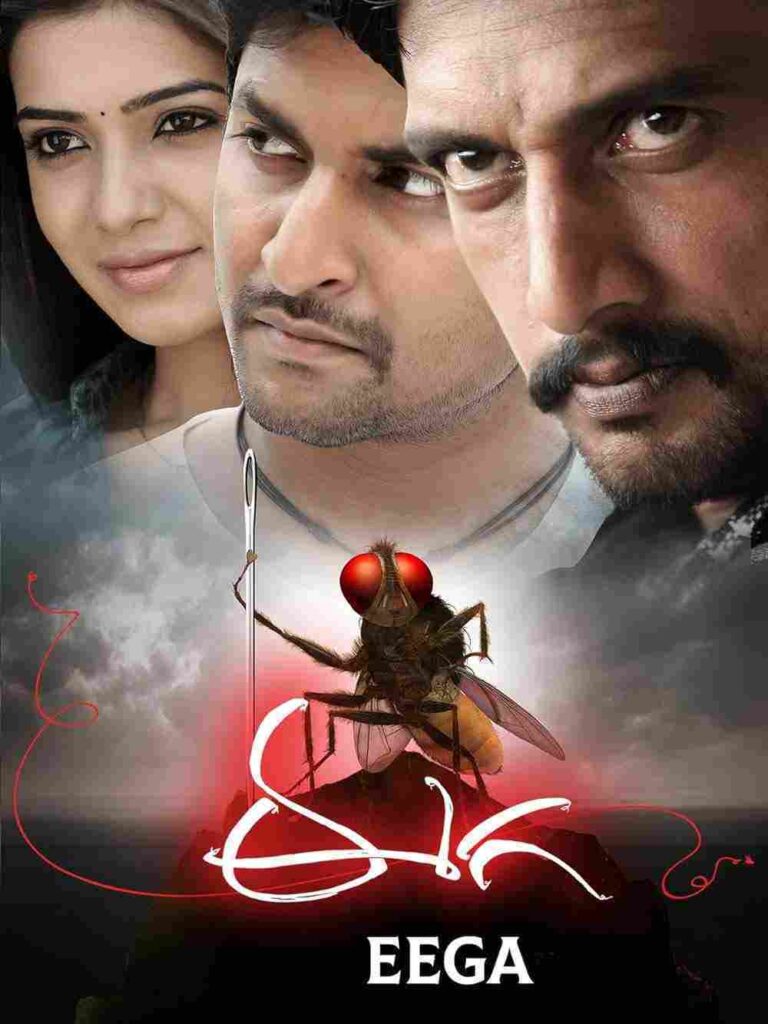
<p>A young girl who is unable to sleep asks her father to tell her a . Although reluctant at first, he tells her a story of a fly named Nani. Nani is a young man based in who specialises in preparing fireworks. He is in love with his neighbour Bindu, a who runs an NGO. Bindu also develops romantic feelings for Nani though she does not express them. Seeking to raise money for her NGO, Bindu visits the office of a rich and powerful industrialist named Sudeep, who also finds her attractive and starts lusting for her. He donates 15 (US$28,000), and befriends her. As days go on Sudeep’s attempts to woo her fail miserably as she does not even notice his intentions. One day he sees Nani following Bindu on the street and realizes that they are attracted to one another. Sudeep sees Nani as a rival and plans to kill him, to avoid competition. One night, Nani inspires Bindu to help her finish a piece of micro art—a heart locket made from a pencil. While returning home, Sudeep kidnaps and strangles Nani to death, making his death look like an accident. Before dying, Nani curses Sudeep, swearing to kill Sudeep if he tries to hurt Bindu. Unaware of the incident, Bindu confesses her love for the dying Nani by phone; it is the last thing Nani hears before he dies. Sudeep leaves the place with his men. Nani is then reincarnated as a housefly, but cannot remember his previous life. Nani, now a fly, struggles to regain his memory, which gets triggered when it encounters Sudeep and Bindu and begins to devote itself to exacting revenge on Sudeep. Sudeep asks the heartbroken Bindu to accompany him to New Delhi to meet the education minister; if she can impress the minister with a presentation about the NGO, he might help it gain national recognition. The fly causes Sudeep to have a freak accident on his way to the airport and writes “I will kill you” on the windshield; this makes Sudeep . The fly, who sees Bindu mourning Nani’s death in her bedroom, reveals itself to be Nani by writing on the desk with her tears. It conveys the circumstances of Nani’s death to Bindu, and they join forces against Sudeep. The latter’s obsession with the fly affects his professional and personal life. In a chain of events, his black money is burnt to ashes, leaving him almost penniless. Sudeep learns from a sorcerer named Tantra that the fly is none other than Nani, and that he yearns for revenge. Sudeep gets scared, and arranges to kill Nani at his home, but the fly escapes after causing a and a fire, which locks up the room. Tantra is killed in an accident and Sudeep is left unconscious from the smoke. Nani and Bindu assume Sudeep is dead, but he is saved by his business partner Adithya. Sudeep is enraged when he learns that Bindu is helping the fly. Sudeep kills Adithya to collect a 700 crore (US$130 million) insurance policy, as well as to prevent his investors from taking action against his company. Sudeep takes Bindu to his home to interrogate her, and Nani follows them. Bindu, after attempting to stab Sudeep with a box cutter, has her life threatened as Sudeep demands Nani to appear. During the encounter however, Nani seriously injures Sudeep with a needle. After an intensive fight, the latter clips Nani’s wing before fatally stabbing him with the same needle. Knowing that he is dying, in a last-ditch attempt to destroy Sudeep, Nani coats himself with gunpowder and jumps through the flame of a burning match and into a cannon, which was loaded with a steel ball. The cannon fires and the projectile passes through Sudeep’s chest and hits an oxygen cylinder, causing a fierce explosion in which Sudeep dies and his entire house burns down. A grieving Bindu (who hid from the inferno unscathed), pines for Nani and takes his wing and makes an with it. One day when travelling to work, an bothers her; Nani, again reborn as a , attacks him with a needle before announcing his return. The young girl is impressed with the story of the fly her father narrates. During the credits, her father recounts the fate of a drunken thief who broke into Bindu’s house earlier in the story; and who ultimately turns his life around after overhearing a loving speech given to Nani by Bindu and mistakenly believing that Bindu was speaking to him. I heard the story [of Eega] 16 years ago from my father about a fly who comes back to take revenge. At that time, I wasn’t even an assistant director. When I started making films, I stuck to formula films for a while which did well at the box office. After a while, I was getting too comfortable with what I was doing, so I wanted to experiment with something completely different. I wanted to take the audience by surprise and that is when I went back to the story I had heard 16 years ago. The idea of originated in the mid-1990s in screenwriter mind. At that time, he was joking about a housefly seeking revenge on a human in a conversation with his son . Prasad later developed the idea as a script for an English-language film set in 1830s America, in which an boy dies in an attempt to free his family from and is reincarnated as a fly. After completing (2010), Rajamouli reconsidered the concept after thinking of directing a film that was distinct from any other. He decided to make a bilingual film in and – each scene including speech was filmed twice, once for each language. The Tamil version, titled , was Rajamouli’s directorial debut in . The film was presented by of . For the first time in his career, Rajamouli began casting after the script was completed because he felt the story required actors who were suitable for the roles. , the protagonist, was the first of the three of the main cast members to be chosen; he completed filming his scenes in 25 days. , the second actor cast, was signed as the female lead. Rajamouli chose to play the fly’s human adversary after being impressed with the actor’s performance in (2010), and cast rapper as Nani’s friend in the film. Sudeepa drew inspiration for his role as the villain from the 1983 Kannada film ; he was portraying a character he considered to be a “bad guy” with “grey shades” rather than an antagonist. The script was by Rajamouli’s cousin, S. S. Kanchi, while Janardhan Maharshi and wrote the dialogue for the Telugu and Tamil versions respectively, marking their first collaboration with Rajamouli. James Fowlds was initially chosen as the film’s director of photography, but was replaced by due to creative differences and scheduling conflicts. composed the film’s soundtrack and score, edited the film, Ravinder Reddy was its art director, and Rajamouli’s wife Rama worked on the costume design. Production of the film began with a formal launch ceremony on 7 December 2010 in . The original version was filmed over a six-month period and cost nearly 11 crore; Rajamouli felt the quality of the material was poor and started again. The film’s final budget was estimated at between 30 and 40 crore. began on 22 February 2011 in Hyderabad; ninety percent of the film was shot at in the city. A sequence was filmed at Sri Sita Ramachandra Swamy Temple in Ammapally near , in early March 2011. Scenes with Nani, Samantha, and Sudeepa were filmed during the first shooting schedule, which was completed on 16 March. Shooting was disrupted in April by an ongoing labour dispute between film workers and producers. Rajamouli considered moving out of Hyderabad if the strike continued. Filming continued in in early September 2011, and principal photography was completed in late February 2012 as began. According to Rajamouli, the film unit consulted a 3D video of the before shooting a scene each day. After the filming of each scene was completed, the editing and re-recording procedures were done with simple animation. An camera, a , and Scorpio and Strada cranes were used for the principal photography, while a probe lens and high-intensity lighting were used for the . Senthil Kumar had to use a special lens with a minimum f-stop of f8.0; the wide apertures required high-intensity lighting to get acceptable shots. He used cameras as they were the smallest possible ones that offered close to professional resolution. was used to film extreme slow motion sequences; certain scenes were shot at 2,000 frames per second. (DI) was conducted at Annapurna Studios in Hyderabad. A high-end DI system was imported and the process took six months to complete. Singer , who dubbed for Samantha in , found the process difficult because the footage did not contain the animated fly. This was the first non-Kannada film to credit Sudeepa (previously Sudeep) by his new stage name. Rajamouli approached to write the dialogue for the Hindi-dubbed version titled . The Hindi dubbing began in Hyderabad, and Gurwara dubbed for Nani in the film. and , acting as parents telling the film’s story to their child at bedtime, provided voiceovers during the opening credits of . The visuals accompanying the closing credits were altered to show the fly mimicking the antics of Devgan, , and . R. C. Kamalakannan and Pete Draper of oversaw visual effects, and Rahul Venugopal was the film’s set supervisor and . , who later collaborated with Rajamouli on , worked on a short sequence for the film. Rajamouli planned to complete work on the fly imagery in four months, but it took fourteen. Ninety percent of the animation-related work was done in Hyderabad; the remaining ten percent was completed in the United States. In an interview, Draper said he collaborated with thirteen experts and a large team of animators to design the fly. Because the film’s fly’s eyes comprise 80 percent of its face, Rajamouli felt they could make it expressive; he used the 1986 American short film for inspiration. The output of the first team of animators, using the reference material prepared, was unsatisfactory, and Rajamouli reworked the fly’s detailing. Using a powerful lens, the film team conducted an arduous photographic shoot of unconscious flies in a bottle stored in a refrigerator. After enlarging the details, Rajamouli made cosmetic changes to the fly’s face to make it look appealing onscreen. A new team, including Draper, three concept artists, three modellers, two shader designers, two hair and fur designers, three riggers and several animators, designed the animated fly in two months. Its head and fur were designed after shaping its body and wings. The fly was refined daily using clay models to expedite the process. The animators found the sequences between Sudeepa and the fly much more difficult to execute because the latter had to express emotions only through its slender arms rather than its face. Some of the special effects could not be designed in India, so Makuta VFX engaged animation consultants in Armenia, China, Iran, Israel, Russia, the United Kingdom, and the United States. The company’s 30-member team underwent a training programme on acting theory and insect formats. is the first Indian film to use for nearly 90 minutes of its length; the film had 2,234 shots. By mid-June 2012, Rajamouli had approved 1,970 shots; the final version was shown to the film unit after the approval of 226 pending shots. The visual effects cost an estimated 7 crore. The film’s main theme is revenge; the soul of a murdered man is reincarnated as a fly and seeks revenge against his killer. Rajamouli identified some similarities to (1986), in which a scientist becomes a fly when his experiment malfunctions, and thought of as a ” ” rather than a . At a meeting with students at the Annapurna International School of Film and Media Campus (AIFSM), he compared the battle between the fly and Sudeepa, which the underdog fly wins, to triumph over and India’s victory in the . Crazy Mohan compared the film with (1989), a revenge drama whose protagonist Appu ( ) is a . Mohan told Malathi Rangarajan of that although the film’s script may resemble those of (1999) and (2001), the use of the plight of someone tormented by a housefly was an original idea. According to Tamil film historian and actor , —unlike the animal-centred films (1972) and (1979)—lacks a human protagonist. Film critic found protagonist realistic, contrary to the ones in the animated films by , except when it displays a few traits. compared to (2010), an Australian short film about a man who is reincarnated as a cockroach after he is accidentally killed on his wedding day. The film’s secondary theme is the survival of love beyond death. Rangan has likened to a ghost film because a dead protagonist returns to his loved ones as a troubled soul. Malini Mannath of found the scene where the fly foils Sudeepa’s attempt to get close to Bindu reminiscent of one in the film (1990). criticised the relationship between the lead pair, which he said advocates stalking as an accepted form of romance. Malathi Rangarajan said the antagonist took the “extreme step” of murdering the hero early in the film, in contrast with the stereotypical antagonist whose lust for the female lead has just begun and threatens the hero. Commenting on the usage of , Kruthi Grover found the death of the similar to the story of , a demon in Indian mythology to whom gives the power to reduce a person to ashes by touching her or his head. When Bhasmasura tries to touch Shiva’s head, assumes the form of and makes Bhasmasura touch his own head, killing him. According to Malathi Rangarajan, the film’s themes of Tantrism and black magic are reminiscent of the use of the occult as a plot device in films directed by . The soundtracks of and , each consisting of five songs—one of which is a remixed version of the film’s title song—were composed by M. M. Keeravani. Keeravani said because the film’s theme of revenge and the protagonist (a housefly) are universal concepts, his “only challenge” was ensuring the music did not have a “distinct ethnic or regional flavour” and “appeal”. He incorporated the buzzing sound made by flies into the score and exaggerated or reduced it according to a scene’s emotional nature. Rajamouli approached to write the lyrics for soundtrack after the release of (2010), explaining the importance of each song in the film’s narrative. As well as providing detailed profiles of the characters, Rajamouli enacted a few scenes, which helped Karky write the lyrics. soundtrack was released on 4 April 2012 at a promotional event at Shanti Sarovar, ‘ academy in , a suburb of Hyderabad. The soundtrack for was released on 2 May at another promotional event at in Chennai. soundtrack release on was delayed until 7 April to avoid piracy and illegal downloads. Writing for , Sangeetha Devi Dundoo called the soundtrack “melodious … sharply contrasted by the background score, which seamlessly moves from sober to playful to pulsating”. Another critic for , S. R. Ashok Kumar praised rendition of “Konjam Konjam”. Kumar appreciated the use of violins in “Eedaa Eedaa” and called “Lava Lava” “a good number”. Karthik Pasupulate of wrote that Keeravani “just seems to reserve his best for [Rajamouli]”, calling the soundtrack “one of his finest”. , with and , was released on 6 July 2012 on approximately 1,100 screens. The levied on at the rate of 30%. Hindi-dubbed version, titled , was released on 12 October 2012. The film was further dubbed into as and released with the slogan “Kisasi Cha Mwisho” ( ). was released in Tanzania, Kenya, Uganda, Rwanda, Burundi, and Republic of the Congo, making the first Telugu film to be released in Africa. Global distribution rights for the Telugu version were sold for 34 crore (US$6.24 million), and acquired distribution rights for 5 crore. Outside India, 14 Reels Entertainment distributed and in association with Ficus, Inc. acquired distribution rights. Weeks after release, its pirated version was released; it was illegally filmed in a theatre in , . A forensic investigation on the pirated copies determined that a camcorder was used in the process. The digital watermarking also helped investigators locate the source of the piracy of to a theatre in . According to Rajamouli, was illegally downloaded 655,000 times within a week of the pirated version being leaked on the Internet. Rajamouli added that a database of IP addresses of non-resident Indians who frequently download content was shared with immigration authorities which could affect their potential applications. The anti-piracy cell delinked more than 2,000 links to the pirated versions of on the internet. satellite television rights were sold to for 3.35 crore—a record price for a Telugu director’s film, exceeding Rajamouli’s initial expectations. television-broadcast rights were sold to for 8 crore. According to STAR Gold general manager Hemal Jhaveri, television premiere had a rating of 3.5; trade analyst Sreedhar Pillai called its performance “phenomenal”. In November 2012, released on with English subtitles and surround sound. The release also contained a two-hour DVD about the the film. J. Hurtado of reviewed the Blu-ray version, writing, “The most egregious mangling of the film comes in the form of a severely fucked contrast scale, which leads to absurdly crushed black levels rendering nearly all shadow detail completely obliterated”. Hurtado called the audio a “thing of beauty, giving good separation and a booming low end that puts you in the middle of the action in a way that even my theatrical experience couldn’t do”. According to trade analyst , netted 17 crore in South India on its first day of release. On its opening weekend, it grossed US$538,996 from 31 screens in the United States—a per-screen average of $17,387. In ten days, grossed 13 crore from 208 screens in Tamil Nadu. On its second weekend, grossed $253,334 from 42 screens in the US, bringing its ten-day total in that country to $913,046. By then, had grossed a total of $14,259 in the United States. earned 18 crore in three weeks at the Tamil Nadu box office—a record for a bilingual, Telugu-Tamil film. By early August 2012, the combined distributor share for the Telugu and Tamil versions was 57 crore. The Hindi-dubbed version, , had not achieved equivalent commercial success as of June 2015. According to , the film grossed 115 crore globally as of August 2012. Its final global gross is estimated at 125 to 130 crore ($23–24 million). grossed nearly $1.08 million in the United States; it was one of the country’s highest-grossing Telugu films. It was declared the highest-grossing bilingual film in Tamil Nadu after it earned 24.66 crore, with a distributor share of 8.5 crore, in 50 days. The film broke the record held by (2009), whose Tamil-dubbed version earned a distributor share of 6.5 crore. Indo-Asian News Service stated that was the highest-grossing Telugu film of 2012, but said it was the second-highest (after ) in box-office revenue. According to , and were the only 2012 big-budget Telugu films to break even and have a positive audience response. opened poorly, despite positive word-of-mouth, eventually ending up as an average grosser. Regarding the performance of , Rajamouli felt the film was poorly presented and did not reach its theatrical audience even though it was better received on television, and so later on collaborated with filmmaker – whom he considered the “one missing link” – on the presentation of the Hindi-dubbed version of his later film, . On the website , of 10 critics’ reviews are positive, with an average rating of 7.5/10. Baradwaj Rangan, writing for , said without a human protagonist, only a villain and a heroine, the audience is “led through a story that’s funny, sentimental, action-packed, romantic—there’s even a bit of the occult thrown in”. Also for , Malathi Rangarajan wrote, “Let’s celebrate the figment of [Rajamouli’s] imagination that has made the housefly appear as invincible as any of our muscle-flexing heroes”. Karishma Upadhyay of called the film “a winner from the first frame to the last” and praised Rajamouli’s screenplay, writing that it made “the absurd seem real, willing you to accept anything that he throws at you”. J. Hurtado of Twitch Film called the “best, most insane, most inventive film of the year”, and praised Rajamouli’s scripting, the visual effects and Sudeepa’s performance, calling the latter “legitimately hilarious”. V. S. Rajapur, Indo-Asian News Service gave four stars out of five, and praised the performances and music; Rajapur was particularly appreciative of the visual effects, saying the hard work put in by the entire team was “clearly visible onscreen”. A reviewer from called an “escapist, comic book-like fantasy” that “throws you into an experience so profound that nothing else really matters”. Radhika Rajamani of awarded four stars out of five; she praised its visual effects, performances and cinematography and said Sudeepa “is such a delight to watch on screen”. Karthik Pasupulate and M. Suganth of both gave four stars out of five; Pasupulate said it offers a “mind-bending thrill-a-second ride of the season, probably the decade”. Suganth called it a “bravura piece of commercial filmmaking that is an unqualified triumph in every aspect”. of gave the film four stars out of five and praised its concept, and said Sudeepa played his role with a “true comic book flair” and a “cartoonish tinge”. Writing for , praised “sharp clenched narrative”, which overshadowed the “shaky plot”. He further wrote, “Gutsy sly and original, this is the entertainer of the season”. gave the film four stars out of five in a review for and called it a “mad roller coaster ride that’s worth taking” and the “most outlandish film [she has] seen in years”. Shabana Ansari rated three stars out of five in a review and called the animated fly a “new-age Indian hero” with “lofty ideas”. Kruthi Grover of wrote that lacks a proper structure despite having effective visual effects and editing. She added that the film turns into a “silly animated movie for kids” after the fly’s birth. Reviewing for , Mayank Shekhar said the film’s premise is stretched beyond its potential and that as a result, it “just goes on and on and on” in its “original, tacky, raw form”. received the and awards at the . It later received a B. Nagi Reddy Memorial Award as Best Wholesome Entertainment from the . At the received seven nominations and won five awards, including , , and (Sudeepa). Samantha received Filmfare Best Actress awards in the and categories for her performances in and , becoming the third Indian female actor to win these awards in both languages in the same year (after and , who won 1972 and 1993 Best Actress awards for , and and respectively). At the , received seven nominations and won three awards; Best Film, Best Cinematographer, and Best Actor in a Negative Role. Ravinder Reddy won the Best Art Direction Award at the 2013 Fantaspoa International Fantastic Film Festival in Brazil for his work in . The film won nine awards, including Most Original Film, Best Film to Watch With a Crowd, and Best Special Effects at the in November 2013. At the in 2013, Sudeepa won the for his performance in . won eight awards at the , including , and for Rajamouli, Sudeepa and M. M. Keeravani respectively. The film’s Telugu version was shown at film festivals worldwide. In December 2012, it was shown at the annual . After showings at the L’Étrange and film festivals, it was the only Telugu film screened in the section of the and the panorama section of the . is the only Telugu film to receive six nominations at the Madrid International Film Festival, and is the first Indian Best Film nominee. Nominations at the 2013 edition of the film festival included Best Film, Best Supporting Actor (Sudeepa), and Best Cinematographer (Senthil Kumar). The film was invited to the 2013 in South Korea, and was the fifth foreign-language film shown at the in October 2013. Sudeepa received national recognition for his performance in ; told him, “I thought I was the best villain to date. But you beat me to it”. His performance was appreciated by other celebrities such as , , and ; Varma said he recognised Sudeep’s potential after watching , adding, “Many take his acting in that film for granted, with respect to his expressions when interacting with the fly, but as a director, I know how difficult it is to act when you are imagining the fly to be there”. Sudeepa’s performance in impressed filmmaker , who cast him as the antagonist in (2015). Speaking about the centenary of Indian cinema at the CII Media & Entertainment Summit 2012, filmmaker said regional cinema is surpassing Hindi cinema in content and story, and cited as an example. Kapur said he was impressed with its story and use of technology, and called it “no less than a Hollywood superhero film”. called an “awesomely original” film and a “must watch” with children. cited Nani’s performance in as one of the reasons she worked with him in (2015). was parodied twice in comedy film (2012); when a young girl asks her father to tell her a bedtime story in the opening credits, and in a scene in which the protagonist threatens to kill a female crime boss with weapons designed by Rajamouli, including the fly’s needle. In December 2012, and Sudeepa topped Radhika Rajamani’s Rediff.com “Top Five Telugu Films of 2012” and “Best Telugu Actors of 2012” lists; according to her, Sudeepa left an “indelible” mark on the film and gave an “exceptionally good account” of himself as the antagonist. Shobha Warrier of Reddif placed Sudeepa on her list of “Top Tamil Actors of 2012”, writing that his performance was “so superlative and far superior to any other actor’s in Tamil” that it “has to be termed as the best performance of the year”. Radhika Rajamani ranked Rajamouli first on her “Top Telugu Directors of 2012” list, which was published in January 2013. In 2020, Sankeertana Verma of included the film in her list of “25 Greatest Telugu Films Of The Decade”. Adam Nayman of listed among “The 25 Best Foreign Films of the Decade”. In August 2015, Pooja Darade of included in her list of “Telugu movies one must watch before dying”; she said it “has set a high standard of how creativity can be used effectively”. In an April 2016 interview with , Tamil actor said films like (1983), , , and (2014) are remembered much longer than more conventional films. In 2019, the film’s plot was widely shared on social media in Spanish-speaking countries because of its unique plot that involved a fly taking revenge on a human.</p>
Details
🎬
Genres:
Drama
✍️
Writer:
S. S. Rajamouli
👤
Producer:
Sai Korrapati
🎵
Music:
🎬
Director:
S. S. Rajamouli
📸
Cinematography:
K. K. Senthil Kumar
📅
Release Date:
06-Jul-12
✂️
Edited By:
Kotagiri Venkateswara Rao
💸
Budget:
40.00 crore
🏭
Production Company:
📺
OTT Platform:
⏱️
Runtime:
🗣️
Language:
Telugu
💵
Box Office:
130.00 crore
🌐
Other Languages:
📄
Screenplay:
🔒
Censorship:
Reviews
There are no reviews yet. Be the first one to write one.