
0.0
0.0 out of 5 stars (based on 0 reviews)
Excellent0%
Very good0%
Average0%
Poor0%
Terrible0%
Your Rating for
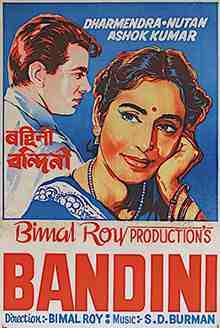
Bandini
Streaming On
Trailer
https://www.youtube.com/watch?v=YDfTgKANnZM
Soundtrack
Storyline
<p>The film is set in a prison in around 1934 in pre-Independence India, where Kalyani is serving life imprisonment prison for committing a murder, and we learn the circumstances of her crime in a series of as she divulges it to the jailor. The film is set in in the 1930s, during the , where Kalyani is the daughter of the postmaster of the village, who falls in love with a freedom fighter, Bikash, who later leaves her in the village promising to come back but never does. Society treats them harshly. Broken by her father’s misery and that of her own, Kalyani moves to the city, while the song “O Jaanewale Ho Sake To Laut Ke Aana” plays. In the city, she works as a caretaker of an obnoxious and mentally unstable woman, who turns out to be the wife of Bikash. Kalyani learns that her father came to the city looking for her and died in an accident. This prompts her to poison her lover’s wife, identifying her as the cause of her miseries in a moment of insane rage. Back from the flashback in the jail, Deven, the jail doctor falls in love with her. Kalyani is not ready for it and starts to stay away from him. They are always shown with a partition in between after Deven proposes her. Another symbolism used in the movie is the occasional shouting of “All is well” by the prison guard when nothing in the movie is; and just as Kalyani is leaving prison for good, she receives yet another ironic message from a jail official, “Ab ghar grihasthi ki jail mein qaid rahogi!” (Now you will be imprisoned in the jail of household!) In the end, she finds Bikash at a ship harbour where she finds him in an ill condition. She then decides to take care of Bikash and her love is again reborn. The screenplay of the film was written by , who had previously done the films (1955) and (1959). It was based on the story by , pen name of Charu Chandra Chakraborty, a former jail superintendent who wrote many stories based on his career as a jailor in Northern Bengal, including many fictional versions of his experiences, (1953), (1958) and (1961), effective creating a new genre in of prison stories. The principal photography of the film took place at Mohan Studios in Mumbai, with some parts in , and Central Jail, and the climax scene on the banks of the at , in present Jharkhand. The soundtrack includes the following tracks, composed by , with lyrics by . The film also marks the debut of , who was working as an assistant director on the film as a film lyricist, initially having refused Bimal Roy on the offering, saying that he didn’t want to become a lyricist, Gulzar relented only after the film’s music director convinced him so, and he wrote the song “Mora Gora Ang Lai Le”, sung by Lata, in five days. The rest of lyrics are by , who gave classics like the haunting “Mere Sajan Hain Us Paar” in the bardic voice of S.D. Burman himself, Mukesh’s sad song “O Jaanewale Ho Sake”, where Burman uses with a variation. The songs depict the situation, like a prisoner singing an ode to an imprisoned bird, “O Panchhi Pyare”, sung by Asha Bhosle and Asha Bhosle’s “Ab ke Baras Bhej Bhaiya ko Babul” composed in , uses the folk idiom of a traditional song of a newly married girl longing for her maternal home, ( ), but being sung by a prison inmate of Kalyani, immediately conveys the irony in its placement. at Bimal Roy Online Museum</p>
Details
✍️
Writer:
Nabendu Ghosh, (screenplay), Paul Mahendra, (dialogue)
👤
Producer:
Bimal Roy
🎵
Music:
Sachin Dev Burman
🎬
Director:
Ashok Kumar, Nutan
📸
Cinematography:
Kamal Bose
👥
Starring:
Nutan, Ashok Kumar, Dharmendra
📅
Release Date:
16-May-05
✂️
Edited By:
Madhu Prabhavalkar
💸
Budget:
🏭
Production Company:
📺
OTT Platform:
⏱️
Runtime:
2h 37m
🗣️
Language:
Hindi
💵
Box Office:
🌐
Other Languages:
📄
Screenplay:
🔒
Censorship:
Reviews
There are no reviews yet. Be the first one to write one.