
Movie Info
ℹ️ More Movie InfoTrailer
Storyline
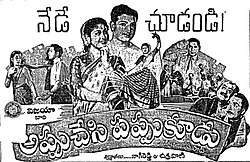
Ramadasu, a devious who recently acquired the colonial title of , is a perennial debtor who believes in leading a luxurious life on credit. Mukunda Rao, a wealthy, generous but naive zamindar, is searching for a royal bridegroom for his granddaughter Manjari. While Ramadasu also borrows from Rao, he secretly wishes to have Manjari married to his son Raghu, so that Rao’s wealth becomes his, enabling him to pay his debts. Complicating things is Raghu’s earlier marriage in his childhood to Leela, whose brother Raja is in prison for his participation in the . In order to get more credit, Ramadasu uses his shrewd manager Bhaja Govindam to find more lenders, and placate angry creditors with false promises. Behind Govindam’s back however, Ramadasu bribes Govindam’s uncle and Rao’s manager, Ramalingam, with the promise of getting Ramalingam’s daughter Usha, who Govindam is in love with, married. Rao, unaware of the deception, agrees to the alliance. Fed up of his boss’s backstabbing, Govindam, Usha and Manjari conspire to stop the wedding. Raja is released from prison after serving his sentence, and is briefed about the situation. Raja and Manjari were in love during their college days, and she tells him about Ramadasu’s intentions. Raja confronts Ramadasu about his sister’s ill treatment, and gets into a scuffle with his bodyguard. Ramadasu offers to let Leela stay in the house on the condition that she becomes a mute servant. After Raghu arrives from London, Ramadasu misleads him into thinking that Leela has died. As part of his plan, Govindam has Raja disguised as Prince Bonkulamarri Raja, a royal prince and businessman, and enters him into Rao’s house. Rao is impressed with Raja and considers him a suitable bridegroom for Manjari. One night, Raghu hears Leela speaking to Raja, and confronts Chenchalayya, Ramadasu’s servant, who divulges her identity and Raja’s secret. Raghu meets with Govindam and is briefed about the plan, but asks him to not tell anyone. Raghu then continues to flirt with Manjari and play the prospective bridegroom, while also trying to tease Leela, much to Ramadasu’s chagrin. After the success of (1957), directed by , and of planned to make a contemporary film. Chakrapani came up with an idea about conflict between two older men who are polar opposites: one a debtor evading his creditors, and the other a wealthy gentleman with an inflated sense of prestige. was chosen to direct the film; he, Chakrapani and developed a script entitled , after a popular Telugu idiom. It was the only film from Vijaya Productions with dialogue written by Sadasivabrahmam. Film historian opines that was a Telugu remake of Prasad’s Tamil film (1958). Others such as and (authors of ), film scholar Swarnavel Eswaran Pillai, and M. L. Narasimhan of believe that they were filmed simultaneously with different casts for different versions. wrote the dialogue for , and M. S. Chalapathi Rao and Jagannadham were the film’s executive producers. and were chosen for the lead roles, with , , and in supporting roles; Jamuna had no dialogue for most of the film. It was Rama Rao’s 55th film as an actor, and Jaggayya’s first film for Vijaya Productions. Jaggayya replaced , who bowed out due to scheduling conflicts. Jaggayya had worked with Prasad as a for the Telugu-dubbed version of the director’s (1954). Comedian and made appearances as the prospective bridegrooms of , who played fiancée; the former made his debut with this film. Prasad, who received 1,116 for his single scene, praised Nagi Reddi and Chakrapani’s generosity. was the director of photography. composed the soundtrack and background score, assisted by Ogirala Ramachandra Rao and K. Prasada Rao. Ramachandra Rao’s son, Narasimhamurthy, was cast as a child artiste. G. Kalyanasundaram and K. Radhakrishna edited the film, and Madhavapeddi Gokhale and Kaladhar were its art directors. The success of (1955) encouraged Chakrapani to include a dream sequence, “Damayanti Swayamvaram”, in which Rama Rao, Savitri and Jaggayya play , and . Rama Rao had to shave his signature moustache for a scene, making the only contemporary film in which he is clean-shaven. Another dance scene, “Aathmathyagam”, was filmed by and in ; both were choreographed by Pasumarthi Krishnamurthy. Though the film is shown almost entirely in black and white, “Aathmathyagam” alone was filmed in colour. M. Pithambaram and T. P. Bhaktavatsalam provided the make-up. was processed at the Vijaya Laboratory, and was recorded with the Westrex Sound System. The film’s final length was 4,934 metres (16,188 ft). S. Rajeswara Rao composed the soundtrack of . wrote the lyrics. Sound mixing was supervised by A. Krishnan and V. Sivaram, processed by N. C. Sen Gupta and orchestrated by A. Krishnamurthy. provided vocals for Rama Rao and Ramaiah, and sang for Jaggayya’s portions. , , and Swarnalatha provided vocals for the actresses. “Echatinundi Veecheno” was based on the . For “Sundarangulanu Choosina Velana” Rajeswara Rao re-used the melody of “Brundavanamadi Andaridi Govindudu Andarivadele”, which he wrote for Vijaya Productions’ at Chakrapani’s urging (a rare example of the composer recycling an earlier song). soundtrack was released in December 1959 on the label. “Kaseeki Poyanu Ramahari”, “Echatinundi Veecheno”, “Moogavaina Emile Nagumome” and “Cheyi Cheyi Kaluparave” became popular over the years; “Cheyi Cheyi Kaluparave” was parodied by the as part of their election campaign during the . The poem “Nava Kala Samithi” and other popular songs were played by keyboardist V. Seetharamaiah at the April 2013 Ghantasala Padya Sangeetha Vibhavari event at Kalabharathi Auditorium in . All lyrics are written by . was released theatrically on 14 January 1959, during the festival season. With mediocre earnings during its first four weeks, the film became an above-average grosser. Its re-release was profitable, and it became a Telugu cult film. According to M. L. Narasimham of , Prasad’s “deft handling” made the scenes “flow smoothly” despite the number of characters but the magic of (1952) and was missing from . In their , Ashish Rajadhyaksha and Paul Willemen wrote that the film “stages the victory of nationalist-modern alliance over decadent feudalism”; Ramaiah’s scenes are its “most remarkable sections”, giving a “semblance of unity” to a plot they found “barely coherent”. K. Moti Gokulsing and Wimal Dissanayake wrote that , , (1962) and (1964) “represented the scope comedy had in the 1950s and 60s.” In September 2006, a postage stamp commemorating Prasad was issued in . M. L. Narasimham, in an article about the honour, listed with (1950), (1950), , , and others as acclaimed films by the director after the release of (1949) and his association with Vijaya Productions. was one of the popular 1950s films featuring and Relangi Venkata Ramaiah, whom film historian Punnami Ravi Chandra termed the of Telugu cinema at the time. 2008 comedy film of the same name, starring , was a commercial failure. In late November 2007, -based Goldstone Technologies acquired the rights to 14 Telugu films produced by Vijaya Vauhini Studios (including and ) to produce digitally-remastered versions in colour. Although the remastered, colourised version of was released in January 2010 and performed well in theatres, Goldstone decided not to remaster the remaining 13 films. According to the company, most of the producers who sold their negative rights to television networks relinquished control of them and the legal ownership and copyright issues proved insurmountable.
Details
Reviews
There are no reviews yet. Be the first one to write one.