
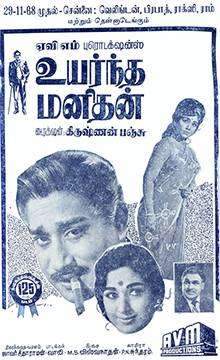
Movie Info
ℹ️ More Movie InfoSoundtrack
| Song Name | Singer(s) | Lyricist | Video |
|---|---|---|---|
| Velli Kinnamthan | T.M. Soundararajan | Vaali | |
| En Kelvikkenna | T.M. Soundararajan and P. Susheela | Vaali | |
| Naalai Intha | P. Susheela | Vaali | |
| Athanin Muthangal | P. Susheela | Vaali | |
| Athai Magal Rathinathai | P. Susheela | Vaali | |
| Anthanaal Nyabagam | T.M. Soundararajan | Vaali |
Storyline
Rajalingam “Raju” is the son of a wealthy -based industrialist, Sankaralingam. Living with Raju is his driver and friend, Sundaram. While vacationing in his family estate at with Sundaram and his family doctor, Gopal, Raju falls in love with a woman named Parvathi. Gopal too becomes smitten with Parvathi when he meets her whilst conducting her father’s medical treatment. Parvathi, who knows Raju through her father, as he is also an accountant of Raju’s family estate, reciprocates Raju’s feelings. Gopal decides not to reveal his love for Parvathi to Raju for Raju’s sake. Raju and Parvathi marry in secret with the help of Gopal and the consent of Parvathi’s father. The couple lives together in Kodaikanal without disclosing the knowledge of their marriage to Raju’s father, Sankaralingam. Three months later, Parvathi becomes pregnant. Sankaralingam, fearing for his son’s safety, arrives at Kodaikanal and becomes furious upon finding out Raju’s marriage to Parvathi. He orders his henchmen to set the estate on fire with Parvathi and her father inside. Raju and Gopal rush to save Parvathi, but they are stopped by Sankaralingam’s henchmen and are forcefully returned to Madurai, leaving Parvathi and her father for dead. A few months after returning to Madurai, Raju is forced to marry his cousin Vimala. After the marriage, Sankaralingam hands over his business affairs to Raju and dies. Nineteen years pass. Despite having mutual affection for each other, Raju and Vimala remain childless and Raju is unable to forget Parvathi. Nineteen-year-old Sathyamurthy, who lives with his uncle Murugan, is unable to retain any job due to his honest nature. He becomes acquainted with Gopal, with whose recommendation he becomes Raju’s personal house servant. When Sathyamurthy displays his mother’s photograph at his house to pray for her, it is revealed that Sathyamurthy is the son of Raju and Parvathi. Parvathi had survived the accident, was cared for by Murugan and died a few years after giving birth to Sathyamurthy without divulging the identity of Raju to Sathyamurthy and Murugan. Sathyamurthy improves his reading and writing skills with the help of Sundaram’s daughter, Gowri and the two fall in love. When Raju learns of their love, he approves of their marriage. Gopal learns that Sathyamurthy is Raju’s son, but dies of a heart attack before revealing it. Jealous of Sathyamurthy’s influence on Raju, another servant Rathnam and his wife hide Vimala’s diamond necklace in Sathyamurthy’s suitcase in an effort to get rid of him. Vimala, upset at losing her necklace, searches the house for it. When Raju, Sundaram, Gowri, and Sathyamurthy return after attending a conference in Kodaikanal, Vimala, acting on Rathnam’s provocation, orders that Sathyamurthy’s suitcase is searched. When the necklace is found in it, Raju throws Sathyamurthy out of his house, despite Sathyamurthy proclaiming his innocence. Gowri then shows Parvathi’s photograph to Raju, who is shocked to learn that Sathyamurthy is his own son. Raju reveals the truth about Parvathi to Vimala, who also accepts Sathyamurthy as her son. Before Raju and Vimala rush to bring Sathyamurthy back, Raju learns of a fire breaking out in one of his mills. Sathyamurthy, unhappy of being wrongly accused by Raju, attempts suicide by entering the burning mill. Raju saves Sathyamurthy in time and reveals the truth about his birth to him. The family is united and Sathyamurthy marries Gowri. Adapted from the opening credits: V. A. P. Iyer, a -based friend of founder , told Meiyappan that a film named (1966) was running well. After watching the film, Meiyappan was impressed and decided to remake it into what would become . was hired as screenwriter, and made a few alterations to the screenplay, while the duo (R. Krishnan and S. Panju) were signed to direct. was hired as the cinematographer, and Panju edited the film under the pseudonym “Panjabi”. When the script was ready, Meiyappan’s sons and the film’s co-producers , M. Kumaran and M. Murugan narrated it to at his residence, Annai Illam. Ganesan initially refused to play the main character, Raju, as he felt the supporting character Gopal had more impact than Raju, and offered to act as Gopal. However, on Saravanan’s insistence, Ganesan played the role of Raju, and the role of Gopal went to . became the 125th film to star Ganesan, and his first with AVM since (1964). When M. Saravanan asked about Ganesan’s salary to Ganesan’s younger brother V. C. Shanmugham, who spoke on Ganesan’s behalf, Shanmugham said that Ganesan was willing to accept any amount that AVM could afford to offer. Taking this to be a vague statement as Shanmugham did not state Ganesan’s salary properly, Saravanan discovered that Ganesan accepted 200,000 (US$26,667 in 1968) for one of ‘s latest films. Since (1965), Nagarajan’s films were made in , and because was made in black-and-white and costume designing for the film was less as compared to those of Nagarajan’s films, M. Saravanan decided to pay 150,000 (US$20,000 in 1968) to Ganesan. , who portrayed Raju’s possessive wife Vimala, felt her character was depicted “negatively”, so some changes to the character were made at her requ- This was the debut film for , who portrayed Vimala’s father. began in . The first song sequence shot was “Velli Kinnamthan”, depicting Raju and Parvathi ( ) in a boat. The song “En Kelvikkenna Badhil”, depicting Sathyamoorthy ( ) and Gowri ( ), was shot at Kodaikanal and My Lady Garden, Madras (now ). Meiyappan was not pleased with the original song sequence shown to him by the production unit as he felt it was incongruous to have two poor characters dressed well in modern attire, so it was reshot. The song “Paal Polave” was initially meant to be shot at Kodaikanal, but due to unfavourable weather conditions, the shoot had to be called off. The film’s art director, A. K. Sekhar, therefore constructed a specially erected set at in Madras that resembled Kodaikanal’s misty ambience. Ganesan assisted him for acting in the scene where Gopal dies of a heart attack. It was speculated that a production company bought the remake rights of (1961) in and titled it as . AVM had already acquired the rights to the film, which they were making under the title (1968). To avoid a clash with that film, AVM stalled production on for eight months to focus on . Ganesan, who thought that the project had been shelved, went to inform AVM that he would commence filming with another technical crew. However, AVM convinced him that the shooting was only delayed, and paid him 50,000 (US$6,667 in 1968) in advance. After the release of , filming was resumed and completed. When filming resumed after a year, Ganesan and Janaki refused to act along each other due to a fallout they had at a public forum but later relented after the producers convinced them. During the shoot, Ganesan noted Janaki’s colour was changed as she wore a black sari in the film’s previous shoot. Janaki initially refused to believe; however after seeing the rushes, she realised her error and apologised to Ganesan. For the scene where Raju beats and throws Sathyamurthy out of his house, multiple canes were kept as backup in case the cane with which Ganesan beats Sivakumar broke. Sivakumar was eventually left with his right arm dislocated after being kicked by Ganesan and falling over the sofa, and was hospitalised. The climax, where Raju rushes to the burning mill to save Sathyamurthy, took four to six days to film. The final length of the film’s prints were 4,591 metres (15,062 ft) long. In his 2015 book , Swarnavel Eswaran Pillai notes that the title , meaning “A Honourable Man”, epitomises the contradiction within the character of Raju, and in the trajectory of the rebel in (1952), as he finally ends up a “meek/reactionary family man” who had forsaken his own offspring/lineage at a critical juncture. The soundtrack and musical score for were composed by , while the lyrics were written by . Vaali worked on the film alongside (1969) and felt that working on two films simultaneously was “torrid”. Mangalamurthy worked as the for the song “Paal Polave”, also known as “Naalai Intha Velai Paarthu”. In the composition and picturisation for the song “Andha Naal Gnaabagam”, Viswanathan was inspired by a sequence in (1964) in which ‘s character sings with a walking stick in hand on a golf course. M. Saravanan, in his book , described the use of dialogues in “Andha Naal Gnaabagam” as something new to Tamil cinema. The song was parodied by and in (2003), and “Paal Polave” was parodied by in (2011). The soundtrack was received positively by critics, with “Andha Naal Gnaabagam” and “Paal Polave” attaining popularity. Malathi Rangarajan of praised the portions in the song “Velli Kinnamthan”. described “Andha Naal Gnaabagam” as “testament to the capabilities of two legends – and Sivaji Ganesan”, adding that the “transition from Sivaji panting and TMS taking over is seamless”. was released on 29 November 1968. An event was organised in Chennai to celebrate its release, and it was attended by , then the . The film became a commercial success, completing a theatrical run of 125 days. The 125th day commemorative celebrations were held in the presence of , the then . This was also the last function which Annadurai attended before his death. On 7 December 1968, the critic from lauded the performances of the cast members, particularly Ganesan, Janaki, Ashokan, Vanisri and Sundararajan along with Ramaswamy’s comedy and Sundaram’s cinematography, but criticised the “predictable” climax, editing and musical score, adding, “But directors Krishnan and Panju see to it that the picture does not fall apart. There lies their moderate success.” On Ganesan’s performance, the Tamil magazine , wrote in a review dated 15 December 1968 that Ganesan proved that he could show both love and hate at the same time, and no more than words of ‘natural acting’ were enough for him. The was introduced in 1968, and Susheela won the award for her rendition of “Paal Polave”. It was also Ganesan’s first film to win a . My first national award came for the song â€Naalai intha velai parthu’ [“Paal Polave”] (from 1969’s [ ] ), which Vaali wrote. How can I ever forget that? I will never forget him. The song “Andha Naal Gnaabagam” was considered one of the most memorable songs written by Vaali that featured in a Sivaji Ganesan film. ranked it alongside “Madhavi Pon Mayilaal” from (1967) and “Potri Paadadi Penne” from (1992). Susheela chose “Paal Polave” along with “Unnai Ondru Ketpen” and “Paartha Gnaabagam Illaiyo” as her favourite songs that she had recorded. Singer , who made her debut with the song “Chinnanchiru Kiliye” from (1987), was chosen to sing the song by M. S. Viswanathan after he was impressed with her rendition of “Paal Polave”, which he had asked her to sing during the song’s audition. Ganesan’s biographer T. S. Narayanswami included in his list of Ganesan’s “all-time greats”. In March 2009, Sharadha Narayanan of rated Sundarrajan’s performance in the film among his other noted films in which he featured like (1965), (1966) and . In her review of the 2011 film , Malathi Rangarajan of said that the premise of the film was “on the lines of Sivaji Ganesan’s poignant [ ]”. was included with other Sivaji Ganesan-starrers in the compilation DVD , featuring Ganesan’s “iconic performances in the form of scenes, songs and stunts”. It was released in May 2012.
Details
Reviews
There are no reviews yet. Be the first one to write one.