
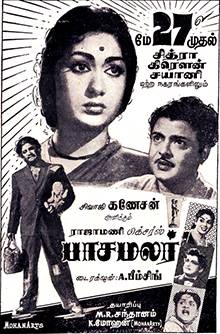
Movie Info
ℹ️ More Movie InfoSoundtrack
| Song Name | Singer(s) | Lyricist | Video |
|---|---|---|---|
| Vaarayen Thozhi | L. R. Eswari | Kannadasan | |
| Yaar Yaar Yaar Aval | P. B. Sreenivas and P. Susheela | Kannadasan | |
| Mayangugiraal Oru Maadhu | P. Susheela | Kannadasan | |
| Anbu Malar | M. S. Viswanathan | Kannadasan | |
| Engalukkum Kaalam Varum | T.M. Soundararajan and P. Susheela | Lyricist Not Known | |
| Paatondru Ketten | Jamuna Rani | Kannadasan | |
| Malargalaipol Thangai | T. M. Soundararajan | Kannadasan | |
| Malarnthum Malaratha | T.M. Soundararajan and P. Susheela | Kannadasan |
Storyline
Rajasekharan alias Raju becomes the guardian to his younger sister Radha after their parents’ death. When the factory where Raju works is closed due to a labour problem and he is depressed, Radha gives him 1000 which she had earned and saved by making toys. She advises him to use this money as and commence his own toy business. Raju assents, and in a short time, becomes rich. Anand, a former colleague of Raju, is jobless and approaches Raju for work. Raju appoints him in his concern and over a period of time, Anand and Radha fall in love. Raju, who is very possessive of his sister, gets angry with Anand as he feels betrayed. However, knowing how intensely Radha loves Anand, he arranges their wedding. After the marriage, Anand, along with his aunt and cousin, move into Raju’s house. Raju marries Malathy, a doctor, on Radha’s suggestion. All of them continue to live under the same roof and several misunderstandings arise. Anand’s aunt uses every opportunity to widen the rift between Malathy and Radha and Radha and Anand. Unable to witness Radha’s troubles, Raju moves out of the house with his wife. Through Radha, Anand’s aunt serves a legal notice to Raju, demanding a share in the property for Radha. Malathy files a counter petition and the property is attached by the court, pending resolution. Unable to see Radha’s sufferings, Raju withdraws the case. Still the families do not unite. Radha delivers a girl and Malathy delivers a boy. After her child’s birth, Malathy goes abroad for further studies, leaving the child with Raju. Unable to cope with the separation from his sister and to have peace of mind, Raju goes on a pilgrimage for several months. He returns on day and goes to meet Radha, but is denied entry by Anand’s aunt. While going back, he saves a little girl from getting burnt by firecrackers and in the process, loses his eyesight. He is hospitalised and Radha rushes to the hospital to see her brother. Raju learns that the girl he saved is none other than his niece. Unable to cope with his inability to see them, he dies; Radha too dies holding his hand. Anand comes after and feels bad for Raju and Radha, and on their behalf, Anand takes care of Radha’s daughter and Raju’s son. K. P. Kottakara, a producer and story writer, wrote a story about the everlasting relationship between a brother and sister, with the intention of making it a film. He approached , a director who gained a reputation for making successful family drama films, and narrated the story to him. After listening to the story, Bhimsingh agreed to make it as the film that would become . Actor also liked the story, got to play the lead character of the brother Raju, and got his friends and to produce the film on behalf of Rajamani Pictures. At the suggestion of , who was cast as the sister Radha, was hired to the dialogues. Principal photography began at Neptune Studios on Christmas Day. Few scenes were shot at Ganesan’s home in T. Nagar. A dialogue in the film that Raju tells Anand ( , not related to Sivaji) which translates to “You may switch off the electric lights here. But a small oil lamp will still be burning, and in that light, one man will toil. That man is this Raju” was inspired by a line Dass earlier told as a refusal to write for one of his films: “Even if it is only a small lamp, let it be exclusively mine. I will use it to light my life”. On the day the climax with the highly emotional dialogue, “Kai Veesamma Kai Veesu” was being filmed, during the break, Sivaji refused to have lunch as he want to starve the whole day to get the perfect emotion and diction for the scene. According to Soorian Kasi Pandian, author of the 1996 book , means “Flower of Love”. The term “Pasa” refers to brotherly love which involves sacrifices for his loved sister. The music was composed by , with lyrics by . “Vaarayen Thozhi Vaarayo” attained popularity, and has been played at many Tamil weddings. It is set in , a . The song provided a major breakthrough for its playback singer . was released on 27 May 1961. The film was a commercial success, running for over 26 weeks, thereby becoming a . The Tamil magazine called it a milestone film and mentioned that though films may come and go, this one would stay forever in the hearts of those who had a chance to see it. Kanthan of appreciated Aaroor Dass’ dialogues and the songs, saying that despite certain flaws, (flower of love) was a (flower of fragrance). The film won – Certificate of Merit for the Second Best Feature Film in 1962. It was included alongside various Sivaji-starrers in a compilation DVD (Sivaji Ganesan: Eighth Wonder of the World), which was released in May 2012. has been remade in number of languages. The first remake, (1962) was directed by Bhimsingh, the director of the original. It was again remade in Hindi in 1986 as . It was remade in Telugu as (1962) with Savitri reprising her role, in as (1965), and in Malayalam as (1977). The film became a trendsetter and inspired similar films of brother-sister relationships like (1978). In July 2007, S. R. Ashok Kumar of asked eight Tamil film directors to list their all-time favourite Tamil films; four of them – , , , – named as one of the favourite films in Tamil. Ravikumar said “As a kid I saw ‘Pasamalar’ and cried. As an adult, each time I have seen it I was moved to tears. That is the power of the script and the performance of lead players”. Playback singer noted that was the first Tamil film she had watched. remarked that his directorial (2015) was a “modern day “. Actor stated, “You can’t reproduce movies like , , , or […] By remaking such films, you are lowering yourself, while it enhances the original artists’ image”. Footage of is featured in the 2011 Tamil film . Footage of the song “Malarnthu Malaratha” is featured in the opening scene of (2014). It is also used in the 2019 film and 2022 film . Dialogues in were also used in the song “Yenga Annan” in (2019). In the same year (1961), Sivaji and Savithri acted as the lead pair in . The film failed as audiences could not digest Sivaji and Savitri as lovers after seeing them as siblings in . A digitally restored version of was released on 15 August 2013, during . The digital conversion was done by , . M. Suganth of rated it 5 out of 5, saying “The restoration, cinemascope and audio conversion are pretty good while the trimming (by veteran editor , Bhimsingh’s son) manages to retain the continuity to a large extent.”
Details
Reviews
There are no reviews yet. Be the first one to write one.