
Movie Info
ℹ️ More Movie InfoTrailer
Storyline
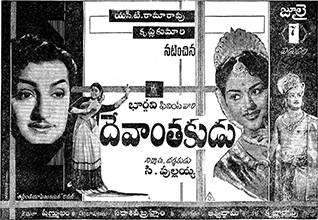
Sundaram is a stage actor. He falls in love with Meenakshi, the daughter of a rich man Bhadrayya who dislikes Sundaram. Bhadrayya fixes his daughter’s marriage with an aged billionaire over his wife’s protests. Meenakshi and Sundaram marry in secret with the help of his friends. Bhadrayya enters with his goons and drags his daughter home while his goons brutally assault Sundaram. Meenakshi jumps into a river to commit suicide. Crestfallen, Sundaram repents that he was responsible for her death. While Sundaram sleeps on a , ‘s men, unable to find the address of a dead man, take Sundaram instead with them to hell, the abode of Yama. Sundaram finds his bull there and by unleashing it on Yama, he occupies his throne, promotes , rewrites Yamaloka’s constitution, and also takes the opportunity to search for Meenakshi with the help of , who takes him to , the abode of and , and to Indraloka, the heaven where he finds Meenakshi. With Vishnu and Lakshmi’s blessings, Meenakshi is brought to life and Sundar, and the two return to Earth. Bhadrayya relents and accepts Sundar as his son-in-law. After the success of the film (1953), which was based on the film (1952), its director waited for five years to adapt another comical Bengali story for Telugu-speaking audiences. The Bengali fantasy comedy (1958) was running successfully in cinemas in . Its screenplay, written by Gour Shee, incorporated satirical attacks on contemporary life and social issues. Pullayya established the production company Bhargavi Films with Ch. Subbarao, a -based building contractor, as managing director and himself as producer, and bought the rights to remake in Telugu and languages. The Telugu version was titled and the Tamil version was titled . Adurthi Narasimha Murthy was the screenwriter of , and the dialogues were written by . Cinematography was handled by A. Shanmugam and the editing by T. R. Srinivasulu while A. Krishnarao served as art director. was cast as the male lead Sundaram and as the female lead Meenakshi. , who played in (1957), reprised his role in . played in addition to working as playback singer. The Tamil version featured a largely different cast, with only Ranga Rao mutual to both. In the Tamil version , Krishna Kumari’s elder sister played Meenakshi. and were filmed simultaneously, with scenes from the former being filmed first and those from the latter second. Because of a belief that if Rama Rao wore multiple different get-ups the film would succeed, he sported two additional disguises for this film: that of a woman, and that of an elderly dance teacher. Though a couple of dialogues from the Yama durbar were borrowed from the Bengali version, Sadasivabrahmam largely followed his own diktat and wrote apt and appealing dialogues reflecting the lifestyle and societal problems of the 1960s. The final cut of was 17 reels, longer than the Bengali original which was 13 reels. The soundtrack was composed by G. Aswatthama, and the lyrics were written by . The songs “Go Go Go Gongura” and “Entha Madhura” attained popularity, as did the various and poems narrated by and Raghuramayya. was released on 7 July 1960. The film was commercially successful. Some critics of the time wrote that the Bengali story was copied from the 1934 American film, But Mitra wrote the play before his death in 1873. became a trendsetter for “socio-fantasy films” in . The film inspired N. T. Rama Rao’s own (1977). mentioned in an interview that the basic plot of his film (2007) was inspired by and .
Details
Reviews
There are no reviews yet. Be the first one to write one.