
Movie Info
ℹ️ More Movie InfoTrailer
Storyline
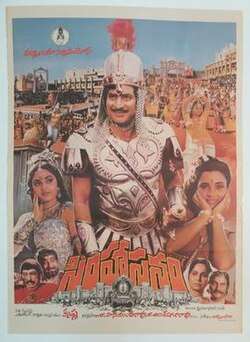
Vikrama Simha, the Senapathi (army chief) of the Dasarna kingdom, defeats several feudal lords and secures their allegiance to King Kshemendra Bhupathi. In recognition of his accomplishments, the king grants Vikrama Simha the titles of the kingdom and gifts him the Bhavani sword, a revered heirloom. Princess Alakananda, the king’s daughter, secretly loves Vikrama Simha. Meanwhile, Bherunda, the kingdom’s Maha Mantri (prime minister), plots to kill Alakananda and claim the throne. Vikrama Simha foils the attempt, but Bherunda accuses him of treason. Despite these accusations, the king, acknowledging Vikrama Simha’s past services, commutes his sentence from death to exile. Vikrama accepts the decision and advises the king to strengthen the security around the princess. The story shifts to the temple of Goddess Aparajitha, where Dasarna and Avanthi kingdoms alternate in performing the first prayer. This year, Alakananda performs the ritual. The queen mother of Avanthi expresses interest in marrying her son, Prince Aditya Vardhana, to Alakananda, uniting the kingdoms. In Avanthi, Prince Aditya Vardhana, who bears a striking resemblance to Vikrama Simha, leads a carefree life. He becomes infatuated with Jaswanthi, a court dancer, but is reprimanded by the queen for his irresponsible behaviour. The queen attempts to reform Aditya, and he matures into a more responsible prince. She wishes for him to marry Alakananda Devi. However, during a hunting expedition, Aditya encounters Chandana, a beautiful woman revealed to be a vishakanya. Aditya falls in love with her, but when Chandana realizes her nature, she attempts to end her life. Vikrama Simha intervenes, rescues her, and helps her reform. Amid these developments, Aditya Vardhana requests Vikrama Simha to temporarily rule Avanthi and resolve the kingdom’s crises. Vikrama agrees, later restoring the throne to Aditya, who marries Chandana. Meanwhile, Avanthi’s Rajaguru (royal guru) conspires to place his son on the throne, but his plan is thwarted by Vikrama Simha. In the end, Vikrama foils Bherunda’s plans in Dasarna, ensuring peace in both kingdoms. The story concludes with Vikrama Simha marrying Alakananda Devi. In November 1984, actor launched his film studio, , aiming to establish it as a significant name in the industry. At the time, he was balancing his acting career in Telugu films with producing Hindi films. To enhance the studio’s reputation, Krishna decided to remake the 1951 Telugu film into Hindi. The remake, titled , was released in May 1985 and became a success, giving Krishna the momentum to pursue a more ambitious project. In 1985, Krishna ventured into direction and set out to create a grand folklore (janapada) film with impressive sets. To make this high-budget venture work, he decided to produce it in both Telugu and Hindi. This led to , the first Telugu film shot in . The Telugu version was titled , while the Hindi version was titled , starring . Produced under the Padmalaya banner with his brothers G. Hanumantha Rao and G. Adiseshagiri Rao managing the project, Krishna made his directorial debut, also taking on roles as screenwriter, editor, and producer. Krishna is officially credited with the story and screenplay, while his frequent collaborator, , is credited with the dialogues. However, Maharadhi played a significant role in writing the entire script, not just the dialogue portion. The film blends historical elements with folk narratives, drawing inspiration from actual events and figures. The characters of Queen Alakananda Devi and army commander Vikrama Simha were based on the historical figures and , who assisted Rudrama Devi during times of crisis in the . Additionally, the character of Chandanagandhi was inspired by a historical incident involving a , who was used against , the . Krishna played dual roles as Vikrama Simha and Aditya Vardhana. was cast as Princess Alakananda Devi, with , and in key female roles. Other prominent actors included , , , , , and . made his Telugu debut with a significant role in both the Telugu and Hindi versions. provided the voice for Amjad Khan, and dubbed for Waheeda Rehman in the Telugu version. Dialogue writer Tripuraneni Maharathi also appeared in a role in the film. The technical team included Bhaskar Raju as the art director and costume designer, C. Madhav Rao for makeup, and for action choreography. took place at Padmalaya Studios in Hyderabad, with additional filming in locations such as and . The film was shot simultaneously in Telugu and Hindi, with starring in the Hindi version, . In a unique production approach, a shot was first filmed in Telugu, and the same setup was later used for the Hindi version. Both versions of the film were completed in 65 days. With a budget ranging from ₹3.2 to 4 , was made at a significantly higher cost compared to typical films of the time, where budgets generally ranged between ₹40 and ₹50 . The cinematography was handled by , a long-time collaborator of Krishna. , a mentor to Swamy in camera work, was responsible for the film’s special effects . , who worked as an assistant to Nagaich, recalled that for the song “Aakasamlo Oka Tara,” trick shots were used to depict a palace in . Art director Bhaskar Raju designed large-scale sets, including the iconic royal darbar set and grand statues, which became significant elements of the film and were displayed in the studio for an extended period. Prior to the establishment of , co-producer Hanumantha Rao is reported to have explained the process of creating these statues to its proprietor, . The film’s music was composed by , marking his debut in . The lyrics were written by and . Tracks such as “Aakasamlo Oka Tara” and “Vahava Nee Yavvanam” became popular and continue to be enjoyed. At the time, a controversy arose between Krishna and singer . Impressed by the voice of Raj Sitaram, a degree student from , Krishna chose him to sing all the songs for (1985). Bappi Lahiri also approved of Sitaram’s voice for ‘s songs. As a result, Raj Sitaram sang all the songs in the film. was censored on 18 February 1986, and released on 21 March 1986, with 85 prints distributed across 153 theaters in . It was the first Telugu film to be released in format. The film attracted large crowds upon release, causing significant traffic jams near theaters and generating considerable buzz at the time. was a commercial success, running for 50 days in 16 centres and 100 days in six centres. It set a record as the first Telugu film to gross over ₹1.5 in its opening week. The film’s 100-day celebration in VGP Gardens, , drew a large crowd of Krishna’s fans, creating significant excitement and attracting attention from the . Approximately 400 buses transported fans from Andhra to Madras for the event.
Details
Reviews
There are no reviews yet. Be the first one to write one.