
Movie Info
ℹ️ More Movie InfoTrailer
Storyline
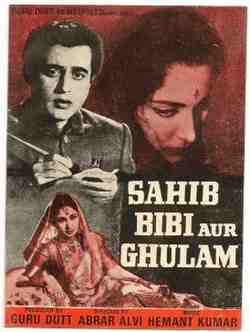
In , a group of labourers is demolishing the ruins of an old . When the workers break for lunch, the overseer walks around the site. As he sits, a flashback to the late 19th century begins. The lower-class yet educated Atulya “Bhoothnath” Chakraborty arrives in the colonial Calcutta looking for work. Along with his brother-in-law, he lives in the of the Choudhury family. Bhoothnath meets Subinay, a dedicated member of the religious sect , and the owner of the factory Mohini Sindoor. Subinay’s daughter Jabba hears their conversation and is amused by the behaviour of Bhoothnath, whom she considers an unsophisticated rural dweller. Over time, the two develop an attraction to each other. Bhoothnath becomes fascinated with the goings-on in the and every night he observes the Choudhury brothers’ decadent lifestyle. One night, Bansi, another servant of the , takes Bhoothnath to meet the younger wife Chhoti Bahu, who implores him to bring her . Chhoti has a poor relationship with her unfaithful husband Chhote Babu, who spends most of his time watching a dancing girl performing, and believes it will keep him home. Bhoothnath is struck by her sadness and inadvertently becomes her secret confidante. When Chhoti Bahu’s repeated attempts to appease her husband fail, she becomes his drinking companion to keep him by her side. In the meanwhile, Subinay falls ill and closes the factory as he is unable to manage it due to his ill health. He also fixes Jabba’s marriage to Supavitra, who is also a Brahmo Samaj member. Learning about this, a heartbroken Bhoothnath leaves from there. He becomes a trainee architect and is assigned to work on a project in a different town. A few months later, he comes back to enquire on his mentor Subinay’s health, and learns that he has succumbed to his illness. After the death of Subinay, Jabba breaks her engagement to Supavitra. Bhoothnath also discovers that long ago he and Jabba were as children. When Bhootnath visits the , he sees it has been partially ruined and the Choudhurys have fallen on bad times. Chhoti Bahu is now a desperate alcoholic and her husband is paralysed. He chastises her on her drinking and they have an argument. Their conversation is overheard by the elder Majhle Babu, who suspects Chhoti Bahu is having an affair with Bhoothnath. One night, when Chhoti Bahu asks Bhoothnath to accompany her to a nearby shrine to pray for her husband; Majhle Babu orders his henchmen to chase them. Bhoothnath and Chhoti Bahu travel in a carriage, but Majhle Babu’s henchmen stop it. Bhoothnath is knocked unconscious and Chhoti Bahu is abducted. When he wakes up in the hospital, Bansi tells Bhoothnath that Chhoti Bahu has disappeared and her husband is dead. The flashback ends. Bhoothnath’s workers inform him a skeleton has been found in the ruins of the . From the jewellery on the corpse, Bhoothnath realises it is the remains of Chhoti Bahu. In the last scene, a nostalgic Bhoothnath rides away in a carriage with Jabba, who is now his wife. The cast is listed below: Guru Dutt wanted to adapt ‘s novel (1953) into a film after reading it and watching its staged version at Rang Mahal Theatre, Calcutta, with his wife , Mitra, and . This marked the novel’s second cinematic adaptation after the . The novel was written in and never translated from . Dutt asked Alvi to write a screenplay; according to Alvi, he was surprised Dutt gave him the offer because Dutt had previously discharged him from his company after Dutt’s (1959), in which Alvi served as the screenwriter, became a and he could not pay his workers. Since then, Dutt decided to not direct any films he worked on. After his next release (1960) commercially succeeded, he was able to save the studio from bankruptcy and later acquired the rights of . Dutt and Alvi started translating the novel to but Alvi was not fluent in Bengali. They tried translating it word-for-word but realised the process would be really slow and stopped after a few days. Dutt invited Mitra, who lived in Calcutta, to visit him at a bungalow Dutt rented in . Alvi said Dutt was thorough on any aspects of his projects and that the bungalow was used to ensure both Mitra and Alvi concentrated on writing the screenplay. After arriving in Khandala, Mitra and Alvi invited a “Mr. Mukherjee”, who was fluent in Bengali and Hindi, to be a “bridge between us”. The translator, however, gave up after fifteen days, asking them to do the rest by themselves. Alvi said the screenplay was written “slowly but surely”; he and Mitra made many changes to the story so the film would be fit with Hindi audience’s interest. For instance, they removed several characters who appear in the novel version, including , and made Bhoothnath more naïve and less educated. Dutt’s biographer estimated the translating took two months and said Dutt, who was impressed by the screenplay, suggested Alvi to direct the film. reported it was the first time the screenplay of a film Dutt produced was finished before filming began. In preparation, Alvi was sent to Calcutta to learn about the Bengali and the background. Dutt and Alvi completed the casting; their first choice to play Bhoothnath was , who was invited for a meeting with Dutt but he arrived two-and-a-half hours late, which irritated Dutt, who then declined to cast him. , who portrayed Bhoothnath in the play, became Dutt’s next choice; he and Chatterjee had dinner at the to discuss it. The film was to be Chatterjee’s debut but his friends and fans informed him his popularity among Bengali people was increasing, so he reluctantly rejected the offer, a decision he later regretted. The role was eventually played by Dutt, who had to shave his moustache to make him look younger. Chhaya Arya, the wife of the photographer Jitendra Arya, was suggested to portray Chhoti Bahu. Living in London, the film’s production team asked her to move to (now Mumbai). In October 1960, she arrived there for a photograph session. When seeing the results, Dutt felt she was not too wanton- or motherly-looking for the role. He searched for a more suitable female actor and chose for the role. In 1953, Kumari lost the opportunity to be cast for a role in (1955), which was eventually given to , Kumari’s husband refused his offers, feeling Chhoti Bahu had a negative reputation; he asked for (US$7,100) but Dutt could pay (US$2,400) only. Kumari persuaded Dutt she was the only actor who was capable of playing the role and, by 1962, she finally got the role. Alvi said Kumari was entranced by the film’s themes and saw the role had the potential to boost her career. The film marked the sixth collaboration between Waheeda Rehman and Dutt. In , Waheeda Rehman stars as the “couldn’t-care-less carefree” Jabba. After reading the novel, she wanted to play Chhoti Bahu but Dutt felt she was too young for that role, saying she looked more like a girl than a woman. Still insisting, she asked Dutt and the film’s cinematographer for a photograph session in which she would dress up as Chhoti Bahu, wearing a and a . After looking at the photographs, Murthy agreed with Dutt and likened her to a child. When Alvi was appointed to direct the film, he called in Waheeda Rehman was and offered her the part of Jabba. Dutt disapproved of this casting because she was an established actress and he did not want her cast as the second female lead after Kumari. According to Dutt, the film’s title represents its three leads; for Rehman, for Kumari, and for Dutt, but these excluded Waheeda Rehman. She, however, told Dutt she was fine by it. for took place in and a forty-to-fifty-room in . It started on 1 January 1961 with a ceremony that was attended by the film’s production team. The cinematographer was Murthy and the sets were designed by . , who knew little about Bengali people and their looks, designed the costumes; Dutt sent her to Calcutta to prepare for filming. According to Usman, Athaiya was also involved in the film’s directing, especially that of the song sequences, though only Alvi’s name appears in the credits. Filming, except for the scenes that feature Chhoti Bahu, was almost completed by the beginning of 1962; filming was completed with a 45-consecutive-day schedule in Andheri. There are no scenes of Chhoti Bahu and Jabba together; Waheeda Rehman wanted to act with Kumari so she asked Dutt to rework the story. She suggested a scene in which Jabba persistently asks Bhootnath about Chhoti Bahu and he later takes her to the . Dutt, however, dismissed the idea, saying the characters never meet in the novel and that the audience would not be interested by it. After filming, P. Thackersey and Y. G. Chawhan handled the sound and editing, respectively. The soundtrack—released by —was composed by Hemant Kumar, wrote the lyrics, and Geeta and sang vocals. Dutt directed the songs but Alvi replaced him while he was absent from the sets during the filming of “Bhanwara Bada Nadan”. Dutt watched the result ten times but felt disappointed and re-filmed it by adding comedic elements. After the film’s release, Dutt cut the song “Sahil Ki Taraf” from the climax, in which Chhoti Bahu rests her head on Bhoothnath’s lap because the audience criticised it. Kumar reused the song for “Ya Dil Ki Suno Duniyawalo” for the 1966 film . Posters for were printed by Dutt and Alvi. When the film was released on 29 July 1962, the initial audience response was negative. A day after its premiere, Dutt went to Bombay’s Minerva Cinema and observed audiences were disappointed by the scene in which Chhoti Bahu asks for a last sip of alcohol and the song “Sahil Ki Taraf” that made the relationship between Chhoti Bahu and Bhoothnath ambiguous. He visited the director ‘s house and was suggested to make Chhoti Bahu recover from her addiction and her marital relationship improve. Dutt asked Alvi and Mitra to write a new climax and invited Kumari for another day’s filming. The next day, while they were discussing the unexpected changes, Dutt decided to maintain it, and instead removed the Chhoti Bahu scene and “Sahil Ki Taraf”, saying he did not mind if the film became a box-office disappointment. He added it was not possible to create another scene because the changes would the audience would be confused about the film’s plot. Exact figures for the film’s box-office earnings are not available. Firoze Rangoonwala, in the 1973 book , reported it performed poorly but better than (1959), while in 2005 called an “average grosser”. estimated its total gross to be (US$99,000), supporting Rangoonwala’s claim. was the official submission from India to the , for which a shorter version was made. On 26 June 1963, Dutt, Kumari, Waheeda Rehman with sister Sayeeda, and Alvi arrived in and the screening occurred the next evening. All twenty-five people attending the screening gave a poor response to the film’s melodramatic plot, unrelatable themes, and slow screenplay. received a nomination but lost to the French comedy and the Japanese action film (both 1963). received positive feedback from both contemporaneous and modern critics, who praised the cast’s performances—particularly that of Kumari—the cinematography, the costumes and the art direction. Reviewers panned the way Chhoti Bahu is unconventionally depicted as an alcoholic woman. In a review dated 24 June 1962, a writer for said the film is excellent because of its well-written screenplay that makes an effective balance between the characters and emotional sequences, and “provides a neat dramatic pattern”. Calling the film “a classic in celluloid”, he said it does “a specially successful job” though it is based on Mitra’s novel, which the reviewer called untidy and with a wordy writing style. Kabir, who collected Dutt’s handwritten letters for a book titled (2006), reported it is one of few reviews Dutt read during his lifetime. , who biographed Kumari’s life in 1972, said Kumari overshadows her co-stars and added; “Gone were the traces of frivolity, gone was the look of undernourishment, gone was the look of the ‘girl-next-door’. She was now a woman of sharp, mature, mysterious persona … whose one smile concealed a thousand enigmas.” In her 1985 book , Shampa Banerjee complimented Kumari for being the greatest performer in the film. She also found Bhoothnath to be completely different Dutt’s previous roles, noting its “rustic simplicity and comic innocence, coupled with a deeply compassionate nature, lent Bhootnath’s character an immediate realism, a natural complexity, which justified the keen internal version of the older Bhootnath who recounts the tale”. On 19 February 1989, called Waheeda Rehman’s role equal to that of Kumari’s and wrote of her importance in the film, even though hers is a supporting role whereas Kumari’s is a lead. , writing for in 2003, called the film “a fascinating mood movie made by people gifted with acute sensitivity”. He said Dutt was at his best when playing Bhootnath without his moustache. Raheja, however, was critical of Rehman and said her scenes could be partly removed because her character, which he deemed perky, is less important to the film’s main plot. Writing for in 2008, A. P. S. Malhotra said Kumari’s portrayal of a “career-defining role” is an “awe-inspiring performance”. He praised Athaiya’s costumes and Murthy’s cinematography, stating both are outstanding throughout the film. , in an article published by in 2020, said Kumari played her role brilliantly and commended the film’s production, including the art direction. In 2021, Sampada Sharma of wrote of Kumari; “Her perpetually melancholic eyes and her pristine beauty make her a tragic figure who is slowly drowning in a sea of despair”. The film won a in the category , and at the , it won , (Alvi), and (Kumari). The chose to in the award at the over the -language romantic drama (1962). , however, failed to be nominated and the wrote to Dutt telling him according to American culture, it was inappropriate for a woman to be an alcoholic. “It must have been in 1961 or 1962. I don’t remember the exact date, but it was during the filming of the final scene in [ ]. Jabba is waiting for Bhoothnath in a carriage in the haveli ruins. That was the last time we worked together. He never offered me another role after [ ].” — Waheeda Rehman on Dutt ending their collaboration with the film attained and became a milestone in Hindi cinema. Along with (1957) and (1959), critics have regarded among Dutt’s best work. According to Banerjee, is Dutt’s last major contribution to the industry. It is also the only film Alvi directed. Film experts have regarded Kumari’s performance in as one of the best of her career; according to , the film made her particularly known for tragic roles, and Raheja commented; “Meena took the audience on an unforgettable odyssey into the inner recesses of the mind of an emotionally and physically cloistered woman”. Kumari played similar roles in several more films, including the dramas (1963), (1964), (1964), (1965), (1966) and (1972). Dutt collaborated with Kumari again in (1964), which was his last film to be released during his lifetime. Several lists have included . In 2005, selected the film for her book , and Rachna Kanwar included it in her listing of “25 Must See Bollywood Movies”, commenting: “Chhoti Bahu is the most spectacular character in tragedienne Meena Kumari’s career; a role that was uncannily similar to her own life Meena Kumari, like the miraculous sindoor she yearns for in the film mesmerizes you with her acting skills … The film remains with you forever simply because of the splendid performance of Meena Kumari.” As part of celebrations of the centenary of Indian cinema in 2013, was featured by on their lists of “100 Greatest Indian Films of All Time”. In the same year, listed among the “100 Best Films” released between 1958 and 1969. The next year, the American Indologist of the chose the film for his list of “Ten Indian Popular Films that are Not-to-be-missed”. Dwyer, in an article for , listed the film in “70 Iconic Movies of Independent India” in 2017. On India’s 75th in 2021, appeared in list of “75 Films that Celebrate the Journey of India”. In a 1994 interview with , the scholar considered the film a much more accurate depiction of India’s corrupt 19th-century than ‘s drama (1958). In 2010, a retrospective of Dutt’s films, including , was screened in Israel and was positively received by the audience. wrote the following year it is “one of Hindi cinema’s most vivid treatments of a transitional period in India’s social history”. A dialogue from Rehman to Kumari ” ” (Break old jewellery sets, make new ones. Play with shells. And sleep.), and Kumari’s dialogue ” ” (Has any Hindu household’s daughter-in-law ever drunk liquor?) attained popularity. In 2012, film historians and Jitendra Kothari published the film’s screenplay as a book titled , which also contains the authors’ interviews with the surviving cast and crew.
Details
Reviews
There are no reviews yet. Be the first one to write one.