
Movie Info
ℹ️ More Movie InfoTrailer
Soundtrack
| Song Name | Singer(s) | Lyricist | Video |
|---|---|---|---|
| Maanjaave Kaanjaachu | Gaana Bala and Srihari | Na. Muthu Kumar | |
| Edhai Ninaithom | G.V. Prakash Kumar | Na. Muthu Kumar | |
| Sel Sel | Sathya Prakash | Na. Muthu Kumar | |
| Karuppu Karuppu | G.V. Prakash Kumar | Na. Muthu Kumar |
Storyline
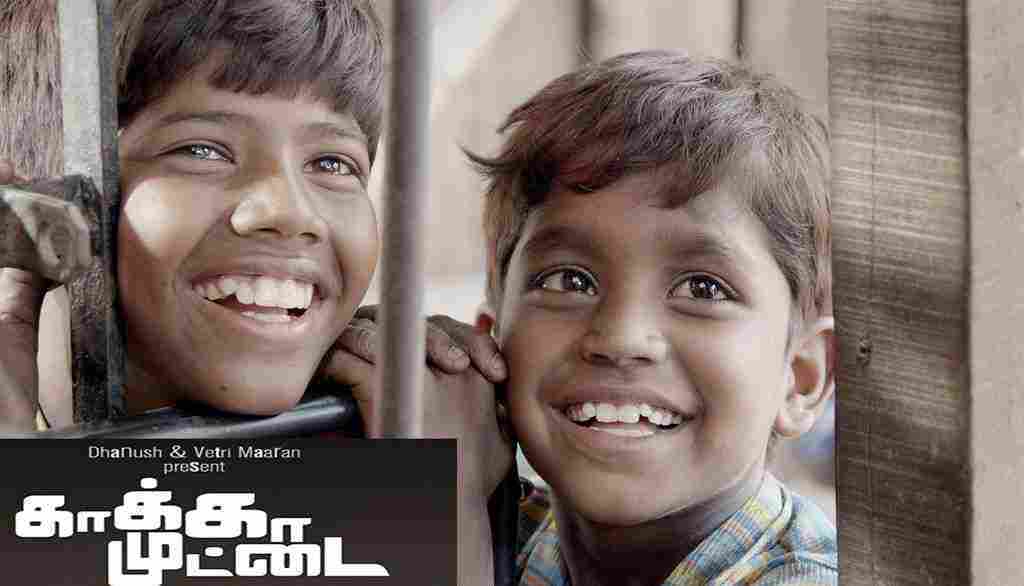
In a tiny concrete-and-tin home in the slums live two young brothers with their mother and their grandmother. Their father is in the prison for unknown reasons and with an ageing mother-in-law, the mother does her best to keep the kitchen fires burning. The brothers spend their time playing games and stealing and devouring eggs from the crows’ nests. Their love for these eggs leads them to start calling themselves as Periya Kaaka Muttai and Chinna Kaaka Muttai. Periya Kaaka Muttai and Chinna Kaaka Muttai constantly beg their mother and their grandmother for Toys they cannot afford and later they beg them for a Television. They don’t yet understand that the two women can’t give them everything they want. When their mother and their grandmother finally bring a Television to their home, a gift from to Ration Card Holders who live below Poverty Line, Television is like opening of Portal. Periya Kaaka Muttai and Chinna Kaaka Muttai see a commercial on Television whose steaming, slow-motion images make the unfamiliar food look like manna from heaven. Meanwhile, a Brand New Pizza Shop named Pizza Spot comes up in the neighbourhood, Actor inaugurates Pizza Spot. Remembering the looks of enjoyment on Actor ‘s Face when he tasted Pizza at Pizza Spot, Periya Kaaka Muttai and Chinna Kaaka Muttai thereafter think of nothing else but getting their first taste of a Pizza at Pizza Spot. Periya Kaaka Muttai and Chinna Kaaka Muttai goes to railway tracks each morning to collect the charcoal that falls from goods trains. They sell the charcoal at a scrap metal shop and are paid for their trouble. They usually hand the money over to their mother, who is saving up to pay their lawyer to get her husband out of prison. But once Periya Kaaka Muttai and Chinna Kaaka Muttai become aware of the cost of a pizza, they begin saving the money for themselves instead, lying to their mother that they have not collected any charcoal since they were out playing. Periya Kaaka Muttai and Chinna Kaaka Muttai succeed in saving ₹ 300 required to buy a Pizza but they are sent away by Pizza Spot’s Watchman since they are badly dressed their clothes, which reflects the fact that they are local slum-dwellers. The boys narrate this story to their friend Pazharasam, who works as a lineman with the railways. Pazharasam tells them that people place a lot of importance on clothes and he advises them to save up and purchase new clothes before approaching Pizza Spot again. Periya Kaaka Muttai and Chinna Kaaka Muttai goes to the work again to save money for buying new clothes at the . In the meantime, Periya Kaaka Muttai and Chinna Kaaka Muttai show their grandmother the Pamphlet from Pizza Spot. Their Grandmother tries to make them a Home-Cooked Pizza using Batter, but they fail her attempts and they insult her. After finally saving up enough money for new clothes, when Periya Kaaka Muttai and Chinna Kaaka Muttai see , they realise that it is another Big Mall which would definitely not allow them inside. But they somehow manage to acquire a newly bought pair of clothes from a couple of rich children by buying them from a street vendor, much against the wishes of the rich boys father, who had denied them the treat as he considered it unhygienic. Periya Kaaka Muttai and Chinna Kaaka Muttai felt happy and they return to Pizza Spot in their new clothes. Another group of slum boys who are envious and sceptical about the Periya Kaaka Muttai’s and Chinna Kaaka Muttai’s story about going to eat pizza them to take a video of what transpires with Periya Kaaka Muttai and Chinna Kaaka Muttai at Pizza Spot. Periya Kaaka Muttai and Chinna Kaaka Muttai are once again confronted by the Pizza Spot’s Watchman and he now forces them to go home right away, but they protest by saying that they have money and they are wearing new clothes. This argument attracts the attention of the Pizza Spot’s Supervisor, who comes out and slaps Periya Kaaka Muttai. This is caught on video by the other slum boys, who laugh at their humiliation. Periya Kaaka Muttai and Chinna Kaaka Muttai felt sad and disappointed and they return to their slum, only to be further overwhelmed by the miserable sight of their dead grandmother. Periya Kaaka Muttai and Chinna Kaaka Muttai feel guilty and responsible when they remember that they were insulting their grandmother some time ago. In the Slum Naina and his friend were watching the video of Periya Kaaka Muttai was being slapped by Pizza Spot’s Supervisor, they try to make money by threatening the Pizza Spot’s Owner to release the video to the media. Pizza Spot’s Owner realises he could be imprisoned and Pizza Spot sealed by the Government due to Pizza Spot’s Supervisor’s act of discrimination and violence against the children. He offers Naina one hundred thousand rupees for not making the video public. He agrees, but his friend releases it to the media hoping to make some money, unaware of the huge sum being offered. This stirs up tension among the Pizza Spot’s Owner, who finally decide to publicly apologise Periya Kaaka Muttai and Chinna Kaaka Muttai. Periya Kaaka Muttai and Chinna Kaaka Muttai are welcomed to the pizza spot on a red carpet reminiscent of Actor being welcomed in the Inauguration Ceremony of the Pizza Spot. Pizza Spot’s Owner also promises them free pizzas for life. Even as Periya Kaaka Muttai and Chinna Kaaka Muttai begin to finally enjoy their first pizza, they tell each other that the Home-Cooked Pizza which their grandmother had earlier made for them using Batter had tasted much better. I thought a children’s movie will be a good idea to introduce myself as a director. Children’s films generally have a safety net. If you do things correctly and make the kids act well, the film will turn out well. And, screenplays that are based on desires and goals will have a tighter structure because they are plot-driven. With kids the normal motivational factors like money and fame don’t work as they do with adults. , a former wedding photographer, had directed a short film named in late 2010, primarily for his cinematography in the film. It was critically raved by cinephiles and other celebrities, and also got the attention of director , when the film was screened at a film festival, where he was a jury member. Vetrimaaran personally approached Manikandan, to ask about his other future film projects, where Manikandan narrated a script about slum children and its essence, impressed and decided to produce the film under his banner. He later called Manikandan to meet him and in Delhi to progress about the narration of the script and storyline, but Dhanush said that he liked the script and also joined the film as a co-producer under the banner. Vetrimaaran said that the storyline has an artistic approach and had similarities to (2008). The script’s basic plot line is inspired from his life, where his son often have craved for , but he could have a little money to buy it, one day. Then he inspired that “what if someone who couldn’t afford a pizza wished to have one”, which he kept as a basic idea pitching the story line. To develop the conflict stronger, he characterised the lead artists as slum children and also realised that the kids get attracted to things only because of catchy advertisements. Initially, he had planned to produce the film on his own, through , where he suggested his friends to send money for the production of the project, before Vetrimaaran agreed to produce the film. On the occasion of (26 January 2013), both Dhanush and Vetrimaaran announced the project officially under the title . For a children’s film, Manikandan eventually planned to cast professional children from the film, but as he was not convinced with their performances, he made a visit to real slums across to pick slum children, who do not have an acting experience. In the process, he picked J. Vignesh and Ramesh, hailing from the fishermen community, both under 15. Manikandan also trained the kids and gave a lot of rehearsals before the shoot. He eventually said that, “During shooting both of them would fight with each other often. But on screen they will look like siblings.” He added that the children will play the lead protagonists and there are no typical male or female leads. was roped to play the mother of the siblings. She was very hesitant at first to play a mother role at such an early stage in her career, but, after seeking advice from her co-star Vijay Sethupathi, she decided to be part of the film. Producer was initially sceptical to cast and thought it would be more apt to cast an actual mother from the slums. and appear in supporting roles. While Manikandan handled the cinematography, Kishore Te., who was a regular in Vetrimaaran’s projects, was assigned as the film editor, which became one of the last works of the editor before his death in March 2013. The principal photography began during late-May 2013, where the entire film will be completed within a single stretch of 61 days. In order to have a realistic approach, the makers shot the film entirely in real slums and streets of . In August 2013, accepted to make a in the film. He joined the team in September 2013 to film scenes alongside who plays a landlord. Manikandan said that, it was difficult to capture the real attitude of kids and bring it to the screen. Further, he faced challenges such as to get a similar expression in the next shot, and to avoid night shoots with kids. But he was aware of the challenges and worked on the film. The entire shooting of the film was wrapped up within March 2014. shows the effects of globalization in a metropolitan city. It critiques politics, media and reverses the quest for a pizza into a symbol of consumerism which is shunned at the end. The ending leaves an indelible impact and finds resonance with the middle class movie-going audience irrespective of their cultural background. Manikandan said that few scenes of the film had inspired from , and , based on the visual themes and setting in slums. He had pointed out a scene where the boys’ mother (Aishwarya Rajesh) gives an interview to a news channel. But as a similar scene was present in , he had to delete that scene. -based critic M. Suganth said that Manikandan’s earnestness in the filmmaking invites comparison with Iranian films like (1997). Writing for American magazine , Jordan Mintzer called “an allegory for the vast class differences that persist in India, revealing how people try to profit off a system that leaves little room for advancement.” Another reviewer from the called that “the film is filled with layers aimed at different sections of the audience, one of them being urban poverty, the other being discrimination based on class system”, but praised director for using humour as a theme to keep the film mostly light hearted, though it deals with a very serious subject. Arpita Bose, writing an article for , said that the “theme is not culture-specific but contemporary and universal. At its core, the film is about the adventures of two slum boys in a world that is taking on a swanky avatar backed by moneyed entrepreneurs, shrewd politicians and loafing opportunists.” Writing for the website, Harsh B. H. Said that the film follows “the themes of class-divide and the perils of consumerism, with just the right amount of irony, without coming off as preachy”. In addition to the themes of class-based discrimination, the film was noted for media sensationalism listed by Surendhar M. K. of , in his article about ‘How media sensationalism drives diverse narratives in Tamil cinema’. The film’s four-song and was composed by . Kumar earlier worked with in the short film , and was brought on board for the project, due to his regular collaborations with , the film’s producer. penned down the lyrics for the songs in the film. The film’s audio was released on 4 May 2015 at and in . Except for the film’s composer, the entire cast and crew, including the producers Dhanush and Vetrimaaran attended the launch event and released the songs. marketed the soundtrack album. rated the album three out of five, stating the album as “an impressive album from G. V. Prakash which speaks of innocence, hope and good days ahead in musical terms.” rated the album 3.25 out of five and said “one of Prakash’s best works till date” Akilan Nagarajan of Moviecrow wrote the album as “simple, yet convincing tracks from Prakash” and gave three stars out of five. Karthik Srinivasan of called the album as “GVP’s best in a long time!” while Vipin Nair of Music Aloud rated the album 8 stars (out of 10), saying that the tracks are “light and likeable”. The film was selected to be screened at the (TIFF), which was the first film by a debut Tamil director to have its world premiere at Toronto since the festival’s inception in 1976. It had its world premiere under the international title on 5 September 2014, and received standing ovation from the audience. In addition, the film was furthermore screened at the held during October 2014, and at the during late-December 2014. The film was further screened at the Brisbane Asia Pacific Film Festival, the on 8 April 2015 (during the inaugural day of the ceremony), and also at the . The film’s worldwide theatrical rights acquisition was brought by the corporate multi-media production house, , in order to ensure a wide reach towards the audience. s theatrical trailer was screened during the inaugural day premiere at IFFLA in Los Angeles, during April 2015, and was positively received by audience. Since it is a children’s film, the producers planned to release on the occasion of , to attract more family audience. In mid-May 2015, the makers announced that the film will be released on 5 June 2015. In addition to the theatrical release in India, the film was also screened at overseas countries, including , , and . The film was theatrically released in on 19 June 2015, where the granted tax-free in the state, becoming the first non- to receive tax-exemption in Karnataka. It was theatrically released on Kerala on 26 June 2015. The presenters of the film, Dhanush and Vetrimaaran, along with the distributor Fox Star Studios, associated with charitable called Bhumi for the well-being of the actors. The company CEO, Vijay Singh, released a statement saying “The Chennai-based NGO will be entrusted with a substantial sum of money towards the food, education and additional needs of the two child actors. Bhumi will be entrusted with the responsibility of handling the money for the monthly expenses as well as monitoring the progress of the kids till they turn 21. At 21, the entire sum of money will be handed over to the kids for their future needs”. The satellite rights of the film were sold to , and was premiered during the occasion of (15 August 2015). The film was also released through the -service . In the first day of its release, collected 90 lakh worldwide, with 40 lakh accounting from the city box-office collection from 144 shows. The film’s collection steadily increased to 1.10 crore upon the second day and 1.35 crore on the third day, totalling up to ₹3.35 crore, as the three-day collection. According to trade analyst Trinath, the number was considered as a “phenomenal” figure, as the film had no star cast. The number of shows steadily increased from 192 screens, owing to the positive response from the audience, which boosted the weekday collections as the film had collected ₹85 lakh (on 8 June) and ₹92 lakh (on 9 June), respectively. The film had collected 7.1 crore, domestically at the first week of its release. Within ten days, the film had earned 8.6 crore, according to . The film’s overall collection stands at ₹12 crore from three weeks. Its success at the box-office, was noted by trade analysts and film critics, that how content-oriented films triumph over commercial South Indian films. also noted s success as an example, that how content-oriented films fare well, as few anticipated big-budget films in Tamil fared badly at the box-office. Many news articles, listed the film as one of the “most profitable films of 2015”. was listed second at ‘s hit-films produced in a limited budget in 2015 according to . The film ran for 50 days in theatres. received universal critical acclaim, praising the direction, script, screenplay, performances and other technical aspects of the film. On the website , of 12 critics’ reviews are positive, with an average rating of 7.10/10. In his review for , film critic called the film as an “outstanding debut” by Manikandan, going on to add, “This is one of the most assured debuts I’ve seen — one deserving of more than just that consolation-prize-of-a-National-Award […] is so entertaining that it’s easy to forget how sad the undercurrents are”. Writing for the same publication, Udhav Naig wrote, “Award-winning films have a troubled reputation amongst the general film audience. These films are brushed aside as ‘high-brow’ and ‘slow’. Debutant filmmaker M Manikandan’s […] breaks from these imagined prejudices: is a highly entertaining film, with a spotlight on poverty”. Deepanjana Pal of wrote, ” (is) one of the most charming films you’ll see this year. It’s beautifully shot, without making either slums or poverty look photogenic and exotic”. Behindwoods gave 3.5 out of 5 and said ” the beautifully made Kaakka Muttai will easily be one of the gems of Tamil cinema that will please all types of audience.” M. Suganth of gave the film 4 stars out of 5 and wrote, “Manikandan’s is multi-layered; on the surface, it is all warm and inviting — a feel-good film about two kids and their simple desire and the earnestness in the filmmaking invites comparison with Iranian films like …there is a hard base to it as well and from time to time, the film turns into a commentary on the class divide in our society and how it is exploited by wily politicians, an allegory of the effects of globalisation, and even a satire on media’s obsession with sensationalism”. S. Saraswathi of gave it 4 out of 5, too, calling it “a delightful entertainer with a subtle message”. A reviewer from wrote, “(It’s) A charming little treat of a film […] Held together by a sharp screenplay that throws up some pleasant surprises, this film is light, easy and enjoyable. The film works because it is intelligent and uncompromising. is a slice of life vibrant film which is sure to put a big smile on your face as you are stepping out of the movie hall.” Anupama Subramanian of gave it 3.5 stars and wrote, “with unenhanced visuals that gives a sense of verisimilitude, acting that isn’t staged and dramatised in any obvious sense, and more importantly, characters that bring alive a subsection of the populace, is sure to make you at least a slightly better person than you were before, owing to the reflective power of the film”. Writing for , Gauthaman Bhaskaran gave 3.5 out of 5 stars wrote “A neatly packaged, well structured narrative with three dimensional characters, Kaaka Muttai (Crow’s Egg) is a delight to behold”. Uday Bhatia of wrote, “the film invites us to admire the resourcefulness of the two siblings without turning them into objects of pity or sentiment. It’s the strangest feel-good film you’ll see this year: two kids in rags, happily walking past piles of garbage, their heads full of pizza”. Shubhra Gupta of gave 3.5 out of 5 saying “Like all good films that children can watch, ‘Kaakkaa Muttai’ has many terrific take-aways, but they are delivered minus hammering.” Suhani Singh of India Today wrote ” celebrates the joys of childhood and the vivid imagination of kids, who find a way to reach their goal even if it is the most arduous one.” Reviewing for the British news portal, , Mike McCahill stated “M Manikandan’s latter-day parable mines both laughter and tears from the struggles of two young brothers to put food on the table”. Paul Byrnes, writing for , said that “The vast Indian film industry produces many films like this – relatively unsophisticated in technique, but rich in observation and character detail. It’s rare to see one with so much satirical edge, or such warm characterisation. The boys were recruited from a slum like the one we see. The style is not quite neo-realism, but that is the main ingredient, with large amounts of Tamil flavour.” Jordan Mintzer of said ” , is an amusing, energetic, occasionally poignant and somewhat unwieldy, that’s part kids movie, part social drama, part Bollywood-style musical montage and part third world farce. And while all the parts do not necessarily form a perfect pie, the film provides some vivid moments and a handful of strong performances, which should help give it a boost”. Mythili Ramachandran of said “Without a star cast or exotic locations, here is a director who dared to present a simple story, without trapping himself in the regular mould of Tamil cinema.” Writing for the , James Marsh said “The light-hearted and witty script […] incorporates everything from political corruption to media manipulation, painting a rich and vibrant portrait of the contemporary Indian experience.” Filmmaker watched the film at a festival in and expressed his interest in adapting the film into . Later he worked on that film, which was titled and altered the script in a minor way to include certain nuances of the Marathi language, by changed the setting to Mumbai instead of Chennai. retained the tracks of the original counterpart for this film, also making his Marathi debut. The film produced by Video Palace, alongside , which distributed the original film, released on 22 July 2016.
Details
Reviews
There are no reviews yet. Be the first one to write one.