
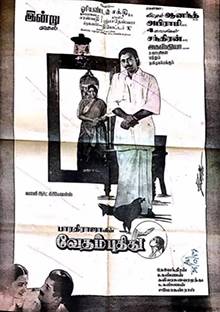
Movie Info
ℹ️ More Movie InfoSoundtrack
| Song Name | Singer(s) | Lyricist | Video |
|---|---|---|---|
| Sandhikka Thudithen | S. Janaki and S. P. Balasubramanyam | Vairamuthu | |
| Putham Pudhu Olai Varum | K.S. Chithra | Vairamuthu | |
| Mattu Vandi Salai | Malaysia Vasudevan | Vairamuthu | |
| Mandhiram Sonnen | Mano and S. Janaki | Vairamuthu | |
| Kannukkul Nooru Nilava | K.S. Chithra and S.P. Balasubrahmanyam | Vairamuthu |
Storyline
Balu Thevar and Pechi, a couple, live in a village and belong to a land-owning caste ( ), held supposedly lower in the hierarchy than . Balu though, is an atheist and speaks openly against the caste system, but is nevertheless tolerated by the villagers because he is generous in helping others in need. Their son Sankarapandi has just returned from the city, having completed his education. He meets Vaidehi, the daughter of a priest Neelakanta Sastrigal, and they fall in love. One night, Sankarapandi and Vaidehi are together in a temple, when Balu is discovered after hiding Vaidehi. To atone for his son’s “crime,” Balu before the Brahmins. Afterwards Vaidehi tells her father about their love, who then tells Balu. Neelakanta tries to marry her off to another man in a neighbouring village, but she fakes her death and hides in the house of a forest ranger, that she happens to pass by. Thinking Vaidehi is dead, Neelakanta confronts Sankarapandi at a waterfall and accuses him of causing her death. During the confrontation, Sankarapandi accidentally falls, but holds onto a plant. Neelakanta tries to save him, but both fall to their deaths. Vaidehi’s younger brother Sankara, who is devoutly studying the Vedas and passing through the student phase of his Brahmin life, is left orphaned. Being considered inauspicious, since his mother, father, and sister are all dead, no one from the Brahmin community wants to take care of him. He thus wanders the streets begging for food. Balu, bothered by this, and having lost his own son, starts raising Sankara as his own son. Balu and Pechi quit eating meat, to not offend Sankara. However, since Sankara has been eating in a lower caste home, he is rejected by his community from learning the Vedas. Pechi, enraged with Sankara’s ostracisation, promises to educate him in an English medium school. Balu later makes fun of Sankara telling him that it is not important to learn Vedas and worry about caste. At this point, Sankara notes Balu’s own hypocrisy: his preference for using his caste name (Thevar), while at the same time professing against the caste system. Balu sees the merit in this argument, and immediately abandons all his weapons, symbols of his Thevar status, by immersing them in a river, and stops referring to himself by his caste name. Vaidehi, not knowing of Sankarapandi and her own father’s death, tells the forest ranger about her love, after which he promises to reunite them. The forest ranger comes to the village and finds out what has happened. After returning, he informs Vaidehi. Vaidehi, then sadly returns to her village, tells Pechi to take care of her younger brother for the rest of his life and prepares to leave. She reunites with Sankara. Krishna , who had wanted to marry Vaidehi but was rebuked, sees her return. He aggravates the villagers with news of Vaidehi’s return and says it is inauspicious for the village, since her last death rites have already been performed. Krishna adds that it is improper for Brahmins to live in a non-Brahmin house; He then sets some hay on fire and tells the villagers it is God’s disapproval of these two “crimes”. Krishna assembles a mob towards Balu’s house, and they demand Balu throw Vaidehi out. Balu refuses, a fight breaks out, and in the ensuing scuffle, he is stabbed and dies. His final request is for the villagers to live in unity, and not let caste divide them. The next day, Sankara, having lost two fathers, removes his and immerses it in a stream, disgusted with and in open defiance of Brahminical beliefs, while performing the last rites of Balu as though he were his own son. , written and directed by , is based on ‘s play . Kannan wrote the film adaptation’s dialogues. This was ‘s third appearance in a Bharathiraja film after (1985) and (1986). He found it comfortable playing the atheist character Balu Thevar, due to being a follower of the atheist/rationalist . Sathyaraj wore a wig to play the character. It is the screen debut of B. Kanakarajsamy, who worked as an electrician in . According to Kanakarajsamy, “It was a group role. I was asked to walk up and down a street”. Filming took place predominantly in , while the song “Kannukkul Nooru Nilava” was filmed at . criticises the , and their hypocrisies. and , in , believe the film purports to “merge humanist values into religious ritual”. They also consider that, like other Bharathiraja films, it has “the local village deity as dramatic pivot”. The music was composed by while the lyrics were written by . Due to differences with his usual composer , Bharathiraja chose Devendran to compose this film’s music. Devendran revealed that he had composed a fusion tune which he had slightly modified as “Kannukkul Nooru Nilava”. The song is set in raga, and “Sandhikka Thudittaen” is set in Poorvikalyani. was released on 27 December 1987. Before release, the objected to the scene where people carry a saint and Balu Thevar commenting on it; as a result the film was stuck in limbo, facing uncertainty over its release. A special screening was later arranged for , then the , at his requ- He saw the film, appreciated Sathyaraj’s performance, and the film was given clearance for release. rated the film 50 out of 100, saying Bharathiraja had moved up to the next step in his career with this film, several scenes were hearttrending and there itself the film achieved success. (a duo) of praised the film for various aspects, including Bharathiraja’s unique storytelling style, the cast performances, Devendran’s music and Vairamuthu’s lyrics. The duo compared the film to a , albeit a hastily made one, but still worth watching. Though the film became controversial for its depiction of Tamil Brahmins and the Tamil Nadu Brahmins Association called for its banning, despite having been certified ” ” (universal) by the censor board without cuts, it became a critical and commercial success, running for over 150 days in theatres. Kannan later came to be known as Kannan. At a July 1988 event organised by the Cine Technicians Association of South India meant to commemorate the platinum jubilee of Indian cinema, Bharathiraja received a newly created “MGR Award” for directing the film. According to Sathyaraj, he was considered for the , but missed out on a technicality.
Details
Reviews
There are no reviews yet. Be the first one to write one.